Industry-Verified Manufacturing Data (2026)

Human-Machine Interface

Based on aggregated insights from multiple verified factory profiles within the CNFX directory, the standard Human-Machine Interface used in the Machinery and Equipment Manufacturing sector typically supports operational capacities ranging from standard industrial configurations to heavy-duty production requirements.

Technical Definition & Core Assembly

A canonical Human-Machine Interface is characterized by the integration of Touchscreen Display and Processor Board. In industrial production environments, manufacturers listed on CNFX commonly emphasize Polycarbonate or glass touchscreen panel construction to support stable, high-cycle operation across diverse manufacturing scenarios.

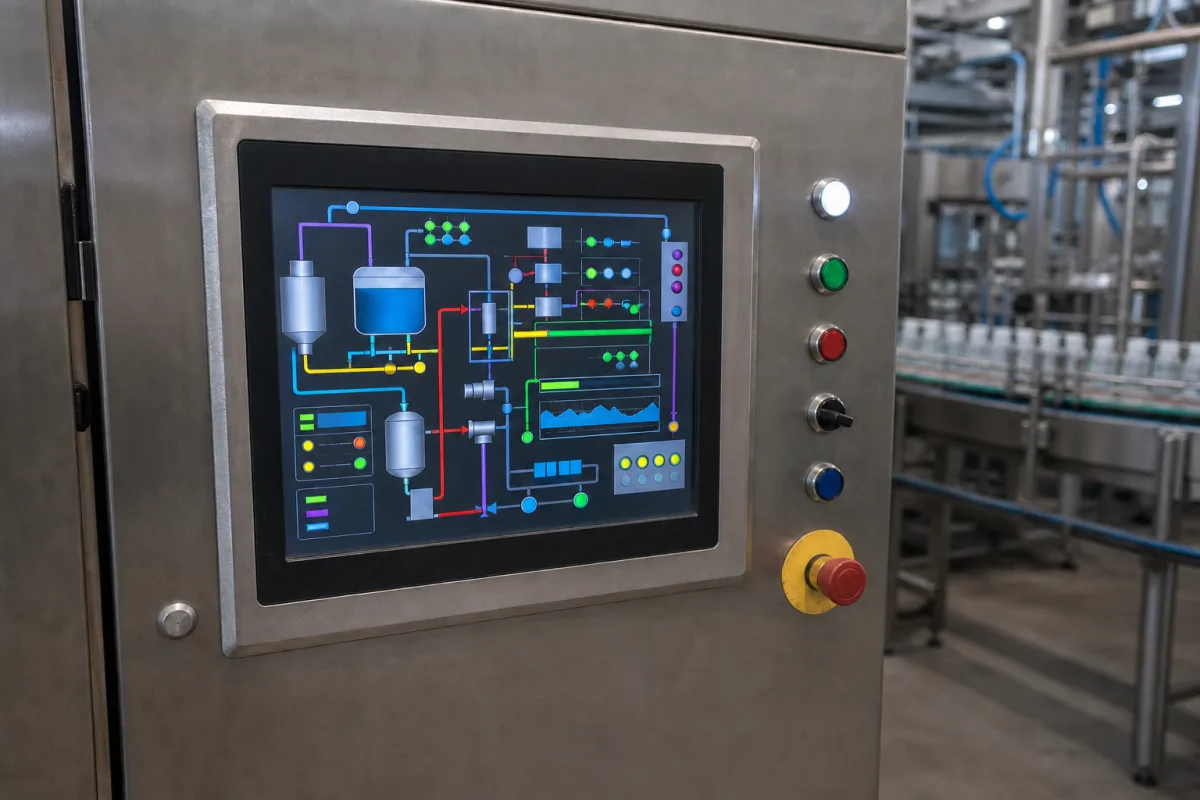
A device or system that allows operators to interact with and control machinery or processes within a control cabinet.

Product Specifications

Technical details and manufacturing context for Human-Machine Interface

Definition
A Human-Machine Interface (HMI) is a critical component of a control cabinet that serves as the primary point of interaction between human operators and automated systems. It typically consists of a display screen (touchscreen or with buttons) and input devices, providing real-time visualization of process data, system status, alarms, and control parameters. The HMI enables operators to monitor operations, input commands, adjust setpoints, and respond to system events, facilitating efficient supervision and control of industrial processes.
Working Principle
The HMI receives data from various sensors, controllers (like PLCs), and other devices within the control system via communication protocols (e.g., Ethernet/IP, Profinet, Modbus). It processes this data to generate graphical representations, trends, and alerts on its display. User inputs (touches, button presses) are captured, translated into control commands, and sent back to the controllers to execute actions such as starting/stopping machines, adjusting parameters, or acknowledging alarms.
Common Materials
Polycarbonate or glass touchscreen panel, Aluminum or steel enclosure, Electronic components (PCB, processors, memory)
Technical Parameters
  • Display screen diagonal size (e.g., 7", 10", 15") (inch) Per Request
Components / BOM
  • Touchscreen Display
    Provides visual output and accepts touch input from operators
    Material: Glass or polycarbonate with conductive layers
  • Processor Board
    Executes the HMI software, processes data, and manages communications
    Material: Fiberglass PCB with electronic components (CPU, memory)
  • Communication Interface
    Handles data exchange with PLCs, sensors, and other control devices
    Material: Electronic components (Ethernet port, serial ports, protocol chips)
  • Enclosure
    Protects internal components from environmental factors and physical damage
    Material: Aluminum or stainless steel
  • Power Supply Unit
    Converts incoming power to appropriate voltages for internal components
    Material: Electronic components (transformers, regulators, capacitors)
Engineering Reasoning
0-60°C ambient temperature, 85-264 VAC input voltage, 0-95% relative humidity non-condensing
Ambient temperature exceeding 70°C, input voltage exceeding 275 VAC, relative humidity exceeding 98%
Design Rationale: Thermal expansion mismatch between silicon chips and FR-4 PCB substrate (CTE difference: 2.6 ppm/°C vs 14 ppm/°C), dielectric breakdown at 3 kV/mm in air gaps, electrochemical migration at dew point
Risk Mitigation (FMEA)
Trigger Electrostatic discharge exceeding 15 kV human body model
Mode: Gate oxide breakdown in CMOS ICs (threshold voltage shift >0.5 V)
Strategy: TVS diodes with 5 ns response time and 500 W peak pulse power rating
Trigger Vibration at 200 Hz resonance frequency with 5 g acceleration
Mode: Solder joint fatigue cracking (Coffin-Manson exponent n=1.9)
Strategy: Conformal coating with 0.5 mm thickness and Shore A 80 hardness

Industry Taxonomies & Aliases

Commonly used trade names and technical identifiers for Human-Machine Interface.

Applied To / Applications

This component is essential for the following industrial systems and equipment:

Industrial Ecosystem & Supply Chain DNA

Complementary Systems
Downstream Applications
Specialized Tooling

Application Fit & Sizing Matrix

Operational Limits
pressure: N/A (typically atmospheric within control cabinet)
other spec: IP65/IP67 ingress protection, 24VDC power supply, 10-90% non-condensing humidity
temperature: -20°C to +70°C (operating), -40°C to +85°C (storage)
Media Compatibility
✓ Industrial control cabinets ✓ Process control rooms ✓ Clean manufacturing environments
Unsuitable: Outdoor environments with direct weather exposure or corrosive atmospheres
Sizing Data Required
  • Required display size/resolution
  • Number of I/O points to be monitored/controlled
  • Communication protocol requirements (e.g., Ethernet/IP, Profinet, Modbus)

Reliability & Engineering Risk Analysis

Failure Mode & Root Cause
Touchscreen Degradation
Cause: Mechanical wear from repeated contact, chemical exposure to cleaning agents, or UV light exposure leading to delamination, reduced sensitivity, or dead zones.
Electronic Component Failure
Cause: Thermal cycling causing solder joint fatigue, power surges, or prolonged exposure to high humidity/dust leading to short circuits, corrupted memory, or processor malfunction.
Maintenance Indicators
  • Unresponsive or erratic touch response (e.g., phantom touches, lag, or dead areas)
  • Intermittent display flickering, distortion, or complete blanking during operation
Engineering Tips
  • Implement regular, gentle cleaning with manufacturer-approved, non-abrasive, non-ammonia solutions and soft cloths to prevent screen and seal degradation.
  • Ensure proper environmental controls: maintain stable temperature/humidity within specs, use protective screens/filters against dust and UV light, and install surge protection on power supplies.

Compliance & Manufacturing Standards

Reference Standards
ISO 9241-210:2019 (Ergonomics of human-system interaction) ANSI/HFES 100-2007 (Human Factors Engineering of Computer Workstations) DIN EN 894-3:2008 (Safety of machinery - Ergonomics requirements for the design of displays and control actuators)
Manufacturing Precision
  • Touchscreen alignment: +/-0.5mm
  • Button actuation force: 1.5N +/-0.3N
Quality Inspection
  • Usability compliance testing (ISO 9241-11)
  • Electromagnetic compatibility (EMC) testing (IEC 61000-4 series)

Factories Producing Human-Machine Interface

Verified manufacturers with capability to produce this product in China

✓ 94% Supplier Capability Match Found

S Sourcing Manager from United Arab Emirates Jan 28, 2026
★★★★★
"Standard OEM quality for Machinery and Equipment Manufacturing applications. The Human-Machine Interface arrived with full certification."
Technical Specifications Verified
P Procurement Specialist from Australia Jan 25, 2026
★★★★☆
"Great transparency on the Human-Machine Interface components. Essential for our Machinery and Equipment Manufacturing supply chain. (Delivery took slightly longer than expected, but technical support was excellent.)"
Technical Specifications Verified
T Technical Director from Singapore Jan 22, 2026
★★★★★
"The Human-Machine Interface we sourced perfectly fits our Machinery and Equipment Manufacturing production line requirements."
Technical Specifications Verified
Verification Protocol

“Feedback is collected from verified sourcing managers during RFQ (Request for Quote) and factory evaluation processes on CNFX. These reports represent historical performance data and technical audit summaries from our B2B manufacturing network.”

10 sourcing managers are analyzing this specification now. Last inquiry for Human-Machine Interface from Germany (49m ago).

Supply Chain Compatible Machinery & Devices

Automated Assembly Line System

Integrated production system for sequential component assembly operations

Explore Specs →
Automated Powder Coating System

Integrated industrial system for applying dry powder coatings to metal substrates.

Explore Specs →
Centrifugal Pump Impeller

Rotating component that transfers energy to fluid in centrifugal pumps.

Explore Specs →
High-Precision CNC Laser Cutting Machine

Computer-controlled industrial machine using focused laser beams to cut sheet metal with micron-level accuracy.

Explore Specs →

Frequently Asked Questions

What environmental protection does this HMI offer for machinery manufacturing applications?

Our HMI features IP65-rated aluminum or steel enclosures and polycarbonate/glass touchscreens resistant to dust, moisture, and industrial contaminants, making it suitable for harsh manufacturing environments.

How does this HMI integrate with existing machinery control systems?

The HMI includes multiple communication interfaces (Ethernet, serial, fieldbus) and supports standard industrial protocols to seamlessly connect with PLCs, drives, and other control cabinet components in machinery systems.

What are the maintenance requirements for this industrial HMI?

With rugged construction and industrial-grade components, this HMI requires minimal maintenance. The front panel is easily cleanable, and the modular design allows for straightforward component replacement if needed.

Can I contact factories directly on CNFX?

CNFX is an open directory, not a transaction platform. Each factory profile provides direct contact information and production details to help you initiate direct inquiries with Chinese suppliers.

Get Quote for Human-Machine Interface

Request technical pricing, lead times, or customized specifications for Human-Machine Interface directly from verified manufacturing units.

Your business information is encrypted and only shared with verified Human-Machine Interface suppliers.

Thank you! Your message has been sent. We'll respond within 1–3 business days.

Need to Manufacture Human-Machine Interface?

Connect with verified factories specializing in this product category

Add Your Factory Contact Us
Previous Product
Hub/Centerbody
Next Product
Human-Machine Interface (HMI)