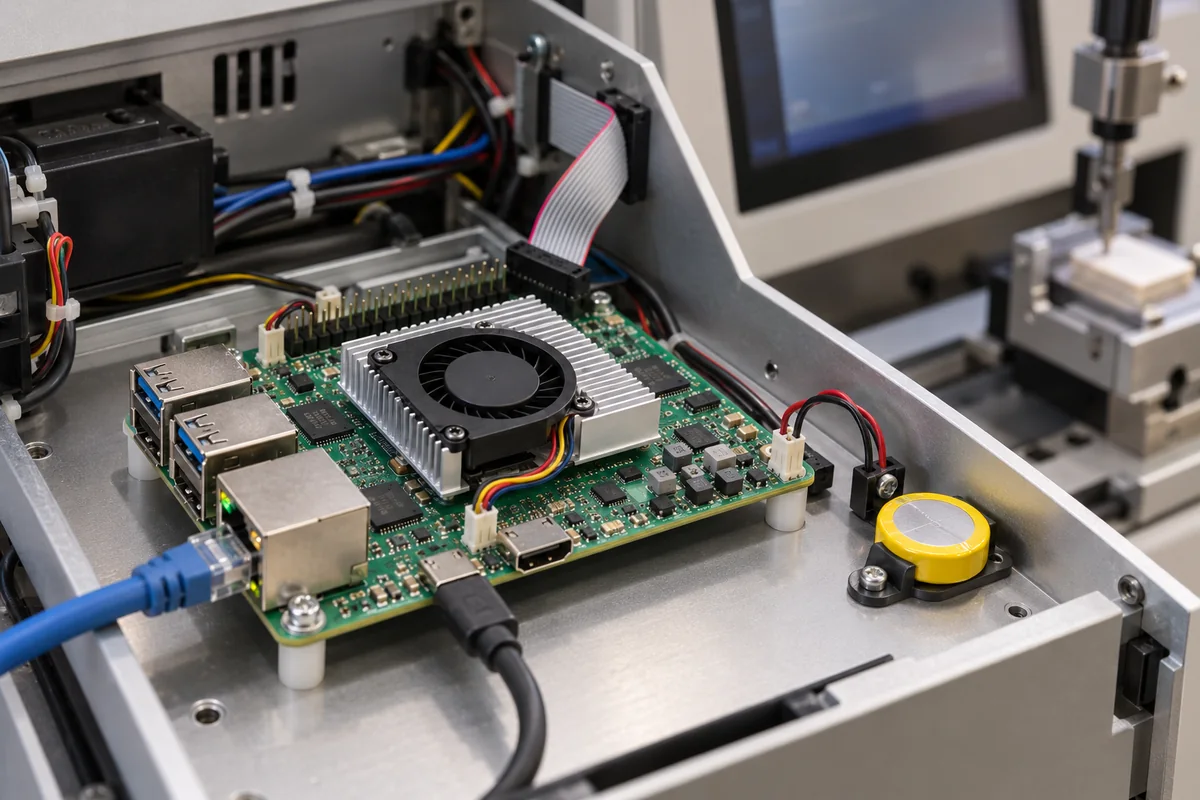
Single board computers for products and machines · Production lifetime, operating temperature and MTBF, Raspberry Pi-compatible vs industrial form factors, storage, power input and GPIO
A single board computer puts the processor, memory, storage interface and input/output of a complete computer on one circuit board, ready to build into a product, machine or kiosk. Ask three things first: how long the exact board will stay in production, since a redesign mid-product is costly; what temperature and power the board will see, since hobby-grade and industrial boards differ; and which form factor, storage and I/O the enclosure and software expect.
Single board computers built into equipment — Raspberry Pi-class Arm boards and industrial Pico-ITX, 3.5-inch, EPIC and PC/104 boards. Microcontroller development kits, computer-on-modules without a carrier board, box and panel PCs, and slot-type motherboards are outside this page except where compared.
CNFX editorial research · Sources checked October 11, 2026 · 4 sources
Check production lifetime, temperature and reliability
Raspberry Pi's product briefs state that Raspberry Pi 5 will remain in production until at least January 2036 and Raspberry Pi 4 Model B until at least January 2034. Pi 5 is rated for 0 to 70 °C operation with a ground-benign MTBF of 93,800 hours; Pi 4 is rated 0 to 50 °C with 211,000 hours. Both briefs warn the board must be ventilated, secured on a stable non-conductive surface, kept away from water, moisture and heat, and handled by the edges to avoid static damage. [1][2]
Advantech describes its embedded SBCs as designed for rugged industrial use, with extended or wide temperature support on its Pico-ITX, 3.5-inch and PC/104 boards and MIL-STD-certified vibration and shock tolerance on PC/104 CPU boards. [4] Geniatech states its Raspberry Pi-compatible XPI-3566 offers a long life-cycle guarantee and sufficient supply. [3]
Editorial calculation: 93,800 hours is about 10.7 years and 211,000 hours about 24 years of continuous running; MTBF is a statistical failure rate for a population of boards, not a service life for one board. [1][2] Editorial note: ask any supplier for the production-lifetime commitment, rated temperature and MTBF method in writing for the exact board revision.
Give the supplier the processor and performance needed, RAM and storage (microSD, eMMC, NVMe), operating system and software stack, I/O (Ethernet, USB, serial, GPIO, display, camera, PCIe), form factor and mounting, power input range, operating and storage temperature, humidity, vibration, production-lifetime and revision-control requirements, certifications, and annual and lifetime quantity.
02
Pick the form factor, storage and power
Advantech's embedded SBCs come in 2.5-inch Pico-ITX boards measuring 100 × 72 mm with rear I/O and fanless operation, 3.5-inch boards measuring 146 × 102 mm, 4-inch EPIC boards measuring 165 × 115 mm with Intel Core processors, and PC/104 boards with PC/104, PCI-104 or PC/104-Plus expansion, plus MI/O extension modules. [4] Geniatech's XPI-3566 keeps the Raspberry Pi's 85 × 55 mm size and 40-pin GPIO, configurable as RS232, SPI, I2C and PWM, with a quad-core Cortex-A55 up to 1.8 GHz, 0.8 TOPS NPU, 2–8 GB LPDDR4, 8–128 GB eMMC and a 5 V/3 A adapter; it says eMMC reads and writes up to 4 times faster than the Pi's SD card storage. [3]
Raspberry Pi 5 uses a 2.4 GHz quad-core Cortex-A76, 1 to 16 GB LPDDR4X, microSD with SDR104, two USB 3.0 and two USB 2.0 ports, Gigabit Ethernet with PoE+ via a HAT, a PCIe 2.0 x1 interface via an adapter, two four-lane MIPI camera/display transceivers, a real-time clock and a 40-pin GPIO header, powered at 5 V/5 A over USB-C. Pi 4 needs 5 V at a minimum of 3 A via USB-C or the GPIO header. [1][2]
Editorial calculation: a Pico-ITX board covers 7,200 mm² against 4,675 mm² for an 85 × 55 mm Pi-size board and 14,892 mm² for a 3.5-inch board; Pi 5's 5 V/5 A supply rating is 25 W, against 15 W for 5 V/3 A. [4][3][1][2]
03
Compare what suppliers offer
Suppliers linked to this page list single board computers; each card links to the page reviewed.
Listings include Raspberry Pi-compatible Arm boards, Arm SBCs with matching system-on-modules, 3.5-inch and 4-inch industrial SBCs, and PICMG slot SBCs; ask each for the production-lifetime commitment, rated temperature, power input, I/O list and board support package.
04
Trace the board construction
This is a functional reference built from the sources cited; it is not one maker's specification.
Fill the specification fields with values for your board
A single board computer quotation needs values for your product. The table explains each field, gives published values where a reviewed source states them, and says what to obtain from the supplier.
Explore company information and manufacturing capabilities, then discuss the scope of your project with a relevant supplier.
Share this page
Compiled and source-reviewed by the CNFX editorial team.
Published product pages show what a company offers, not tested performance. Confirm the legal seller, factory and scope for your order. How we source and review
· Page last updated 13 October 2026
Buyer questions
How long will a Raspberry Pi stay in production?
Raspberry Pi states Pi 5 will be produced until at least January 2036 and Pi 4 Model B until at least January 2034. [1][2]
What temperature range does a Raspberry Pi 5 support?
Its product brief rates it for 0 °C to 70 °C operation. [1]
What sizes do industrial SBCs come in?
Advantech lists 100 × 72 mm Pico-ITX, 146 × 102 mm 3.5-inch and 165 × 115 mm EPIC boards, plus PC/104. [4]
Sources and what still needs a direct check
Sources checked 2026-10-11. Raspberry Pi, Geniatech and Advantech make the boards they describe; Geniatech's comparisons with Raspberry Pi are its own claims. Ask for written lifetime and temperature commitments for the exact board.