Industry-Verified Manufacturing Data (2026)

Antenna Clamping Mechanism

Based on aggregated insights from multiple verified factory profiles within the CNFX directory, the standard Antenna Clamping Mechanism used in the Computer, Electronic and Optical Product Manufacturing sector typically supports operational capacities ranging from standard industrial configurations to heavy-duty production requirements.

Technical Definition & Core Assembly

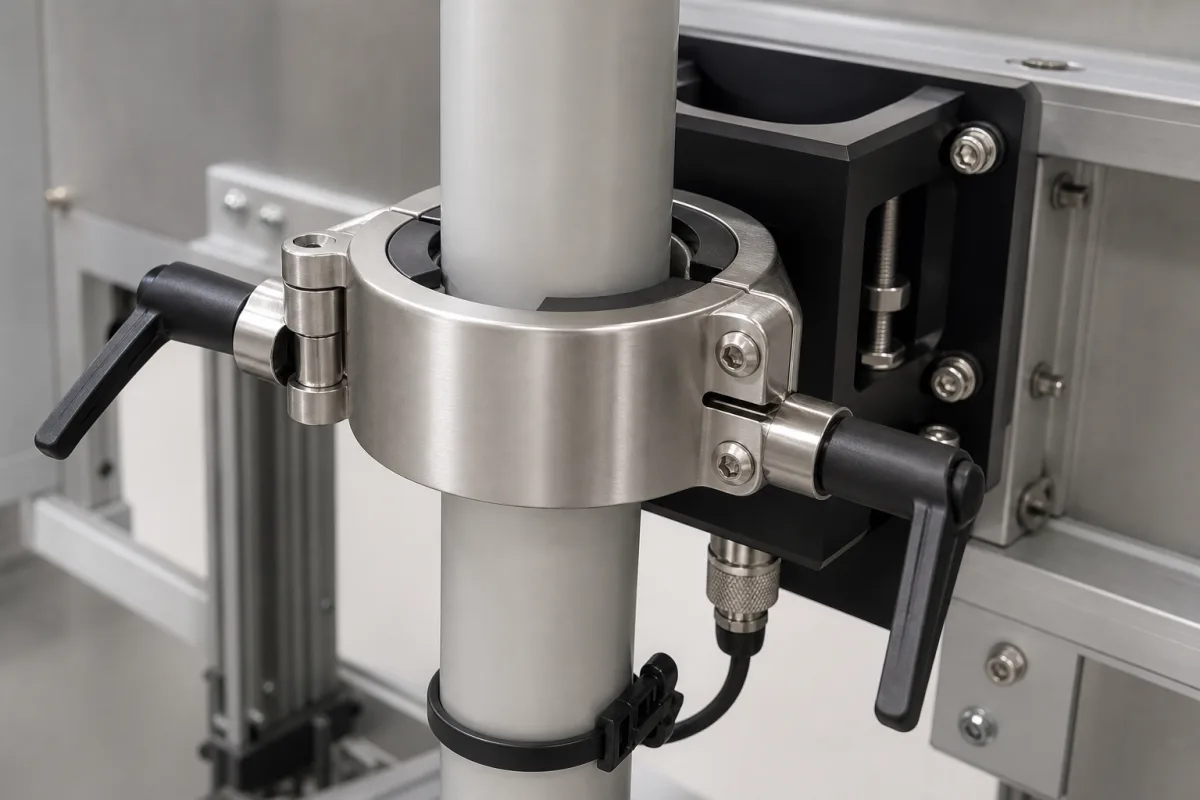
A canonical Antenna Clamping Mechanism is characterized by the integration of Clamping Jaw/Bracket and Fastener (Screw/Bolt). In industrial production environments, manufacturers listed on CNFX commonly emphasize Stainless Steel construction to support stable, high-cycle operation across diverse manufacturing scenarios.

A mechanical component designed to securely fasten and position an antenna within an internal mounting system.
Product Specifications

Technical details and manufacturing context for Antenna Clamping Mechanism

Definition
The Antenna Clamping Mechanism is a critical sub-assembly of the Internal Antenna Mounting System. Its primary function is to provide a rigid, adjustable, and vibration-resistant connection between the antenna element and the mounting structure, ensuring optimal signal transmission and reception by maintaining precise antenna alignment and preventing movement during operation.
Working Principle
The mechanism typically employs a combination of mechanical fasteners (e.g., screws, bolts) and clamping surfaces (e.g., jaws, brackets) to apply compressive force around the antenna's mounting interface. This force creates sufficient friction and/or mechanical interlock to hold the antenna firmly in place against external forces such as vibration, shock, and thermal expansion/contraction.
Common Materials
Stainless Steel, Aluminum Alloy, Engineering Plastic (e.g., PEEK, Nylon)
Technical Parameters
  • Clamping diameter range, defining the minimum and maximum antenna shaft or base diameters the mechanism can accommodate. (mm) Per Request
Components / BOM
  • Clamping Jaw/Bracket
    The main structural element that contacts and applies force to the antenna. Often includes a contoured or lined surface to improve grip and protect the antenna.
    Material: Stainless Steel or Aluminum Alloy
  • Fastener (Screw/Bolt)
    Provides the adjustable tensile force that tightens the clamping jaws/brackets around the antenna.
    Material: Stainless Steel
  • Pressure Plate/Spacer
    Distributes the clamping force evenly and may provide alignment or anti-rotation features.
    Material: Steel or Engineering Plastic
  • Insulating Sleeve/Washer
    Electrically isolates the antenna from the mounting structure if required, preventing ground loops or signal interference.
    Material: Plastic (e.g., Nylon, PTFE) or Ceramic
Engineering Reasoning
0-150 N·m clamping torque, -40°C to +85°C ambient temperature, 0-100% relative humidity
Clamping force reduction below 80 N·m at 85°C, material yield strength exceeded at 200 N·m torque, fastener loosening at vibration amplitude >2.5 g RMS
Design Rationale: Thermal expansion coefficient mismatch (aluminum bracket: 23.1×10⁻⁶/°C vs steel fastener: 11.7×10⁻⁶/°C) causing stress relaxation, fretting corrosion at contact interfaces under cyclic loading, plastic deformation exceeding material yield strength (6061-T6 aluminum: 276 MPa)
Risk Mitigation (FMEA)
Trigger Thermal cycling between -40°C and +85°C causing differential expansion
Mode: Clamping force reduction by 30% after 1000 cycles, antenna positional drift exceeding ±0.5°
Strategy: Implementation of Belleville washers with 50 N preload compensation, thermal interface material with 5 W/m·K conductivity
Trigger Vibration exposure at 2-2000 Hz frequency spectrum with 1.5 g RMS acceleration
Mode: Fastener loosening due to thread walk, fretting wear at bracket-antenna interface
Strategy: Nord-Lock washer system with 30° wedge angle, thread locking compound with 20 N·m breakaway torque

Industry Taxonomies & Aliases

Commonly used trade names and technical identifiers for Antenna Clamping Mechanism.

Applied To / Applications

This component is essential for the following industrial systems and equipment:

Industrial Ecosystem & Supply Chain DNA

Complementary Systems
Downstream Applications
Specialized Tooling

Application Fit & Sizing Matrix

Operational Limits
pressure: 0 to 2 bar (non-pressurized applications)
other spec: Vibration resistance: up to 5g RMS, 10-2000 Hz
temperature: -40°C to +85°C
Media Compatibility
✓ Aluminum mounting structures ✓ Stainless steel antenna masts ✓ Fiberglass composite housings
Unsuitable: Continuous saltwater immersion (marine splash zone acceptable)
Sizing Data Required
  • Antenna mast diameter (mm)
  • Required clamping force (N)
  • Available mounting space dimensions (mm)

Reliability & Engineering Risk Analysis

Failure Mode & Root Cause
Fatigue cracking
Cause: Cyclic wind loading and vibration causing stress concentration at clamping bolt holes or contact points, leading to crack initiation and propagation in metal components.
Corrosion-induced loosening
Cause: Galvanic corrosion between dissimilar metals (e.g., aluminum clamp and steel bolts) or environmental corrosion weakening clamping force, resulting in reduced preload and antenna movement.
Maintenance Indicators
  • Visible rust streaks or white corrosion products at metal interfaces
  • Abnormal antenna movement or audible creaking/groaning during wind events
Engineering Tips
  • Apply anti-seize compound with corrosion inhibitors on bolt threads and use proper torque sequence during installation to ensure even clamping pressure distribution
  • Implement regular torque checks (annually or after extreme weather) and consider using locking washers or thread-locking compounds on critical fasteners

Compliance & Manufacturing Standards

Reference Standards
ISO 2768-1: General tolerances for linear and angular dimensions ANSI/ASME B18.2.1: Square and Hex Bolts and Screws DIN 934: Hexagon nuts, product grade C
Manufacturing Precision
  • Bore diameter: +/-0.05mm
  • Surface flatness: 0.15mm per 100mm
Quality Inspection
  • Torque testing for clamping force verification
  • Salt spray test (ASTM B117) for corrosion resistance

Factories Producing Antenna Clamping Mechanism

Verified manufacturers with capability to produce this product in China

✓ 94% Supplier Capability Match Found

P Procurement Specialist from United Arab Emirates Jan 07, 2026
★★★★★
"Testing the Antenna Clamping Mechanism now; the technical reliability results are within 1% of the laboratory datasheet."
Technical Specifications Verified
T Technical Director from Australia Jan 04, 2026
★★★★★
"Impressive build quality. Especially the technical reliability is very stable during long-term operation."
Technical Specifications Verified
P Project Engineer from Singapore Jan 01, 2026
★★★★★
"As a professional in the Computer, Electronic and Optical Product Manufacturing sector, I confirm this Antenna Clamping Mechanism meets all ISO standards."
Technical Specifications Verified
Verification Protocol

“Feedback is collected from verified sourcing managers during RFQ (Request for Quote) and factory evaluation processes on CNFX. These reports represent historical performance data and technical audit summaries from our B2B manufacturing network.”

16 sourcing managers are analyzing this specification now. Last inquiry for Antenna Clamping Mechanism from UAE (14m ago).

Supply Chain Compatible Machinery & Devices

Industrial Smart Camera Module

Embedded vision system for industrial automation and quality inspection.

Explore Specs →
Industrial Wireless Power Transfer Module

Wireless power transfer module for industrial equipment applications

Explore Specs →
Industrial Smart Sensor Module

Modular industrial sensor with embedded processing and wireless connectivity

Explore Specs →
Surface Mount Resistor

Passive electronic component for current limiting and voltage division in circuits

Explore Specs →

Frequently Asked Questions

What materials are used in this antenna clamping mechanism?

This mechanism uses stainless steel and aluminum alloy for structural components, and engineering plastics like PEEK or Nylon for insulating parts to prevent signal interference.

How does this clamping mechanism ensure secure antenna positioning?

It features a clamping jaw/bracket with pressure plates and spacers that apply even pressure, combined with insulating sleeves to maintain precise positioning while preventing electrical contact.

Is this antenna clamp suitable for industrial electronic applications?

Yes, it's designed for computer, electronic, and optical product manufacturing, offering vibration resistance, material durability, and reliable performance in internal mounting systems.

Can I contact factories directly on CNFX?

CNFX is an open directory, not a transaction platform. Each factory profile provides direct contact information and production details to help you initiate direct inquiries with Chinese suppliers.

Get Quote for Antenna Clamping Mechanism

Request technical pricing, lead times, or customized specifications for Antenna Clamping Mechanism directly from verified manufacturing units.

Your business information is encrypted and only shared with verified Antenna Clamping Mechanism suppliers.

Thank you! Your message has been sent. We'll respond within 1–3 business days.

Need to Manufacture Antenna Clamping Mechanism?

Connect with verified factories specializing in this product category

Add Your Factory Contact Us
Previous Product
Antenna Array
Next Product
Antenna Interface / Matching Network