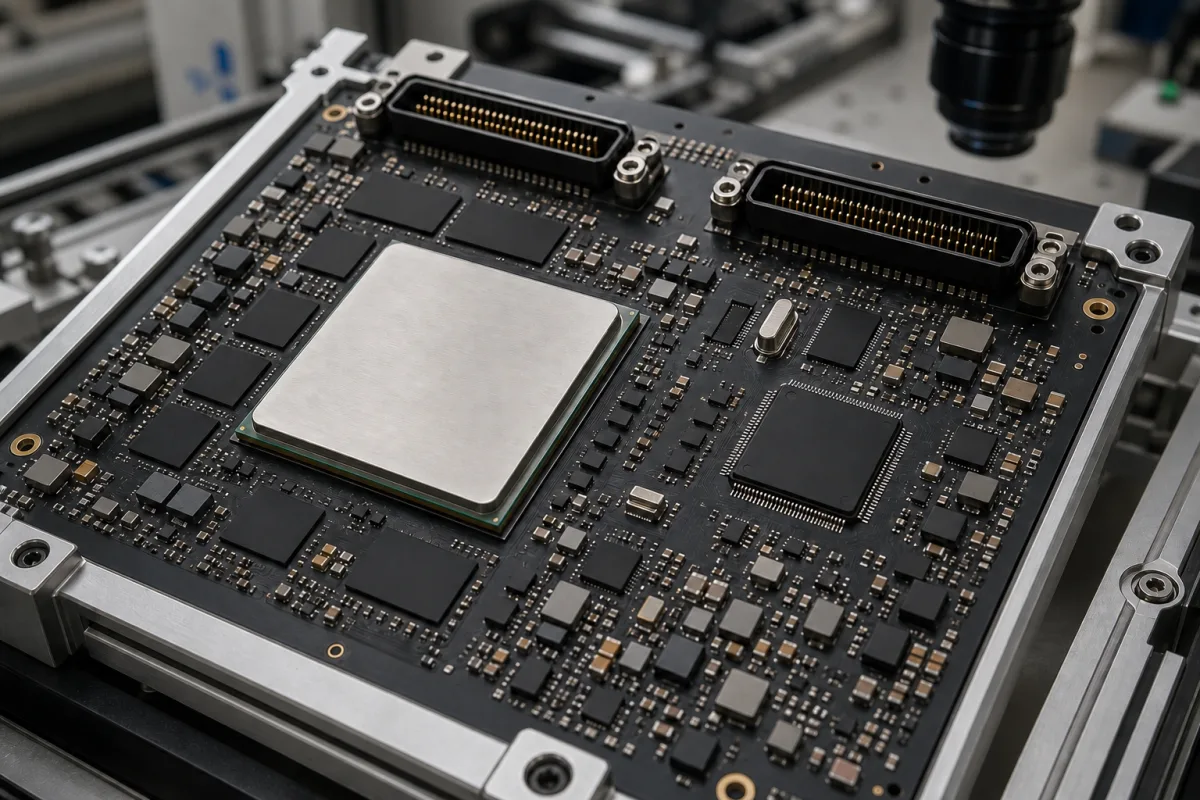
Microcontrollers (MCUs) and embedded processors for control boards, motor drives, appliances and instruments · core and clock, flash and RAM, analog peripherals, communication interfaces, low-power modes, supply and temperature range, ESD, package and pin count
A microcontroller (MCU) is a single chip combining a processor core with memory and peripherals — timers, analog-to-digital converters and communication interfaces — that runs the control program on a main processing board. Ask three things first: what the firmware needs in core performance, flash and RAM; which analog functions and interfaces the board must provide; and the supply, temperature, power and package limits of the product.
Microcontrollers and embedded processors used as the main control unit on electronic boards — 8-, 16- and 32-bit MCUs, including mixed-signal and wireless MCUs — supplied as chips. Desktop and server CPUs, FPGAs, ASICs (separate page), single-board computers and complete control modules are outside this page except where compared.
CNFX editorial research · Sources checked October 12, 2026 · 4 sources
Match core, memory and peripherals to the firmware
Texas Instruments' MSPM0G350x datasheet shows what an MCU specification covers. The MSPM0G3507 has a 32-bit Arm Cortex-M0+ CPU with memory protection unit at up to 80 MHz, up to 128 KB of flash with error correction and up to 32 KB of SRAM with parity (smaller family members have 32 KB or 64 KB flash). Analog peripherals include two simultaneous-sampling 12-bit, 4 Msps ADCs with up to 17 external channels, a 12-bit DAC, two zero-drift chopper op-amps, a general-purpose amplifier, three high-speed comparators and an internal temperature sensor. Digital peripherals include a 7-channel DMA controller, a maths accelerator, seven timers with up to 22 PWM channels, two watchdogs and an RTC; communication interfaces are four UARTs, two I²C, two SPI (one up to 32 Mbit/s) and one CAN 2.0/CAN-FD; security functions include CRC, a true random number generator and AES with 128- or 256-bit keys. It offers up to 60 GPIOs and is aimed at motor control, home appliances, UPS and inverters and point-of-sale systems. [1]
For 16-bit mixed-signal designs, TI's MSP430FR235x data sheet describes a 16-bit RISC MCU up to 24 MHz with up to 32 KB of ferroelectric RAM (FRAM) non-volatile memory with ECC and 10¹⁵ write-cycle endurance, a 20 KB ROM of driver and FFT libraries, a 12-channel 12-bit 200 ksps ADC with 1.5, 2.0 or 2.5 V internal reference, two enhanced comparators and, on the FR235x parts, four smart analog combo blocks usable as op-amps or PGAs with gains of ×1 to ×33. [2]
For wireless products, TI's CC2340R family integrates a 48 MHz Arm Cortex-M0+ with up to 512 KB flash and 64 KB SRAM and a 2.4 GHz radio for Bluetooth LE (qualified against Core 5.4), Zigbee, Thread and proprietary protocols, with −96.5 dBm sensitivity at Bluetooth LE 1 Mbps, output up to +8 dBm, up to 26 I/O pads, a 12-bit ADC up to 1.2 Msps, UART, SPI, I²C and an AES-128 accelerator. [3]
Not every MCU uses an Arm core. Espressif's ESP32-C3 is a single-core Wi-Fi and Bluetooth 5 (LE) microcontroller SoC built on the open-source RISC-V architecture: a 32-bit RISC-V core at up to 160 MHz with 22 configurable GPIOs and 400 KB of internal RAM, offered in variants with integrated or external flash. Its security list covers RSA-3072-based secure boot, AES-128/256-XTS-based flash encryption, a digital signature peripheral and an HMAC peripheral, and it is supported by Espressif's open-source ESP-IDF framework or can run as a connectivity co-processor for an external host MCU. [4]
Editorial calculation: the ESP32-C3's 160 MHz is twice the MSPM0G3507's 80 MHz and its 400 KB of internal RAM is 12.5 times the MSPM0G3507's 32 KB SRAM, while the MSPM0G3507 offers up to 60 GPIOs against 22; compare instruction set, toolchain and pin count rather than clock alone. [4][1]
Editorial note: list every interface and analog channel the board needs, then check pin multiplexing in the datasheet's package tables for the package you choose, since pin counts range from 28 to 64.
Give the supplier the core and clock needed, flash and RAM sizes, analog channels and resolution, timers and PWM, communication interfaces, security functions, supply voltage, operating temperature grade, current budget for run and sleep, ESD requirement, package and pin count, functional-safety or automotive qualification, development tools, longevity, and annual volume.
02
Check power, supply range, temperature and package
The same datasheet specifies a 1.62–3.6 V supply and operation from −40 to 125 °C; low-power modes of 101 µA/MHz in run (CoreMark), 40 µA/MHz in sleep, 190 µA in stop at 4 MHz, 1.5 µA in standby with RTC and SRAM retained, and 80 nA in shutdown; ESD ratings of ±2,000 V human-body model; clocks from an internal 4–32 MHz oscillator, PLL to 80 MHz and external crystals; and packages of 64- and 48-pin LQFP, 48- and 32-pin VQFN and 28-pin VSSOP at 0.5 mm pitch. [1]
The MSP430FR235x runs from 1.8–3.6 V over −40 to 105 °C, drawing 142 µA/MHz active, 1.43 µA in LPM3 with a 32 kHz crystal, 620 nA in LPM3.5 and 42 nA in shutdown. The CC2340R runs from a single 1.71–3.8 V supply with an on-chip buck converter at junction temperatures of −40 to 125 °C, drawing 53 µA/MHz (CoreMark), under 710 nA in standby on the CC2340R52 and 165 nA in shutdown, with radio currents of 5.3 mA receive and 5.1 mA transmit at 0 dBm, in 5 × 5 mm QFN40, 4 × 4 mm QFN24 or 2.2 × 2.6 mm WCSP packages. [2][3]
Editorial calculation: at 24 MHz the MSP430FR235x's 142 µA/MHz is about 3.4 mA (142 × 24 µA), and the CC2340R's 53 µA/MHz at 48 MHz is about 2.5 mA (53 × 48 µA), close to its listed 2.6 mA CoreMark active current. [2][3]
Editorial calculation: at 101 µA/MHz the core draws 101 µA × 80 = 8,080 µA, about 8.1 mA, at 80 MHz, against 1.5 µA in standby — about 5,400 times less — so battery life depends mainly on how long the MCU can stay in standby. [1]
03
Compare what suppliers offer
The companies in the manufacturer list below show this product on their own websites. Confirm the legal seller, factory and scope for your order.
The reviewed data sheets cover a 32-bit general-purpose MCU with fast ADCs (MSPM0G3507), a 16-bit ultra-low-power mixed-signal MCU with FRAM and configurable op-amps (MSP430FR235x), and a 32-bit wireless MCU with an integrated 2.4 GHz radio (CC2340R)., plus a RISC-V Wi-Fi and Bluetooth LE SoC from Espressif (ESP32-C3). [1][2][3][4]
Ask each supplier for core and clock, memory types and sizes, analog and communication peripherals, power in each mode at your supply, temperature grade, packages, toolchain and long-term supply commitment. [1]
04
Trace what the MCU integrates
This is a functional reference built from the source cited; it is not a design recommendation.
Fill the specification fields with values for your project
A microcontroller quotation needs values for your project. The table explains each field, gives published values where a reviewed source states them, and says what to obtain from the supplier.
Field
What it means and published values
Ask the supplier for
Clock frequency
Up to 80 MHz example. [1] Other examples: 24 MHz; 48 MHz. [2][3] 160 MHz RISC-V. [4]
Explore company information and manufacturing capabilities, then discuss the scope of your project with a relevant supplier.
Share this page
Compiled and source-reviewed by the CNFX editorial team.
Published product pages show what a company offers, not tested performance. Confirm the legal seller, factory and scope for your order. How we source and review
· Page last updated 13 October 2026
Buyer questions
How much current does a low-power MCU draw?
TI's MSPM0G3507 lists 101 µA/MHz in run mode, 1.5 µA in standby and 80 nA in shutdown. [1]
What supply and temperature ranges are available?
The MSPM0G3507 runs from 1.62–3.6 V and −40 to 125 °C. [1]
Can an MCU include encryption?
Yes; the MSPM0G3507 includes AES with 128- or 256-bit keys and a true random number generator. [1]
Do microcontrollers come with built-in wireless?
Yes; wireless MCUs such as TI's CC2340R integrate a 2.4 GHz radio for Bluetooth LE, Zigbee and Thread alongside an Arm Cortex-M0+ core. [3]
Are there microcontrollers that do not use an Arm core?
Yes; Espressif's ESP32-C3 uses a 32-bit RISC-V core at up to 160 MHz with 400 KB of internal RAM, 22 GPIOs, Wi-Fi and Bluetooth 5 (LE). [4]
Sources and what still needs a direct check
Sources checked 2026-10-12. Texas Instruments' MSPM0G350x, MSP430FR235x and CC2340R datasheets and Espressif's ESP32-C3 product page are used here as examples of MCU specifications.