Industry-Verified Manufacturing Data (2026)

Main Processing Board

Based on aggregated insights from multiple verified factory profiles within the CNFX directory, the standard Main Processing Board used in the Computer, Electronic and Optical Product Manufacturing sector typically supports operational capacities ranging from standard industrial configurations to heavy-duty production requirements.

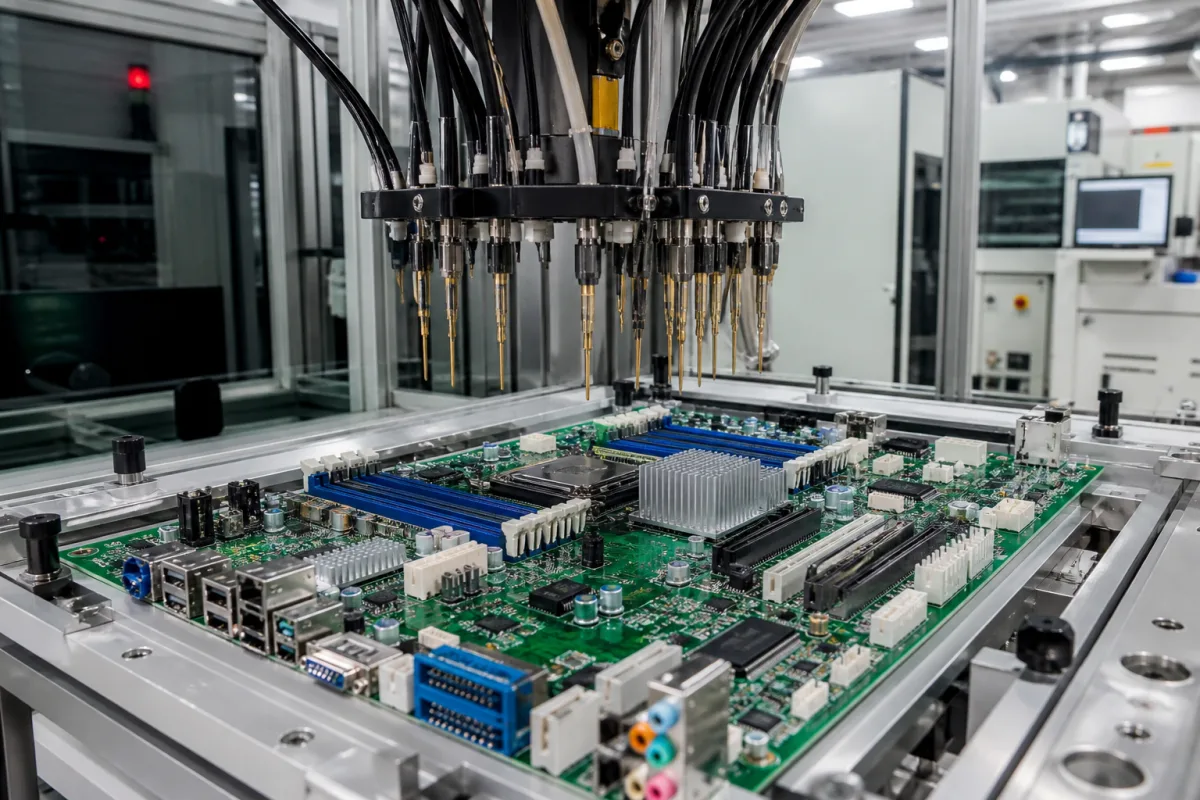
Technical Definition & Core Assembly

A canonical Main Processing Board is characterized by the integration of Central Processing Unit (CPU)/Microcontroller and Voltage Regulator Module. In industrial production environments, manufacturers listed on CNFX commonly emphasize FR-4 PCB Substrate construction to support stable, high-cycle operation across diverse manufacturing scenarios.

The central electronic circuit board that serves as the primary computational and control unit within an industrial system.
Product Specifications

Technical details and manufacturing context for Main Processing Board

Definition
The Main Processing Board is the core electronic component of an Industrial System, responsible for executing control algorithms, processing sensor data, managing communication protocols, and coordinating the operations of peripheral subsystems. It acts as the central nervous system, interpreting commands and ensuring synchronized, efficient, and safe system performance.
Working Principle
The board operates by receiving electrical power and input signals (data, commands) via its connectors. Its embedded microprocessor or microcontroller executes pre-programmed firmware, processing inputs according to control logic. It then generates output signals to drive actuators, control power distribution, and communicate status via its various ports (digital I/O, analog, communication buses). Its physical operation involves the regulated flow of electrical currents through integrated circuits, passive components, and conductive traces on the PCB substrate.
Common Materials
FR-4 PCB Substrate, Solder (Tin-Lead or Lead-Free)
Technical Parameters
  • The clock speed of the board's primary processor, determining its computational throughput. (MHz) Customizable
Components / BOM
  • Central Processing Unit (CPU)/Microcontroller
    Executes the system's control program and performs all computational tasks.
    Material: Silicon semiconductor
  • Voltage Regulator Module
    Converts and stabilizes the input power supply to the various voltage levels required by onboard components.
    Material: Semiconductor (e.g., MOSFETs, ICs), Inductors, Capacitors
  • Communication Interface ICs
    Manages data exchange with other system components via protocols like Ethernet, CAN, RS-485, or USB.
    Material: Silicon semiconductor
  • Memory (RAM/Flash)
    Provides volatile working memory (RAM) for program execution and non-volatile storage (Flash) for the firmware and parameters.
    Material: Silicon semiconductor
  • Input/Output Connectors
    Provide physical electrical interfaces for connecting power, sensors, actuators, and communication cables to the board.
    Material: Phosphor bronze or brass contacts with plastic housing
Engineering Reasoning
0-85°C ambient temperature, 4.75-5.25V DC supply voltage, 0-100% relative humidity (non-condensing)
Ambient temperature exceeding 125°C, supply voltage exceeding 6.0V or dropping below 4.5V, junction temperature exceeding 150°C for silicon components
Design Rationale: Thermal runaway in semiconductor junctions (Arrhenius equation: failure rate doubles per 10°C increase above 85°C), electromigration in copper traces at current densities exceeding 10^6 A/cm², dielectric breakdown in FR-4 substrate at voltages exceeding 500V/mm
Risk Mitigation (FMEA)
Trigger Electrostatic discharge (ESD) event exceeding 2000V HBM (Human Body Model)
Mode: Gate oxide breakdown in CMOS components, immediate loss of computational function
Strategy: Integrated ESD protection diodes at all I/O pins with clamping voltage of 5.5V, conformal coating with 10^12 Ω·cm surface resistivity
Trigger Thermal cycling between -40°C and 125°C at 100 cycles/hour
Mode: Solder joint fatigue failure via Coffin-Manson relationship, intermittent electrical disconnections
Strategy: SnAgCu (SAC305) lead-free solder with creep resistance, underfill epoxy with CTE of 25 ppm/°C matching FR-4 substrate

Industry Taxonomies & Aliases

Commonly used trade names and technical identifiers for Main Processing Board.

Applied To / Applications

This component is essential for the following industrial systems and equipment:

Industrial Ecosystem & Supply Chain DNA

Complementary Systems
Downstream Applications
Specialized Tooling

Application Fit & Sizing Matrix

Operational Limits
pressure: Atmospheric (non-pressurized enclosure)
other spec: Humidity: 5-95% non-condensing, Vibration: 5g max, EMI/RFI shielded
temperature: -40°C to +85°C
Media Compatibility
✓ Clean dry air environments ✓ Industrial control cabinets with filtered air ✓ Electronics enclosures with climate control
Unsuitable: Direct exposure to conductive fluids, abrasive particulates, or corrosive chemical atmospheres
Sizing Data Required
  • Required I/O count and types (digital/analog/communication)
  • Computational performance requirements (CPU speed, memory, processing load)
  • Power supply specifications (voltage, current, backup requirements)

Reliability & Engineering Risk Analysis

Failure Mode & Root Cause
Thermal stress cracking
Cause: Cyclic heating/cooling from power cycling or ambient temperature fluctuations causing solder joint fatigue and board warpage
Electrochemical migration
Cause: Contamination (dust, moisture, ionic residues) creating conductive paths between traces, leading to short circuits
Maintenance Indicators
  • Intermittent system resets or erratic behavior under load
  • Visible discoloration (darkening/blistering) on board surface or components
Engineering Tips
  • Implement controlled environment with stable temperature/humidity and filtered air to minimize thermal cycling and contamination
  • Apply conformal coating after thorough cleaning to protect against moisture and contaminants while allowing heat dissipation

Compliance & Manufacturing Standards

Reference Standards
ISO 9001:2015 Quality Management Systems CE Marking (EU Directive 2014/35/EU Low Voltage Directive) IEC 61000-6-2 Electromagnetic Compatibility (EMC)
Manufacturing Precision
  • PCB Dimensional Tolerance: +/-0.15mm
  • Component Placement Accuracy: +/-0.1mm
Quality Inspection
  • Automated Optical Inspection (AOI)
  • In-Circuit Test (ICT)

Factories Producing Main Processing Board

Verified manufacturers with capability to produce this product in China

✓ 94% Supplier Capability Match Found

T Technical Director from United Arab Emirates Jan 30, 2026
★★★★★
"Reliable performance in harsh Computer, Electronic and Optical Product Manufacturing environments. No issues with the Main Processing Board so far."
Technical Specifications Verified
P Project Engineer from Australia Jan 27, 2026
★★★★☆
"Testing the Main Processing Board now; the technical reliability results are within 1% of the laboratory datasheet. (Delivery took slightly longer than expected, but technical support was excellent.)"
Technical Specifications Verified
S Sourcing Manager from Singapore Jan 24, 2026
★★★★★
"Impressive build quality. Especially the technical reliability is very stable during long-term operation."
Technical Specifications Verified
Verification Protocol

“Feedback is collected from verified sourcing managers during RFQ (Request for Quote) and factory evaluation processes on CNFX. These reports represent historical performance data and technical audit summaries from our B2B manufacturing network.”

8 sourcing managers are analyzing this specification now. Last inquiry for Main Processing Board from Poland (1h ago).

Supply Chain Commonly Integrated Components

Signal Processor

Electronic device that conditions, amplifies, filters, and converts raw sensor signals into standardized outputs for temperature measurement systems

Explore Specs →
Optical Spectrometer

An analytical instrument that measures the intensity of light as a function of wavelength to determine the elemental composition of materials.

Explore Specs →
Stereo Camera Array

A multi-camera system that captures synchronized images from multiple perspectives to enable 3D depth perception and pattern recognition.

Explore Specs →
Structured Light Projector

Optical device that projects precisely controlled light patterns onto surfaces for 3D scanning applications

Explore Specs →

Frequently Asked Questions

What is the primary function of a Main Processing Board in industrial systems?

The Main Processing Board serves as the central computational and control unit, managing data processing, system operations, and communication between components in industrial equipment.

What materials are used in Main Processing Board construction?

These boards are typically built on FR-4 PCB substrates with either tin-lead or lead-free solder, ensuring durability and compliance with industrial and environmental standards.

What key components are included in the Main Processing Board BOM?

The bill of materials includes a CPU/microcontroller, communication interface ICs, input/output connectors, memory (RAM/Flash), and a voltage regulator module for stable power distribution.

Can I contact factories directly on CNFX?

CNFX is an open directory, not a transaction platform. Each factory profile provides direct contact information and production details to help you initiate direct inquiries with Chinese suppliers.

Get Quote for Main Processing Board

Request technical pricing, lead times, or customized specifications for Main Processing Board directly from verified manufacturing units.

Your business information is encrypted and only shared with verified Main Processing Board suppliers.

Thank you! Your message has been sent. We'll respond within 1–3 business days.

Need to Manufacture Main Processing Board?

Connect with verified factories specializing in this product category

Add Your Factory Contact Us
Previous Product
Main Grinding Spindle
Next Product
Main Processor Board