Industry-Verified Manufacturing Data (2026)

CMOS Counter Circuit

Based on aggregated insights from multiple verified factory profiles within the CNFX directory, the standard CMOS Counter Circuit used in the Computer, Electronic and Optical Product Manufacturing sector typically supports operational capacities ranging from standard industrial configurations to heavy-duty production requirements.

Technical Definition & Core Assembly

A canonical CMOS Counter Circuit is characterized by the integration of CMOS Flip-Flops and Clock Input Buffer. In industrial production environments, manufacturers listed on CNFX commonly emphasize Silicon (Semiconductor Wafer) construction to support stable, high-cycle operation across diverse manufacturing scenarios.

A digital integrated circuit using CMOS technology to count clock pulses and track time intervals.

Product Specifications

Technical details and manufacturing context for CMOS Counter Circuit

Definition
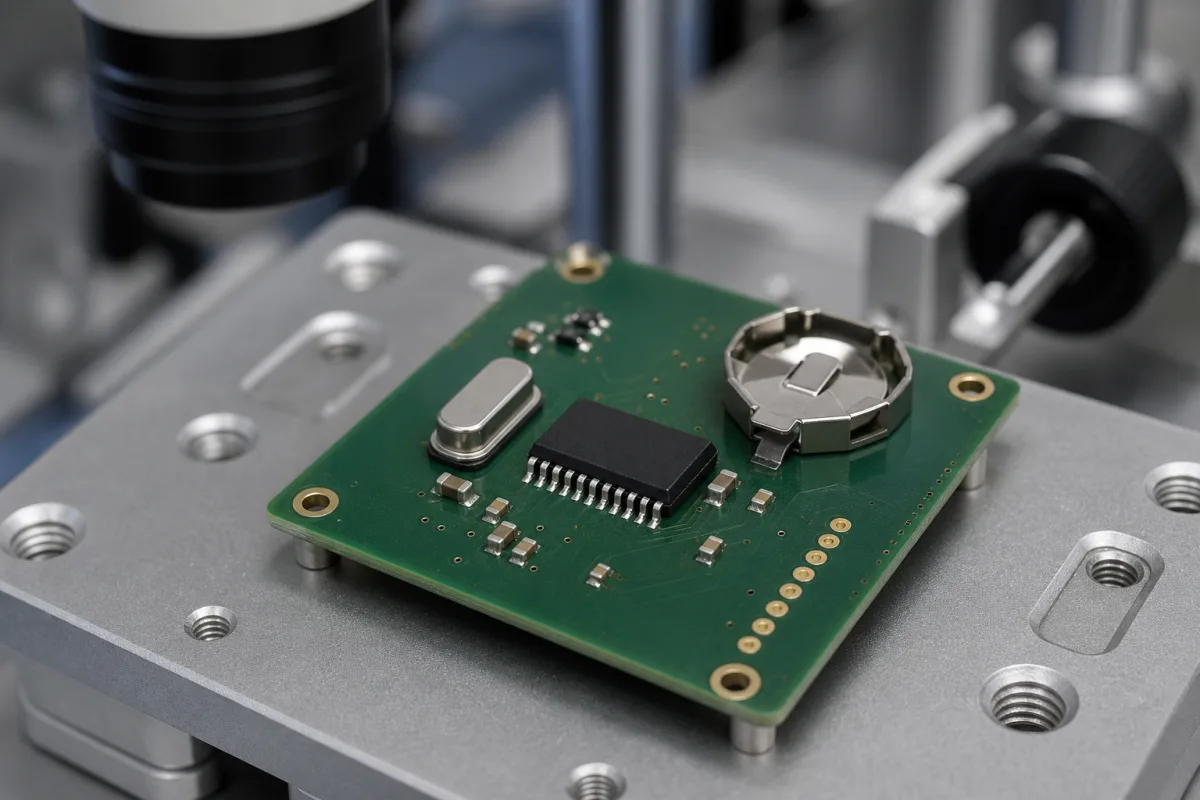
A CMOS counter circuit is a fundamental component within a Real-Time Clock (RTC) system. It is responsible for counting precise clock pulses generated by a crystal oscillator. This count is used to increment time registers (seconds, minutes, hours) and maintain accurate timekeeping, even when the main system power is off, by utilizing a backup power source.
Working Principle
The circuit operates by using a series of CMOS flip-flops connected in a cascaded configuration (e.g., ripple counter, synchronous counter). Each flip-flop toggles its state based on the incoming clock pulse from the RTC's oscillator. The binary output of these flip-flops represents the count value. Control logic manages overflow (e.g., resetting after 60 seconds) and interfaces with other RTC components like registers and the I2C/SPI communication bus.
Common Materials
Silicon (Semiconductor Wafer), Silicon Dioxide (Insulator), Metal (Interconnects - typically Aluminum or Copper)
Technical Parameters
  • Maximum operating frequency of the counter, determining timekeeping resolution and speed. (MHz) Standard Spec
Components / BOM
  • CMOS Flip-Flops
    Basic memory element that stores one bit of the count; toggles state on clock edge.
    Material: Silicon-based semiconductor
  • Clock Input Buffer
    Conditions the clock signal from the oscillator for reliable triggering of the flip-flops.
    Material: Silicon-based semiconductor
  • Output Registers/Buffers
    Hold and drive the counted binary value for reading by the RTC's control logic or external microcontroller.
    Material: Silicon-based semiconductor with metal interconnects
Engineering Reasoning
2.0-5.5 V supply voltage, -40 to 85°C ambient temperature, 0-20 MHz clock frequency
Supply voltage below 1.8 V causes logic state corruption, junction temperature exceeding 125°C initiates thermal runaway
Design Rationale: CMOS transistor threshold voltage violation at low supply voltages, carrier mobility degradation and gate oxide breakdown at elevated temperatures
Risk Mitigation (FMEA)
Trigger Electrostatic discharge exceeding 2000 V HBM
Mode: Gate oxide rupture causing permanent short circuit between gate and substrate
Strategy: Integrated ESD protection diodes with snapback triggering at 1500 V
Trigger Clock signal overshoot beyond 6.0 V peak amplitude
Mode: Latch-up condition with sustained 50 mA parasitic thyristor current
Strategy: Guard ring structures with 5 μm spacing between PMOS and NMOS wells

Industry Taxonomies & Aliases

Commonly used trade names and technical identifiers for CMOS Counter Circuit.

Applied To / Applications

This component is essential for the following industrial systems and equipment:

Industrial Ecosystem & Supply Chain DNA

Complementary Systems
Downstream Applications
Specialized Tooling

Application Fit & Sizing Matrix

Operational Limits
voltage: 3V to 18V supply range (typical CMOS operating voltage)
frequency: Up to 50 MHz maximum clock frequency (depends on specific model)
temperature: -40°C to +85°C (industrial grade), -55°C to +125°C (military grade)
power consumption: Low static power (nanoamps), dynamic power depends on frequency and load
Media Compatibility
✓ Digital control systems ✓ Timing circuits in consumer electronics ✓ Industrial automation counters
Unsuitable: High-voltage or high-current switching environments (requires additional protection circuits)
Sizing Data Required
  • Required counting range (bits/resolution)
  • Maximum clock frequency needed
  • Power supply voltage available

Reliability & Engineering Risk Analysis

Failure Mode & Root Cause
Latch-up
Cause: Excessive voltage spikes or electrostatic discharge (ESD) causing parasitic thyristor activation, leading to high current flow and potential thermal damage.
Output signal degradation
Cause: Electromigration or hot carrier injection over time, exacerbated by high operating temperatures or excessive switching frequencies, resulting in timing errors or logic failures.
Maintenance Indicators
  • Inconsistent or erratic counting behavior (e.g., missed counts, double counts) during operation
  • Abnormal heating of the CMOS IC package during normal operation, indicating potential internal short circuits or excessive current draw
Engineering Tips
  • Implement proper ESD protection and voltage regulation in the circuit design, including decoupling capacitors near the power pins and transient voltage suppressors if needed
  • Operate within specified temperature and frequency ranges, and consider heat sinking or forced air cooling if high ambient temperatures are present

Compliance & Manufacturing Standards

Reference Standards
ISO 9001:2015 - Quality management systems IEC 60747-14-1:2020 - Semiconductor devices - Integrated circuits - Part 14-1: Digital integrated circuits - CMOS circuits CE Marking - Directive 2014/35/EU (Low Voltage Directive)
Manufacturing Precision
  • Power supply voltage tolerance: +/-5% of nominal VDD
  • Propagation delay variation: +/-10% across temperature range (-40°C to +85°C)
Quality Inspection
  • Electrical parametric testing (DC/AC characteristics verification)
  • Environmental stress screening (temperature cycling and burn-in)

Factories Producing CMOS Counter Circuit

Verified manufacturers with capability to produce this product in China

✓ 95% Supplier Capability Match Found

P Project Engineer from Brazil Jan 17, 2026
★★★★★
"Great transparency on the CMOS Counter Circuit components. Essential for our Computer, Electronic and Optical Product Manufacturing supply chain."
Technical Specifications Verified
S Sourcing Manager from Canada Jan 14, 2026
★★★★★
"The CMOS Counter Circuit we sourced perfectly fits our Computer, Electronic and Optical Product Manufacturing production line requirements."
Technical Specifications Verified
P Procurement Specialist from United States Jan 11, 2026
★★★★★
"Found 13+ suppliers for CMOS Counter Circuit on CNFX, but this spec remains the most cost-effective."
Technical Specifications Verified
Verification Protocol

“Feedback is collected from verified sourcing managers during RFQ (Request for Quote) and factory evaluation processes on CNFX. These reports represent historical performance data and technical audit summaries from our B2B manufacturing network.”

6 sourcing managers are analyzing this specification now. Last inquiry for CMOS Counter Circuit from UAE (1h ago).

Supply Chain Compatible Machinery & Devices

Modular Industrial Edge Computing Device

Rugged computing platform for industrial data processing at the network edge

Explore Specs →
Industrial Smart Camera Module

Embedded vision system for industrial automation and quality inspection.

Explore Specs →
Industrial Wireless Power Transfer Module

Wireless power transfer module for industrial equipment applications

Explore Specs →
Industrial Smart Sensor Module

Modular industrial sensor with embedded processing and wireless connectivity

Explore Specs →

Frequently Asked Questions

What are the main advantages of CMOS counter circuits over other technologies?

CMOS counter circuits offer significantly lower power consumption, higher noise immunity, and better integration density compared to TTL or other logic families, making them ideal for battery-powered and high-density electronic applications.

What is the typical operating frequency range for CMOS counter circuits?

CMOS counter circuits typically operate from DC up to several hundred MHz, with specific maximum frequencies depending on the manufacturing process, supply voltage, and circuit design. Advanced CMOS processes can support GHz-range counting applications.

How do CMOS counter circuits handle power supply variations?

CMOS counters have wide operating voltage ranges (typically 3V to 15V for standard CMOS) and maintain reliable counting operation across supply variations. They feature excellent power supply rejection ratio (PSRR) to minimize counting errors from voltage fluctuations.

Can I contact factories directly on CNFX?

CNFX is an open directory, not a transaction platform. Each factory profile provides direct contact information and production details to help you initiate direct inquiries with Chinese suppliers.

Get Quote for CMOS Counter Circuit

Request technical pricing, lead times, or customized specifications for CMOS Counter Circuit directly from verified manufacturing units.

Your business information is encrypted and only shared with verified CMOS Counter Circuit suppliers.

Thank you! Your message has been sent. We'll respond within 1–3 business days.

Need to Manufacture CMOS Counter Circuit?

Connect with verified factories specializing in this product category

Add Your Factory Contact Us
Previous Product
Clock/Timer Unit
Next Product
CNC Motion System