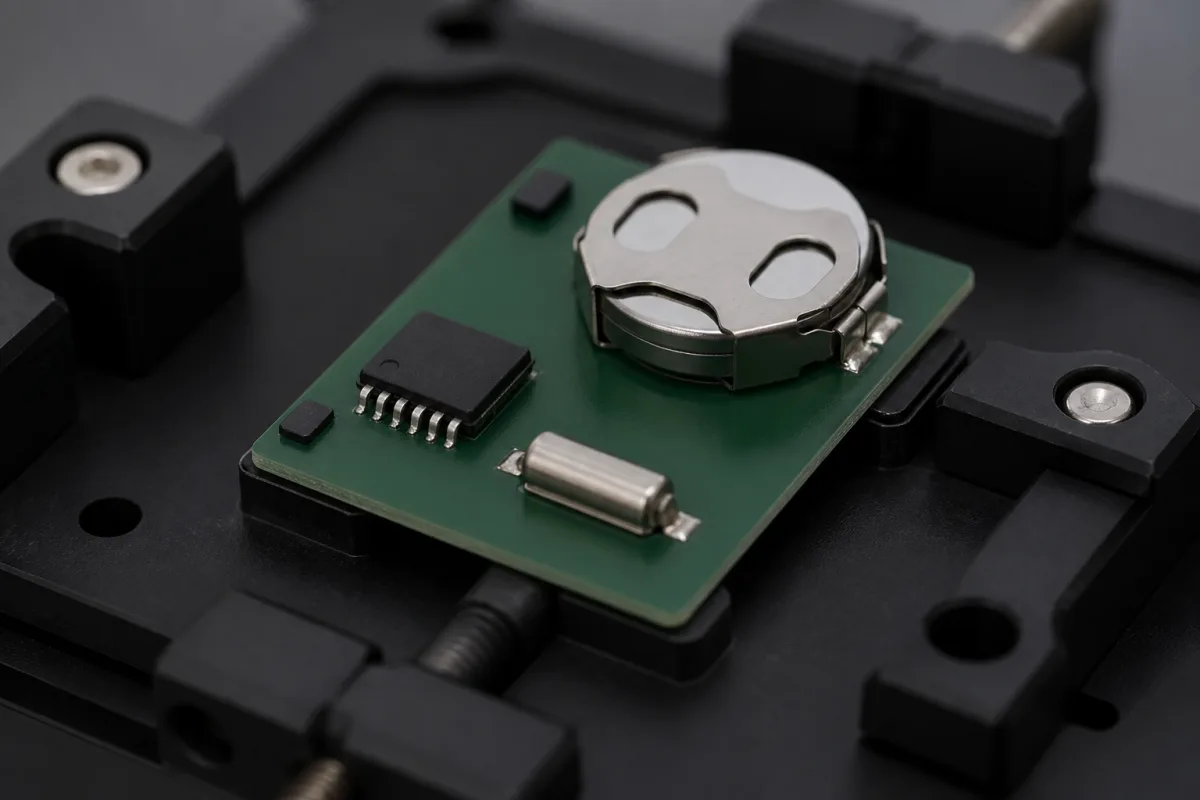
RTC chips and modules · timekeeping error in ppm and seconds per day, 32.768 kHz crystal temperature curve, calibration, backup supply current
A real-time clock is a low-power timekeeping chip, or a small module with the chip, a 32.768 kHz quartz crystal and a backup battery or capacitor, that keeps the date and time while the main system is off and reports it over I²C or SPI. Ask three things first: what accuracy it achieves across your temperature range and over years, whether it can be calibrated or is temperature-compensated, and how much current it draws from the backup supply.
Real-time clock ICs and RTC modules for embedded and industrial electronics, with their 32.768 kHz crystals and backup supplies. General-purpose crystal oscillators, network time servers and GPS-disciplined clocks are outside this page.
CNFX editorial research · Sources checked October 12, 2026 · 5 sources
Abracon's AB26T 32.768 kHz watch crystal datasheet gives a frequency tolerance of ±20 ppm at 25 °C, a turnover temperature of +25 °C ± 5 °C, a temperature coefficient of −0.034 ± 0.006 ppm/°C², first-year ageing of ±3 ppm at 25 °C, a load capacitance of 12.5 pF (typ.) and 35 kΩ maximum series resistance, for operation from −10 °C to +60 °C as standard. [2] Its ABS07 surface-mount crystal lists −0.036 to −0.040 ppm/°C². [3]
Editorial calculation: with a parabolic coefficient of −0.034 ppm/°C² and turnover at 25 °C, the crystal runs 0.034 × (0 − 25)² ≈ 21 ppm slow at 0 °C and about 42 ppm slow at −10 °C or +60 °C, on top of its ±20 ppm room-temperature tolerance. Each 1 ppm is 0.0864 s per day, so 42 ppm is about 3.6 s a day, or roughly 1.8 minutes in 30 days. [2]
TI's BQ32000 data sheet quotes a pre-calibration accuracy of ±35 ppm (typ.) at 25 °C with a reference board and a specific surface-mount crystal, and notes that board design and crystal selection change the result. [1] It specifies a crystal load capacitance of 12 pF and series resistance up to 70 kΩ, and says no external load capacitor should be used when the crystal's CL is 12 pF. [1] Editorial note: match the crystal's load capacitance to the RTC and ask for accuracy across your temperature range, not only at 25 °C.
Give the supplier the accuracy needed (seconds per day or month) over your temperature range, supply voltage, backup source (coin cell, supercapacitor, rechargeable) and expected time on backup, interface (I²C or SPI), alarms and interrupts needed, package or module format, operating temperature and qualification (industrial, automotive).
02
Plan the backup supply and calibration
The BQ32000 runs from 3 to 3.6 V, draws up to 100 μA from VCC, switches automatically to a backup supply (with an integrated trickle charger for rechargeable backup), keeps time with the backup supply down to 1.4 V, and draws 1.2 μA (typ.), 1.5 μA maximum from a 3 V backup with the oscillator running at 25 °C. [1] It operates from −40 °C to 125 °C. [1]
Its programmable calibration adjusts the clock from −63 ppm to +126 ppm by periodically adjusting the width of the 1 Hz clock, which can be measured on the IRQ pin; the effect is observable only every eight or sixteen minutes. An OF (oscillator fail) flag shows whether the clock has stopped. [1]
Editorial calculation: at the 1.5 μA maximum backup current, one year on backup draws 1.5 μA × 8,760 h ≈ 13 mAh from the backup source, before self-discharge and temperature effects. Compare it with the usable capacity of the cell or capacitor you choose.
03
Choose between an RTC with a built-in compensated crystal and one with an external crystal
Seiko Epson's Epson Crystal Device site lists its "RX8900CE" RTC module with a built-in 32.768 kHz crystal unit and a Digital Temperature Compensated Crystal Oscillator (DTCXO), an I²C-Bus interface at 400 kHz, an interface voltage range of 2.5 V to 5.5 V, a temperature-compensated voltage range of 2.0 V to 5.5 V and a clock supply voltage range of 1.6 V to 5.5 V, with selectable clock outputs of 32.768 kHz, 1024 Hz and 1 Hz. [4]
Renesas lists the ISL1208 as an I2C real-time clock/calendar with automatic backup to battery or super capacitor, power failure detection, on-chip oscillator compensation and the "Same Pin Out as ST M41Txx and Maxim DS13xx Devices". [5] With a part like this the error budget still depends on the external crystal's tolerance, temperature coefficient and ageing, which Abracon's data sheets give for its AB26T and ABS07 crystals [2][3].
Epson moves the crystal into the package and compensates it digitally for temperature [4], so the crystal parameters are no longer a separate purchase line. The page reviewed does not state a ppm figure, so ask Epson or its distributor for the accuracy over your temperature range from the RX8900CE data sheet before comparing it with a crystal-plus-calibration design such as the BQ32000 [1].
Editorial calculation: 1 ppm is about 2.6 s in a 30-day month (30 × 86,400 s × 10⁻⁶); a 400 nA battery current is one-third of the 1.2 µA (typ.) backup current listed for the BQ32000. [5][1]
Item
Epson RX8900CE (module)
Renesas ISL1208 (IC + external crystal)
TI BQ32000 (already cited)
Crystal
Built-in 32.768 kHz, DTCXO
External; crystal frequency trimming
External 32.768 kHz
Compensation or trim
Digital temperature compensation
Oscillator Compensation -94 to +140 (as listed)
Programmable calibration
Interface
I²C-Bus, 400 kHz
I2C, 400kHz
I²C
Supply
Interface 2.5–5.5 V; compensated 2.0–5.5 V; clock 1.6–5.5 V
2 Bytes battery-backed SRAM; 15 frequency outputs; MSOP, SOIC, TDFN
Trickle charger
Values are from the Epson and Renesas product pages; their data sheets were not reviewed. Units for the ISL1208 compensation range are not shown on the parameter table.
04
Analogue chip makers and frequency-control makers
The companies shown below fall into two groups: semiconductor makers listing RTC ICs, and crystal and oscillator makers listing RTC modules or chips.
Listings include RTC ICs among analogue and automotive-grade semiconductors, and RTC modules or chips alongside quartz crystals, TCXOs and oscillators from frequency-control makers. Ask each for accuracy over temperature, backup current and crystal requirements.
05
Crystal, counters, calibration, backup switchover, interface and flags
All rows except the crystal follow the BQ32000 data sheet; the crystal row follows Abracon.
IC package or module; e.g. 8 Ld MSOP, SOIC, TDFN. [5]
Package and footprint.
ESD Tolerance (HBM) (V)
Handling robustness.
Rating.
Humidity (Non-condensing) (%RH)
Module environment.
Range.
07
Send the accuracy, power and interface data together
Paste it into your enquiry below or into an email to a maker, then replace every bracket.
Accuracy: [seconds per day or month; temperature range]
Power: [supply; backup source; time on backup]
Interface: [I2C or SPI; alarms; interrupts]
Crystal: [included or external; CL; tolerance]
Format: [IC package or module]
Grade: [industrial; automotive]
3 companies list this product among what they make. Company figures are quoted from each
company's own website; every card states where the relationship came from.
Shanghai Belling Co., Ltd.
Manufacturing site to be confirmed for the order
Lists real-time clock ICs alongside voltage references, op-amps, LDOs and automotive-grade semiconductors.
Explore company information and manufacturing capabilities, then discuss the scope of your project with a relevant supplier.
Share this page
Compiled and source-reviewed by the CNFX editorial team.
Each manufacturer above links to the page on that company's own website where the product is listed, with the date we checked it. How we source and review
· Page last updated 13 October 2026
Buyer questions
How many seconds a day is 1 ppm?
0.0864 s per day (editorial calculation: 86,400 s × 10⁻⁶); 20 ppm is about 1.7 s per day. [2]
Why does an RTC lose time when it is cold or hot?
Its 32.768 kHz crystal follows a parabola; Abracon gives −0.034 ppm/°C² around a 25 °C turnover. [2]
How much current does an RTC draw on backup?
TI's BQ32000 draws 1.2 μA (typ.), 1.5 μA maximum from a 3 V backup at 25 °C. [1]
What is the difference between an RTC module with a DTCXO and an RTC chip with an external crystal?
A module such as Epson's RX8900CE has a built-in 32.768 kHz crystal with digital temperature compensation; a chip such as Renesas's ISL1208 uses an external crystal with on-chip compensation and frequency trimming, so the crystal's tolerance and temperature behaviour must be specified separately. [4][5]
Sources and what still needs a direct check
Sources checked 2026-10-12. TI's data sheet describes its own RTC; Abracon's data sheets describe its own crystals. Values are examples for comparison, not limits for other parts.