Industry-Verified Manufacturing Data (2026)

Common Mode Choke

Based on aggregated insights from multiple verified factory profiles within the CNFX directory, the standard Common Mode Choke used in the Computer, Electronic and Optical Product Manufacturing sector typically supports operational capacities ranging from standard industrial configurations to heavy-duty production requirements.

Technical Definition & Core Assembly

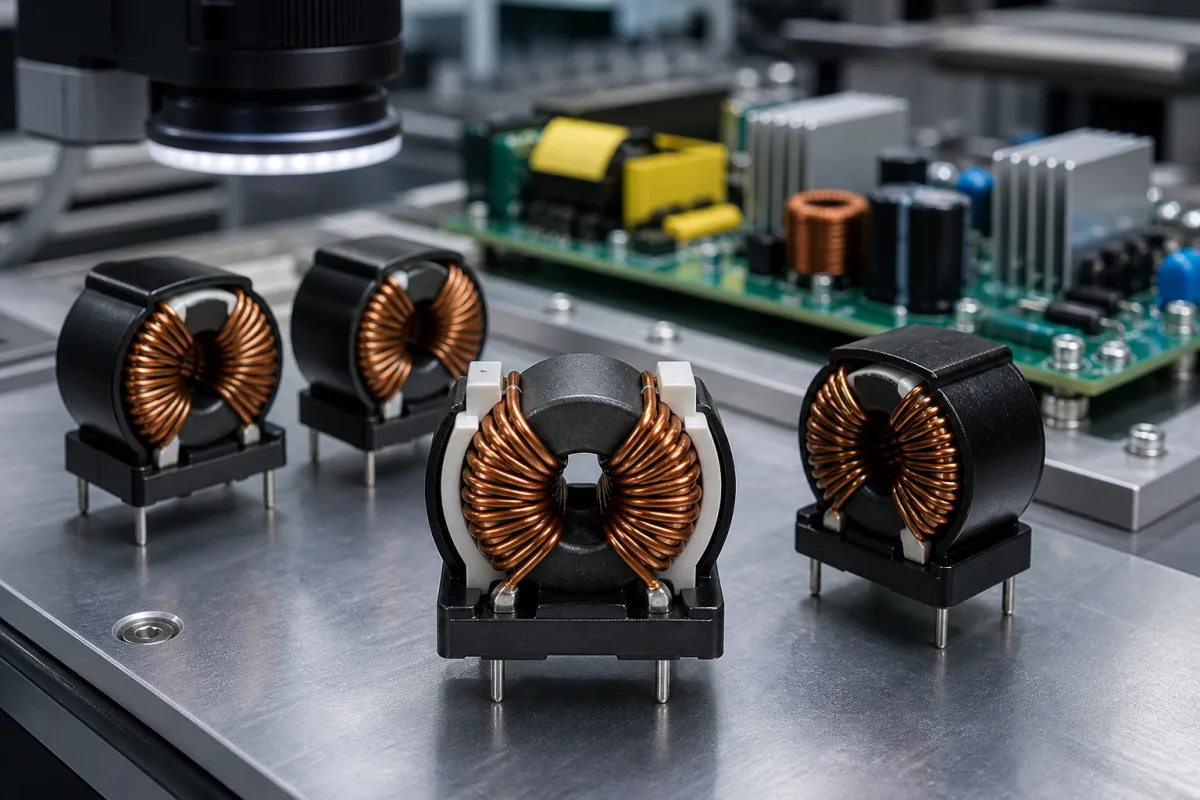
A canonical Common Mode Choke is characterized by the integration of Magnetic Core and Windings. In industrial production environments, manufacturers listed on CNFX commonly emphasize Ferrite Core construction to support stable, high-cycle operation across diverse manufacturing scenarios.

An inductive component designed to suppress common-mode electromagnetic interference in electronic circuits.
Product Specifications

Technical details and manufacturing context for Common Mode Choke

Definition
A common mode choke is a passive electronic component used within EMI filters to attenuate unwanted high-frequency noise that appears equally on both signal lines relative to ground. It consists of two or more windings on a magnetic core, creating high impedance to common-mode currents while allowing differential-mode signals to pass with minimal attenuation.
Working Principle
The common mode choke operates by creating a high impedance path for common-mode noise currents through mutual inductance. When identical noise currents flow in the same direction through both windings, they generate reinforcing magnetic fields in the core, creating high impedance. Differential signals (currents flowing in opposite directions) produce cancelling magnetic fields, resulting in low impedance for the desired signals.
Common Materials
Ferrite Core, Copper Wire, Insulation Material
Technical Parameters
  • Common-mode impedance at specified frequency (typically 100MHz) (Ω) Standard Spec
Components / BOM
  • Magnetic Core
    Provides magnetic path for flux, determines inductance and saturation characteristics
    Material: Ferrite
  • Windings
    Conduct current and create magnetic fields, typically bifilar wound
    Material: Copper
  • Bobbin
    Supports windings and provides insulation between core and windings
    Material: Plastic
  • Terminals
    Electrical connection points for circuit integration
    Material: Copper Alloy
Engineering Reasoning
1-100 MHz frequency range, 0.1-10 A current rating, -40°C to +125°C temperature range
Core saturation at 1.2-1.5 times rated current, insulation breakdown at 500-1000 V RMS, Curie temperature at 200-250°C
Design Rationale: Core magnetic saturation (Bmax = 0.3-0.5 T for ferrite), dielectric breakdown (E = 15-25 kV/mm for enamel coating), thermal demagnetization (Tc = 200-250°C for MnZn ferrite)
Risk Mitigation (FMEA)
Trigger Core saturation due to 1.5x rated current transient
Mode: Inductance reduction to 10-20% of nominal value
Strategy: Current limiting circuit with 1.2x safety margin, core material with higher Bsat (0.5 T NiZn ferrite)
Trigger Insulation breakdown from 600 V RMS common-mode voltage
Mode: Inter-winding short circuit with <1 Ω resistance
Strategy: Double-insulated wire (polyimide + polyester), 1000 V RMS rated insulation, 2.5 mm creepage distance

Industry Taxonomies & Aliases

Commonly used trade names and technical identifiers for Common Mode Choke.

Applied To / Applications

This component is essential for the following industrial systems and equipment:

Industrial Ecosystem & Supply Chain DNA

Complementary Systems
Downstream Applications
Specialized Tooling

Application Fit & Sizing Matrix

Operational Limits
pressure: Atmospheric (not pressure-sensitive, but mounting torque typically 0.5-1.0 N·m for through-hole types)
other spec: Current Rating: 0.1A to 100A (depends on model), Impedance: 10Ω to 10kΩ @ 100MHz, Insulation Resistance: ≥100MΩ
temperature: -40°C to +125°C (operating range, typical for electronic components)
Media Compatibility
✓ PCB-mounted in consumer electronics (e.g., power supplies) ✓ Automotive CAN bus networks (for EMI suppression) ✓ Industrial motor drives (inverter output filtering)
Unsuitable: High-vibration environments without proper potting/mechanical securing (risk of solder joint fatigue)
Sizing Data Required
  • Required impedance at target frequency (e.g., 100Ω @ 100MHz)
  • Maximum continuous current (to avoid saturation/heating)
  • Circuit voltage rating (isolation/breakdown voltage requirement)

Reliability & Engineering Risk Analysis

Failure Mode & Root Cause
Thermal degradation
Cause: Excessive current or ambient temperature causing insulation breakdown, core saturation, or winding overheating due to poor ventilation, overloading, or harmonic distortion.
Mechanical failure
Cause: Vibration, shock, or thermal cycling leading to cracked ferrite core, broken windings, or solder joint fatigue, often from improper mounting, environmental stress, or manufacturing defects.
Maintenance Indicators
  • Audible buzzing or humming indicating core saturation or loose windings
  • Visible discoloration, bulging, or burnt smell from overheating or insulation failure
Engineering Tips
  • Ensure proper derating and thermal management by maintaining adequate airflow, avoiding enclosure hotspots, and monitoring for harmonic currents that cause excessive heating.
  • Implement vibration isolation and secure mounting to prevent mechanical stress, and use conformal coating in harsh environments to protect against moisture and contaminants.

Compliance & Manufacturing Standards

Reference Standards
IEC 60939-1:2010 (Passive filter units for electromagnetic interference suppression) UL 1283:2019 (Standard for Safety for Electromagnetic Interference Filters) EN 55032:2015 (Electromagnetic compatibility of multimedia equipment - Emission requirements)
Manufacturing Precision
  • Inductance tolerance: +/-20% at rated current
  • DC resistance tolerance: +/-10% at 25°C
Quality Inspection
  • Impedance measurement test at specified frequencies
  • Insulation resistance test (minimum 100 MΩ at 500 VDC)

Factories Producing Common Mode Choke

Verified manufacturers with capability to produce this product in China

✓ 93% Supplier Capability Match Found

T Technical Director from Germany Feb 07, 2026
★★★★★
"The technical documentation for this Common Mode Choke is very thorough, especially regarding technical reliability."
Technical Specifications Verified
P Project Engineer from Brazil Feb 04, 2026
★★★★☆
"Reliable performance in harsh Computer, Electronic and Optical Product Manufacturing environments. No issues with the Common Mode Choke so far. (Delivery took slightly longer than expected, but technical support was excellent.)"
Technical Specifications Verified
S Sourcing Manager from Canada Feb 01, 2026
★★★★★
"Testing the Common Mode Choke now; the technical reliability results are within 1% of the laboratory datasheet."
Technical Specifications Verified
Verification Protocol

“Feedback is collected from verified sourcing managers during RFQ (Request for Quote) and factory evaluation processes on CNFX. These reports represent historical performance data and technical audit summaries from our B2B manufacturing network.”

16 sourcing managers are analyzing this specification now. Last inquiry for Common Mode Choke from Germany (17m ago).

Supply Chain Compatible Machinery & Devices

Modular Industrial Edge Computing Device

Rugged computing platform for industrial data processing at the network edge

Explore Specs →
Industrial Smart Camera Module

Embedded vision system for industrial automation and quality inspection.

Explore Specs →
Industrial Wireless Power Transfer Module

Wireless power transfer module for industrial equipment applications

Explore Specs →
Industrial Smart Sensor Module

Modular industrial sensor with embedded processing and wireless connectivity

Explore Specs →

Frequently Asked Questions

What is the primary function of a common mode choke in electronic manufacturing?

A common mode choke suppresses electromagnetic interference (EMI) by filtering out unwanted common-mode noise that can disrupt sensitive electronic circuits, ensuring compliance with EMC standards.

Why are ferrite cores used in common mode chokes for computer applications?

Ferrite cores provide high magnetic permeability and low core losses at high frequencies, making them ideal for suppressing EMI in computer and optical equipment where signal integrity is critical.

How do I select the right common mode choke for my electronic circuit design?

Consider the frequency range of interference, current rating, impedance characteristics, and physical size constraints. For computer and optical products, prioritize chokes with stable performance across the operating frequency spectrum.

Can I contact factories directly on CNFX?

CNFX is an open directory, not a transaction platform. Each factory profile provides direct contact information and production details to help you initiate direct inquiries with Chinese suppliers.

Get Quote for Common Mode Choke

Request technical pricing, lead times, or customized specifications for Common Mode Choke directly from verified manufacturing units.

Your business information is encrypted and only shared with verified Common Mode Choke suppliers.

Thank you! Your message has been sent. We'll respond within 1–3 business days.

Need to Manufacture Common Mode Choke?

Connect with verified factories specializing in this product category

Add Your Factory Contact Us
Previous Product
Color Processing Unit
Next Product
Communication Chipset