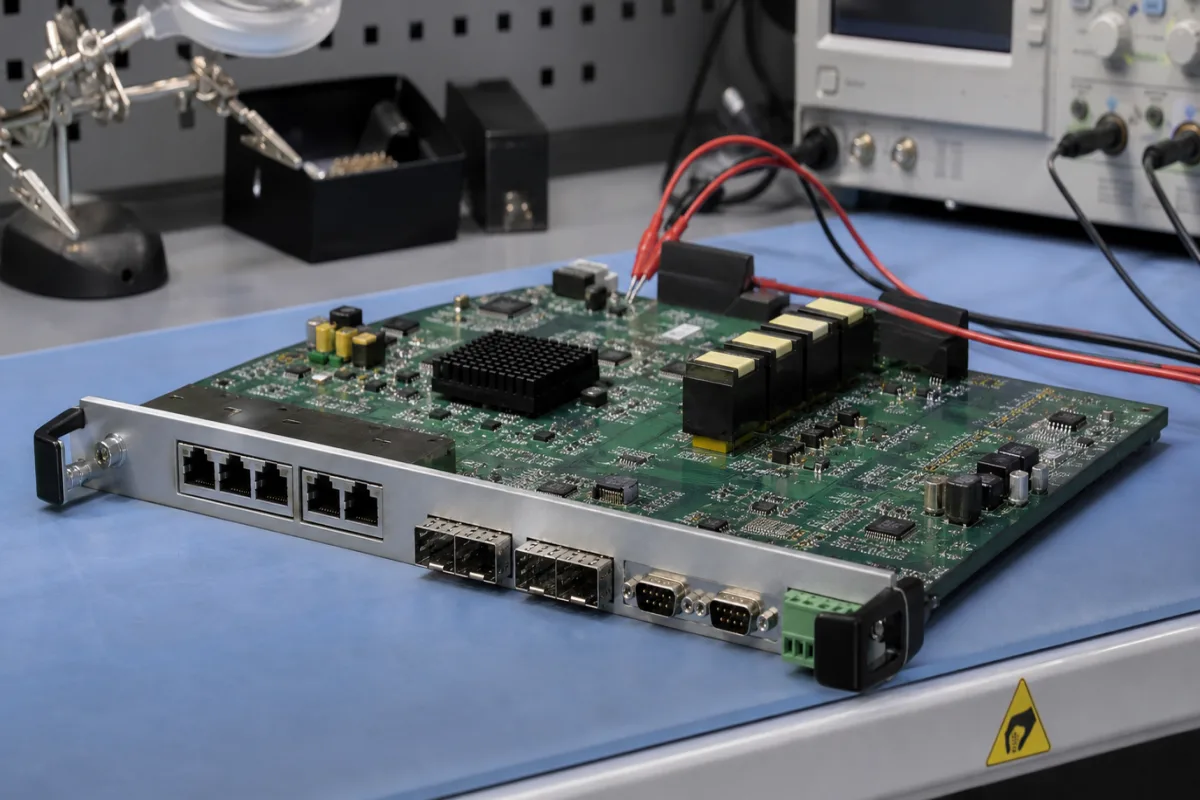
Communication interface board (Ethernet, SFP and serial port card)
Communication interface boards · plug-in cards and adapter boards carrying Ethernet copper, SFP fibre cages and isolated serial ports for racks, controllers and host computers
A communication interface board is a finished printed circuit card whose job is to provide network and serial ports: a plug-in card for a rack or controller backplane, an add-in card for a computer slot, or a small adapter board between a processor's logic-level UART and an RS-232 or RS-485 line. Ask three things first: which ports and how many (RJ45 Ethernet, SFP cages for fibre or copper modules, serial), how each port is isolated from the board's ground, and what power the board must deliver to pluggable modules.
Finished communication interface boards: rack and backplane plug-in cards, PCIe and M.2 network and serial cards, and serial adapter boards carrying Ethernet, SFP and RS-232/RS-485 ports, with their transceivers, magnetics and isolation. Contract PCB assembly (SMT and through-hole) as a service is covered on the PCB assembly (PCBA) service page. Embedded protocol modules for field devices, bare PCBs and network switches are outside this page. RS-232, RS-422 and RS-485 transceivers, converters and isolators bought on their own belong to the Serial communication interface page, while server and data-centre Ethernet adapters chosen by port speed, offloads and queues belong to the Network interface controller (NIC / Ethernet adapter card) page.
CNFX editorial research · Sources checked October 12, 2026 · 3 sources
TI's application report AN-1519 states that Ethernet transformers provide DC isolation from the cable and DC biasing at the PHY, and that IEEE 802.3 isolation requirements (section 14.3.1.1) include sustaining cable faults of 1,500 V at 50 or 60 Hz or 2,250 V DC for 60 seconds. [1]
For transformerless designs, TI recommends non-polarised blocking capacitors of at least 33 nF to meet IEEE 802.3 impedance specifications, forced 100 Mb/s operation, and verification at the application level when connections exceed 1 m; it notes backplane connections can use 50 Ω PCB traces. [1]
For serial ports, Skyworks' Si858x isolated RS-485 transceivers list UL 1577 isolation of up to 5,000 Vrms for one minute (approvals shown as pending on the datasheet), a common-mode transient immunity of at least 100 kV/µs, bus-pin ESD of 15 kV HBM, bus fault protection of ±30 V, signalling up to 10 Mbps (1 Mbps on slew-rate-controlled options), up to 256 transceivers per bus and an ambient range of –40 to +125 °C. [3]
Give the supplier the host (backplane standard and slot, PCIe or M.2 slot, or controller), the port list with connector types, the protocols and speeds, isolation test voltage per port, supply rails available and their current, cooling, operating temperature range, and the conformance tests the board must pass.
02
Budget power and hot-plug behaviour for SFP cages
The SFP transceiver multisource agreement (INF-8074i, rev 1.0, 2001) defines the module's receiver and transmitter supplies as 3.3 V ±5% at the connector pin with a maximum supply current of 300 mA, and recommends host-board supply filtering with inductors below 1 Ω DC resistance. [2]
With the recommended filter, hot-plugging an SFP module produces an inrush current no more than 30 mA greater than steady state, and the module initialises once Vcc exceeds 3.15 V. The transmitter inputs are AC-coupled inside the module with 100 Ω differential termination and accept 500–2,400 mV differential swings, with 500–1,200 mV recommended for EMI performance. [2]
Editorial calculation: at 3.3 V and 300 mA one SFP cage can draw about 1.0 W, so a board with four cages must budget about 4.0 W (4 × 3.3 V × 0.3 A = 3.96 W) for the modules alone, before PHYs, processor and serial transceivers. [2]
03
Compare board types
Board types differ in host interface and ports; values come from the cited documents for the port technology, not for a particular board.
Ethernet 1,500 V for 60 s; RS-485 parts up to 5,000 Vrms for 1 min. [1][3]
Tested isolation per port.
MTBF (h)
Predicted reliability.
Value and method.
Dimensions (W x H x D) (mm)
Card format and front panel.
Outline drawing.
Weight (g)
Board mass.
Weight.
06
Send the host, ports and isolation data together
Paste it into your enquiry below or into an email to a maker, then replace every bracket.
Host: [backplane and slot; PCIe or M.2; controller]
Ports: [RJ45 count and speed; SFP cages; serial type and count]
Isolation: [test voltage per port]
Power: [rails available; budget]
Environment: [temperature; humidity; cooling]
Firmware: [protocols; configuration]
Tests: [conformance; burn-in]
Explore company information and manufacturing capabilities, then discuss the scope of your project with a relevant supplier.
Share this page
Compiled and source-reviewed by the CNFX editorial team.
Each manufacturer above links to the page on that company's own website where the product is listed, with the date we checked it. How we source and review
· Page last updated 13 October 2026
Buyer questions
What isolation does an Ethernet port need?
TI's AN-1519 says IEEE 802.3 requires cabled ports to sustain 1,500 V at 50 or 60 Hz or 2,250 V DC for 60 seconds. [1]
How much power does each SFP cage need?
The SFP MSA defines 3.3 V ±5% at up to 300 mA per module, about 1 W (editorial calculation). [2]
What isolation do isolated RS-485 transceivers list?
Skyworks lists its Si858x isolated RS-485 transceivers at up to 5,000 Vrms for one minute under UL 1577, with approvals shown as pending. [3]
Sources and what still needs a direct check
Sources checked 2026-10-12. TI and Skyworks are semiconductor makers; their documents describe their own parts and summarise IEEE 802.3 and UL 1577 requirements. The SFP MSA is the industry agreement published through the SFF Committee (now SNIA).