Editorial Technical Reference

Communication Interface (e.g., RS-485, Ethernet)

This page explains how Communication Interface (e.g., RS-485, Ethernet) is classified within Computer, Electronic and Optical Product Manufacturing. Technical values and manufacturer relationships are research references; confirm the current specification and supplier evidence for each order.

Technical Definition & Core Assembly

A hardware component on a Control PCB that enables data exchange between the control system and external devices or networks using standardized protocols.
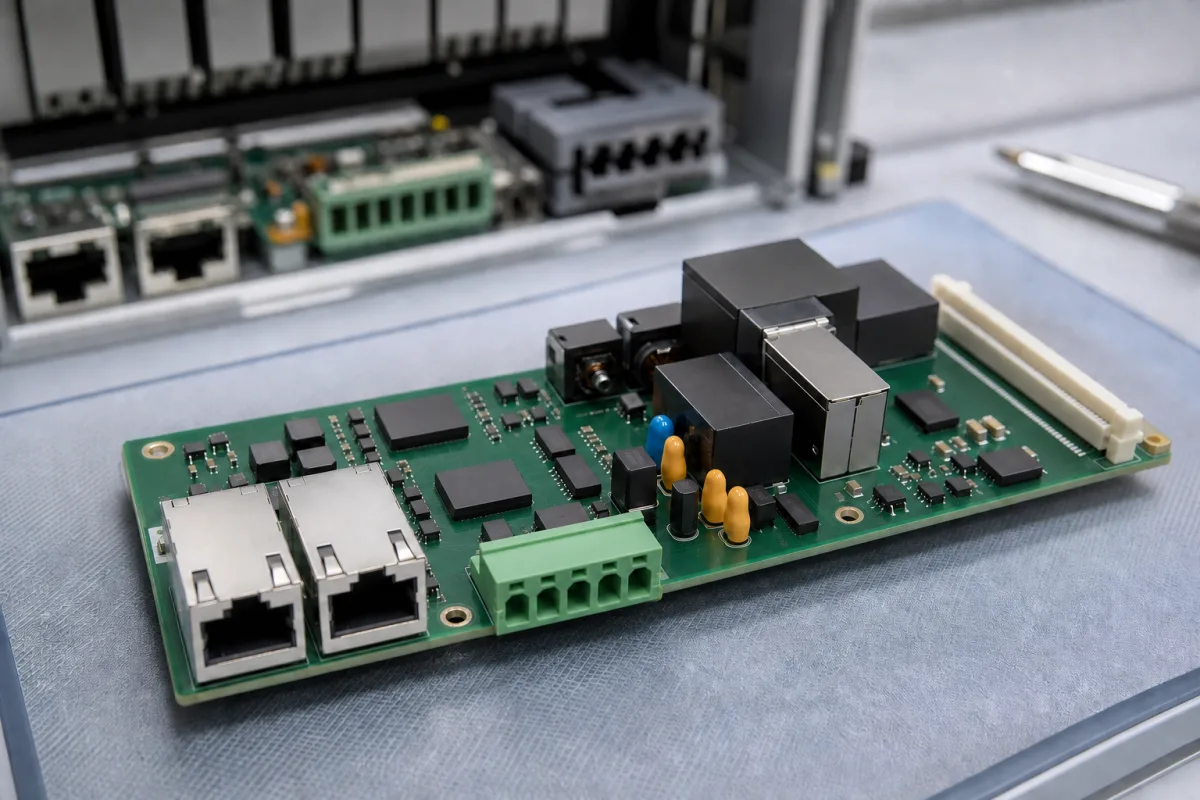
Representative product image. Confirm appearance and specifications with the manufacturer.

Product Specifications

Technical details and manufacturing context for Communication Interface (e.g., RS-485, Ethernet)

Definition
A communication interface is an essential electronic component integrated into a Control PCB that facilitates bidirectional data transmission between the control unit and peripheral devices, other control systems, or supervisory networks. It implements physical layer standards (like RS-485 for industrial serial communication or Ethernet for network connectivity) and associated protocols to ensure reliable, often noise-resistant, data exchange in industrial environments. Its role is critical for system integration, remote monitoring, and centralized control within automated machinery or production lines. The interface typically includes transceivers, controllers, connectors, and passive components mounted on a PCB substrate such as FR-4. It converts internal digital signals from the control processor into electrical signals compatible with the chosen communication standard, handling signal conditioning, timing, error-checking, and protocol adherence (e.g., Modbus, Profibus, TCP/IP). Receiving functions reverse this process, interpreting incoming signals for the control logic. The data transmission rate is a key parameter, often specified in Mbps (e.g., 10/100 Mbps for Ethernet, up to 10 Mbps for RS-485). When selecting a communication interface, verify the required data rate, physical layer standard, connector type, and protocol support against the specific application. Confirm model-specific values and standards with the legal manufacturer or supplier, as directory listings are for reference only. Maintenance signals include intermittent communication errors, physical damage to connectors, or failure to establish link. Boundaries of failure may involve transceiver burnout, PCB trace damage, or protocol mismatches. Always consult the manufacturer's documentation for installation and troubleshooting guidance.
Working Principle
The interface converts internal digital signals from the control processor into electrical signals compatible with the chosen communication standard (e.g., differential voltage levels for RS-485, or modulated packets for Ethernet). It handles signal conditioning, timing, error-checking, and protocol adherence (e.g., Modbus, Profibus, TCP/IP) to transmit commands, sensor data, or status information. Receiving functions reverse this process, interpreting incoming signals for the control logic.
Common Materials
PCB substrate (e.g., FR-4), Integrated circuits (transceivers, controllers), Connectors (e.g., RJ45, terminal blocks), Passive components (resistors, capacitors)
Technical Parameters

What to specify in your RFQ

  • Data transmission rate (e.g., 10/100 Mbps for Ethernet, up to 10 Mbps for RS-485) in Mbps

These are the quantities to specify to the manufacturer when sizing or requesting a quote. The manufacturer's own documentation governs the exact figures and applicable standard.

Components / BOM
  • Transceiver IC
    Converts logic-level signals to/from the physical communication standard (e.g., RS-485 differential signals)
    Material: semiconductor (silicon)
  • Connector Part
    Provides physical port for cable attachment (e.g., RJ45 jack, screw terminals)
    Material: metal (copper alloy) and plastic
  • Isolation Circuit
    Electrically isolates the interface from the main PCB to prevent noise or ground loop issues
    Material: optocouplers or isolation transformers
  • Protocol Handling Logic
    Frames the data, checks it for errors and keeps to the protocol; the transceiver only puts the bits on the wire.

Applied To / Applications

This component is essential for the following industrial systems and equipment:

Industrial Ecosystem & Supply Chain Structure

Complementary Systems
Downstream Applications
Specialized Tooling

Application Fit & Sizing Matrix

Operational Limits
pressure: N/A (non-mechanical interface)
other spec: Operating Voltage: 3.3V or 5V DC ±10%, Data Rate: Up to 10 Mbps (Ethernet) or 10 Mbps (RS-485), Isolation Voltage: 1500V RMS typical
temperature: -40°C to +85°C
Media Compatibility
✓ Industrial control cabinets (dry, controlled environments) ✓ Factory automation networks (clean electrical environments) ✓ Building management systems (indoor, temperature-controlled)
Unsuitable: Direct exposure to corrosive chemicals, conductive dust, or high-moisture condensing environments without proper IP-rated enclosure
Sizing Data Required
  • Required communication protocol (e.g., Modbus TCP, PROFINET, EtherNet/IP)
  • Network topology and maximum cable length (for RS-485: up to 1200m; for Ethernet: 100m per segment)
  • Number of simultaneous connections and data throughput requirements (packets/second, bandwidth)

Reliability & Engineering Risk Analysis

Failure Mode & Root Cause
Signal degradation or loss
Cause: Electrical noise interference from nearby equipment, improper grounding/shielding, or cable damage leading to data corruption or communication failure.
Physical connector/cable failure
Cause: Mechanical wear from repeated connection/disconnection, corrosion due to environmental exposure, or improper installation causing bent pins or broken conductors.
Maintenance Indicators
  • Intermittent or complete loss of communication between devices, often accompanied by error messages in control systems.
  • Visible physical damage to connectors or cables, such as corrosion, bent pins, or loose connections that may cause audible crackling or sparking.
Engineering Tips
  • Implement proper electrical isolation and shielding: Use shielded cables with correct termination, maintain proper grounding, and separate communication cables from power cables to minimize electromagnetic interference.
  • Establish regular inspection and testing protocols: Perform periodic visual inspections of connectors and cables, conduct signal integrity tests, and use diagnostic tools to monitor communication health before failures occur.

Indicative industry ranges for design and RFQ preparation. Confirm the exact figures and applicable standard with the manufacturer before specifying.

Compliance & Manufacturing Standards

Applicable Standards
ISO/IEC 11801: Information technology - Generic cabling for customer premises ANSI/TIA-568.2-D: Balanced Twisted-Pair Telecommunications Cabling and Components Standards EN 55032: Electromagnetic compatibility of multimedia equipment - Emission requirements

Quoted from the published standard.

Manufacturing Precision
  • Connector Pin Alignment: +/-0.1mm
  • Signal Integrity: Jitter < 0.1 UI at 100 Mbps
Quality Inspection
  • Bit Error Rate Test (BERT) for data transmission accuracy
  • Electromagnetic Compatibility (EMC) testing for interference compliance

Manufacturers of Communication Interface (e.g., RS-485, Ethernet)

Manufacturer profiles associated with Communication Interface (e.g., RS-485, Ethernet).

Sourcing Communication Interface (e.g., RS-485, Ethernet) from China?
Tell us your specification and target quantity — we will match it against manufacturer records and come back with the factories that fit.
Request manufacturers We manufacture this

Manufacturer listings support early research and capability understanding. They are not certification, ranking, or transaction guarantees.

Technical documentation
Request current drawings, revision history, and a signed specification sheet.
Manufacturing capability
Verify equipment lists, process limits, capacity, and representative production evidence.
Inspection readiness
Confirm test methods, calibrated equipment, sampling plans, and traceable reports.
Supplier transparency
Check the legal entity, factory address, ownership, certifications, and direct contacts.

CNFX does not score or rank suppliers. Buyers must verify all claims and documents with the legal manufacturer before ordering.

Supply Chain Compatible Machinery & Devices

Modular Industrial Edge Computing Device

This modular industrial edge computing device is a ruggedized system designed for deployment in harsh industrial environments to perform real-time data processing, analytics, and control functions at the network edge.

Explore Specs →
Industrial Smart Camera Module

The Industrial Smart Camera Module is a compact, self-contained vision processing unit designed for integration into industrial machinery and production lines.

Explore Specs →
Surface Mount Resistor

Passive electronic component for current limiting and voltage division in circuits

Explore Specs →
Surface Mount Capacitor

A surface mount capacitor is a fundamental electronic component used for energy storage, filtering, coupling, and decoupling in electronic circuits.

Explore Specs →

Frequently Asked Questions

What are the common types of communication interfaces used on Control PCBs?

Common types include RS-485 for industrial serial communication and Ethernet for network connectivity. RS-485 uses differential signaling for noise resistance, while Ethernet supports higher data rates and TCP/IP protocols.

How do I choose the right communication interface for my application?

Consider the required data transmission rate, distance, environmental noise, and protocol compatibility. Verify the interface's specifications against your system's needs and consult the manufacturer for model-specific details.

What is the typical data rate for RS-485 and Ethernet interfaces?

RS-485 can support up to 10 Mbps, while Ethernet commonly supports 10/100 Mbps. Actual rates depend on the specific implementation and cable quality.

What maintenance signals indicate a failing communication interface?

Signs include intermittent communication errors, difficulty establishing a link, physical damage to connectors, or unusual heat. If these occur, inspect the interface and consult the manufacturer's troubleshooting guide.

Data Basis

Editorial classification, named public sources where available, and source-reviewed manufacturer records.

Preliminary Technical Classification
This page supports structured research, RFQ preparation, and supplier evaluation. It does not replace buyer-led supplier qualification, standards review, or technical approval.
Buyer enquiry

Request manufacturing insight for Communication Interface (e.g., RS-485, Ethernet)

Ask for use case, specification boundaries, supplier type, and RFQ preparation information for this product.

Where it goes
Straight to the CNFX editorial desk, and to the manufacturer if this product is linked to a claimed profile. Nothing is broadcast to a supplier list.
Your details stay here
We do not sell or rent enquiry data, and we do not add you to a mailing list. Used only to answer this request.
No commission, no middleman
CNFX is a directory. We take no cut of any order and never negotiate on a supplier's behalf.
What we don't claim
A listing is not an endorsement. Qualify every supplier and verify every figure yourself before ordering.

Your business information is used only to process this request.

Thank you! Your message has been sent. We'll respond within 1–3 business days.
Sorry, we couldn't send your message. Please try again, or email us at contact@cnfx.com.

Need to Manufacture Communication Interface (e.g., RS-485, Ethernet)?

Compare manufacturer profiles with relevant product and process capability.

Previous Product
XY Positioning Stage
Last Product
Get QuotesChat