Industry-Verified Manufacturing Data (2026)

Communication Interface Circuitry

Based on aggregated insights from multiple verified factory profiles within the CNFX directory, the standard Communication Interface Circuitry used in the Computer, Electronic and Optical Product Manufacturing sector typically supports operational capacities ranging from standard industrial configurations to heavy-duty production requirements.

Technical Definition & Core Assembly

A canonical Communication Interface Circuitry is characterized by the integration of Protocol Transceiver IC and Communication Processor / Controller. In industrial production environments, manufacturers listed on CNFX commonly emphasize Printed Circuit Board (PCB) construction to support stable, high-cycle operation across diverse manufacturing scenarios.

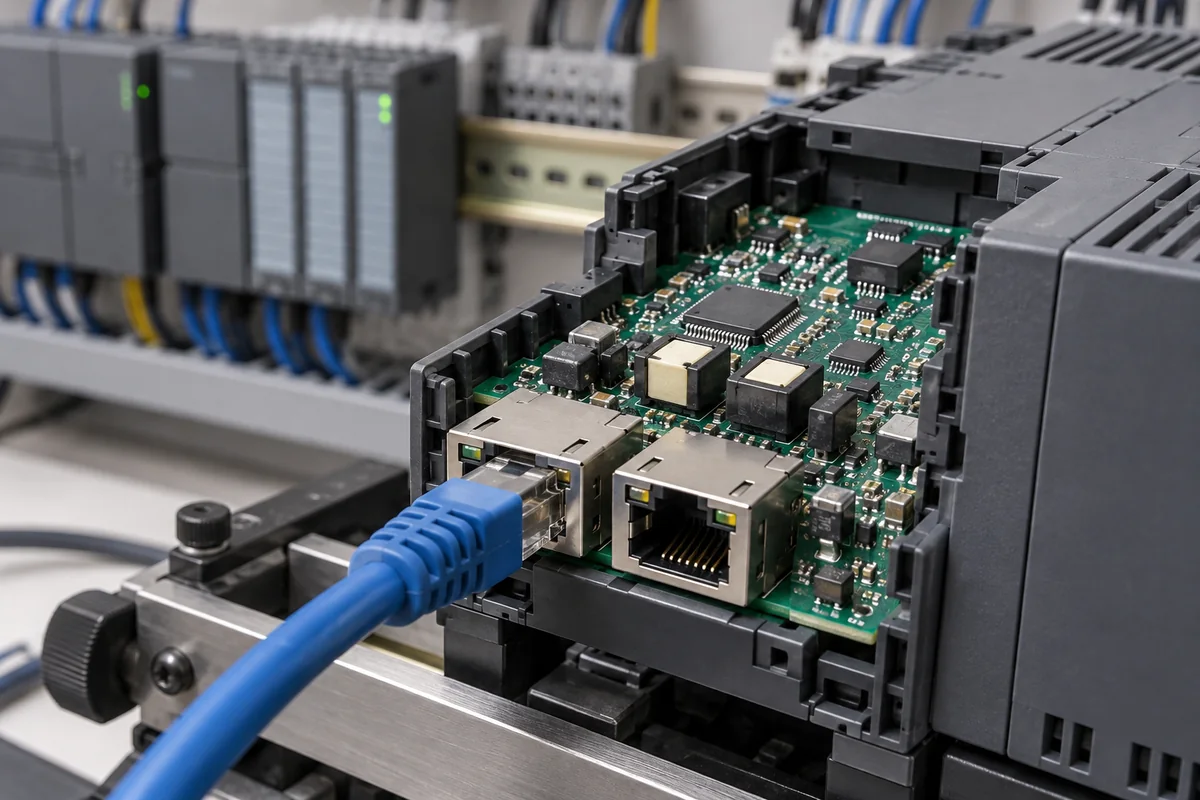
Electronic circuitry within a PLC processor module that enables data exchange with external devices and networks.
Product Specifications

Technical details and manufacturing context for Communication Interface Circuitry

Definition
Communication interface circuitry is the electronic subsystem embedded within a Programmable Logic Controller (PLC) processor module responsible for establishing, managing, and terminating data communication channels. It translates internal processor signals into standardized electrical or optical protocols (e.g., RS-232, RS-485, Ethernet, Profibus, Modbus) and vice-versa, enabling the PLC to connect with HMIs, SCADA systems, sensors, actuators, other PLCs, and enterprise networks for monitoring, control, and data acquisition.
Working Principle
The circuitry typically consists of protocol-specific transceiver ICs, signal conditioning components (like opto-isolators or line drivers), and a microcontroller or dedicated communication processor. It operates by: 1) Receiving parallel data and control signals from the PLC's central processing unit (CPU). 2) The communication processor or logic formats this data according to the target protocol (adding headers, error-checking codes). 3) The transceiver converts the logical signals into the appropriate physical layer voltage/current levels (e.g., differential signals for RS-485) for transmission over cables. 4) In reverse, it receives incoming signals, conditions them, checks for errors, extracts the data payload, and presents it to the CPU.
Common Materials
Printed Circuit Board (PCB), Integrated Circuits (ICs - transceivers, microcontrollers), Passive components (resistors, capacitors), Connectors (e.g., RJ45, terminal blocks)
Technical Parameters
  • Maximum data transmission rate supported by the interface (e.g., 10/100 Mbps for Ethernet, 115.2 kbps for serial). (Mbps) Standard Spec
Components / BOM
  • Protocol Transceiver IC
    Converts internal logic-level signals to/from the physical layer electrical specifications of a specific communication standard (e.g., Ethernet PHY, RS-485 driver).
    Material: Semiconductor (Silicon)
  • Communication Processor / Controller
    Manages the communication stack (data link and application layers), handles protocol framing, addressing, error checking, and data buffering.
    Material: Semiconductor (Silicon)
  • Signal Conditioning Circuitry
    Provides electrical isolation (via opto-couplers or transformers), surge protection, and signal filtering to ensure data integrity in noisy industrial environments.
    Material: Mixed (Opto-isolators, resistors, capacitors, TVS diodes)
  • Connector
    Physical port (e.g., RJ45 jack, screw terminal, D-Sub) for attaching communication cables to external devices.
    Material: Metal (contacts), Plastic (housing)
Engineering Reasoning
3.0-5.5 VDC at 25°C ambient, derating to 2.7-5.8 VDC over -40°C to 85°C operating temperature range
Voltage transients exceeding ±15 kV per IEC 61000-4-2 (ESD) or sustained operation above 125°C junction temperature
Design Rationale: Electromigration in copper interconnects at current densities > 1×10⁶ A/cm², accelerated by Joule heating (P=I²R) when T_j > 125°C
Risk Mitigation (FMEA)
Trigger Galvanic corrosion between dissimilar metals (copper traces and tin-lead solder) in humid environments (>85% RH)
Mode: Increased contact resistance from 50 mΩ to >500 mΩ, causing signal attenuation exceeding -3 dB
Strategy: Conformal coating with 25-75 μm acrylic/parylene layer meeting IPC-CC-830B Class 3 requirements
Trigger Latch-up from substrate injection when input voltage exceeds V_CC + 0.7 V during 5 ns transients
Mode: Sustained short-circuit current > 500 mA causing thermal runaway and silicon melting at 1414°C
Strategy: Integrated silicon-controlled rectifier (SCR) clamps with holding current > 100 mA and trigger voltage < 6.8 V

Industry Taxonomies & Aliases

Commonly used trade names and technical identifiers for Communication Interface Circuitry.

Applied To / Applications

This component is essential for the following industrial systems and equipment:

Industrial Ecosystem & Supply Chain DNA

Complementary Systems
Downstream Applications
Specialized Tooling

Application Fit & Sizing Matrix

Operational Limits
voltage: 24V DC nominal (18-30V DC range)
humidity: 5% to 95% non-condensing
temperature: 0°C to 60°C (operating), -40°C to 85°C (storage)
communication speed: 10/100 Mbps Ethernet, up to 12 Mbps serial
Media Compatibility
✓ Industrial Ethernet networks (Profinet, EtherNet/IP) ✓ RS-232/RS-485 serial devices ✓ Modbus TCP/RTU protocols
Unsuitable: High-voltage electrical environments (>600V AC) without proper isolation
Sizing Data Required
  • Required communication protocols (Ethernet, serial, fieldbus)
  • Number of simultaneous connections/devices
  • Data throughput requirements (bandwidth in Mbps)

Reliability & Engineering Risk Analysis

Failure Mode & Root Cause
Signal Degradation/Noise
Cause: Oxidation/corrosion of connectors, solder joints, or PCB traces due to environmental exposure (moisture, contaminants) or thermal cycling, leading to increased resistance and intermittent connections.
Component Overheating/Failure
Cause: Excessive current draw, poor thermal management (e.g., inadequate ventilation, dust buildup), or voltage spikes/surges damaging sensitive ICs, transistors, or capacitors.
Maintenance Indicators
  • Intermittent or complete loss of communication signals (e.g., flickering indicators, data dropouts) despite normal power supply.
  • Audible buzzing/hissing from circuitry or visible signs like discolored/burned components, bulging capacitors, or unusual heat emission.
Engineering Tips
  • Implement regular preventive maintenance: clean connectors and PCBs with appropriate solvents, apply conformal coating to protect against moisture/contaminants, and ensure proper enclosure sealing.
  • Use surge protection devices (e.g., transient voltage suppressors) on power and signal lines, and design/enforce thermal management protocols (e.g., adequate airflow, heat sinks, ambient temperature monitoring).

Compliance & Manufacturing Standards

Reference Standards
ISO 11898-1:2015 (CAN bus physical layer) ANSI/TIA-568-C.2 (Balanced twisted-pair cabling) CE EN 55032:2015 (Electromagnetic compatibility)
Manufacturing Precision
  • Impedance: +/-10% (e.g., 50Ω ±5Ω)
  • Signal rise/fall time: ±20% of nominal value
Quality Inspection
  • Bit Error Rate Test (BERT) for signal integrity
  • Electrostatic Discharge (ESD) immunity test per IEC 61000-4-2

Factories Producing Communication Interface Circuitry

Verified manufacturers with capability to produce this product in China

✓ 94% Supplier Capability Match Found

T Technical Director from United Arab Emirates Jan 26, 2026
★★★★★
"Great transparency on the Communication Interface Circuitry components. Essential for our Computer, Electronic and Optical Product Manufacturing supply chain."
Technical Specifications Verified
P Project Engineer from Australia Jan 23, 2026
★★★★☆
"The Communication Interface Circuitry we sourced perfectly fits our Computer, Electronic and Optical Product Manufacturing production line requirements. (Delivery took slightly longer than expected, but technical support was excellent.)"
Technical Specifications Verified
S Sourcing Manager from Singapore Jan 20, 2026
★★★★★
"Found 44+ suppliers for Communication Interface Circuitry on CNFX, but this spec remains the most cost-effective."
Technical Specifications Verified
Verification Protocol

“Feedback is collected from verified sourcing managers during RFQ (Request for Quote) and factory evaluation processes on CNFX. These reports represent historical performance data and technical audit summaries from our B2B manufacturing network.”

12 sourcing managers are analyzing this specification now. Last inquiry for Communication Interface Circuitry from India (1h ago).

Supply Chain Compatible Machinery & Devices

Modular Industrial Edge Computing Device

Rugged computing platform for industrial data processing at the network edge

Explore Specs →
Industrial Smart Camera Module

Embedded vision system for industrial automation and quality inspection.

Explore Specs →
Industrial Wireless Power Transfer Module

Wireless power transfer module for industrial equipment applications

Explore Specs →
Industrial Smart Sensor Module

Modular industrial sensor with embedded processing and wireless connectivity

Explore Specs →

Frequently Asked Questions

What protocols does this communication interface circuitry support?

This interface circuitry typically supports industrial protocols like Modbus, Profibus, Ethernet/IP, and CAN bus through configurable transceiver ICs and communication processors.

How does this circuitry ensure reliable data exchange in industrial environments?

It incorporates signal conditioning components, EMI shielding on the PCB, and robust connectors to maintain data integrity despite electrical noise and harsh industrial conditions.

Can this interface be integrated with existing PLC systems?

Yes, it's designed as a modular component with standard connectors and voltage levels for seamless integration with various PLC processor modules and industrial networks.

Can I contact factories directly on CNFX?

CNFX is an open directory, not a transaction platform. Each factory profile provides direct contact information and production details to help you initiate direct inquiries with Chinese suppliers.

Get Quote for Communication Interface Circuitry

Request technical pricing, lead times, or customized specifications for Communication Interface Circuitry directly from verified manufacturing units.

Your business information is encrypted and only shared with verified Communication Interface Circuitry suppliers.

Thank you! Your message has been sent. We'll respond within 1–3 business days.

Need to Manufacture Communication Interface Circuitry?

Connect with verified factories specializing in this product category

Add Your Factory Contact Us
Previous Product
Communication Interface Circuit
Next Product
Communication Interface IC