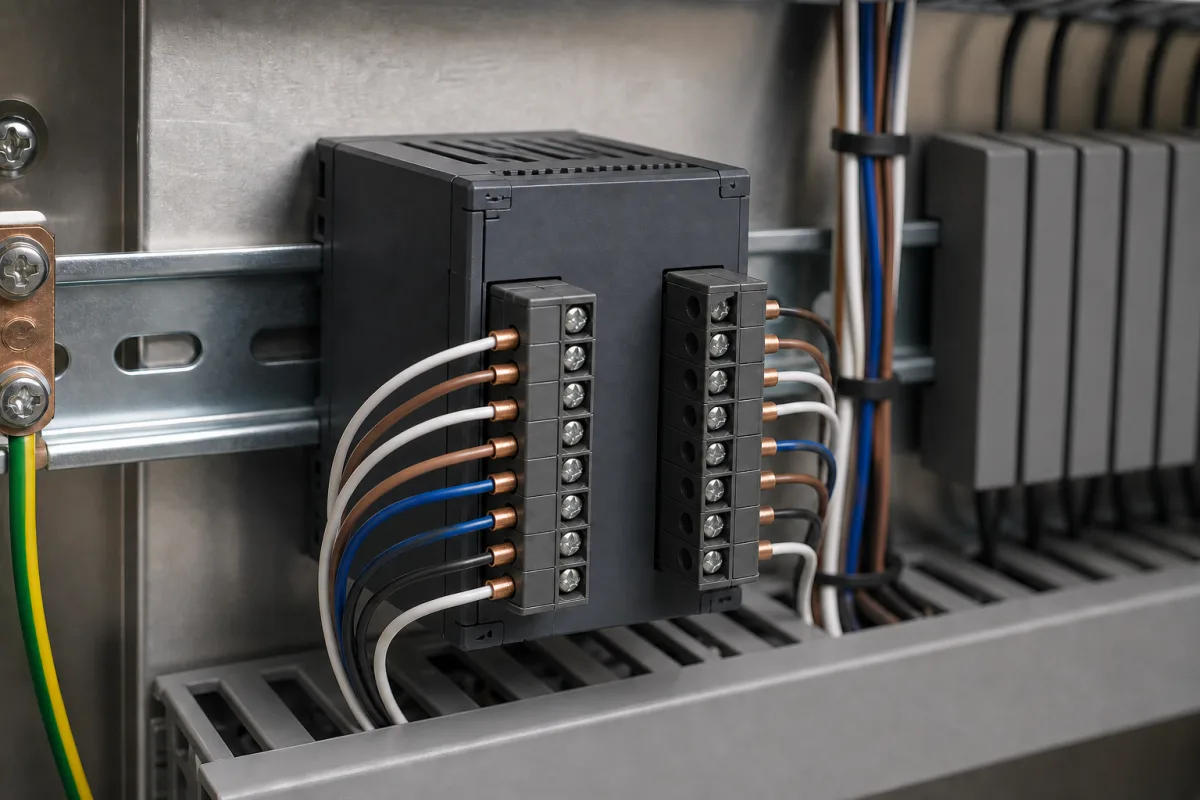
Analog input module for PLC, remote I/O and data acquisition
I/O for data acquisition and control · Measuring error vs resolution, full-scale value, differential vs single-ended, common-mode and isolation, conversion time
An analog input module converts continuous sensor signals such as ±10 V, 0–10 V, 0/4–20 mA or temperature-sensor signals into digital values for a PLC, remote I/O station or data acquisition system. Ask three things first: what measuring error over the full range and temperature the module guarantees (not only its bit count), whether the inputs are differential or single-ended and what common-mode voltage and isolation they tolerate, and how fast each channel is converted and filtered.
Analog input modules and terminals for PLC racks, fieldbus remote I/O (EtherCAT, PROFINET, Modbus) and data acquisition, including voltage, current and RTD/thermocouple inputs. Analog output modules, signal isolators as separate devices, sensors and complete PLCs are outside this page.
CNFX editorial research · Sources checked October 12, 2026 · 4 sources
Beckhoff's EL31xx manual lists its EL3101 and EL3102 terminals for −10 to +10 V with 16-bit resolution (including sign) and a measuring error over the full measuring range of less than ±0.3% at 0 to +55 °C relative to the full scale value, or ±0.5% when the extended temperature range is used. Its EL3141 and EL3144 current terminals for 0–20 mA carry the same ±0.3% / ±0.5% figures. [1]
The manual explains that in the EL3174's extended range the usable range runs to about ±107% of the full scale value, so a ±10 V range reads from −10.7 to +10.7 V, while the legacy range maps ±100% to ±32,767 counts. [1] EDATEC lists its EtherCAT analog input modules with 4 voltage/current or 8 current channels, 4–20 mA, 0–20 mA, ±5 V, 0–10 V and ±10 V ranges and 16-bit conversion. [2]
Helmholz states its error limits relative to the nominal range: ±0.1% basic error at 25 °C, ±0.2% operational error over the whole 0 to +60 °C range, a temperature error of ±0.005%/K, and 15 bits plus sign resolution, with SIMATIC S7, SIMATIC S5 or INT16 value representation. [3] Editorial calculation: ±0.2% of 20 mA is ±40 µA, against ±60 µA for ±0.3% on the Beckhoff current terminals; 15 bits plus sign gives 32,768 steps per polarity, about 0.61 µA per step on the ±20 mA range, so ±40 µA spans about 65 steps. [3][1]
Editorial calculation: on a ±10 V range, ±0.3% of full scale is ±30 mV, while one 16-bit count (including sign) is 10 V / 32,767 ≈ 0.31 mV, so the guaranteed error is about 100 counts. On a 0–20 mA range used for a 4–20 mA transmitter, ±0.3% of 20 mA is ±60 µA, which is ±0.375% of the 16 mA signal span. [1] Compare modules on error and temperature range, and ask whether calibration data are supplied.
Give the supplier the signals per channel (range, sensor type), number of channels, required measuring error and temperature range, differential or single-ended wiring, common-mode and isolation needs, sampling rate or update time, filter needs, fieldbus or PLC platform, power supply, installation (DIN rail, IP rating, hazardous area) and documents required.
02
Check input reference, common-mode limits, isolation and speed
Beckhoff gives its ±10 V terminals differential inputs with a shared internal ground, a common-mode voltage limit of 35 V maximum referred to internal ground, input resistance above 200 kΩ, and 500 V electrical isolation between the E-bus and field side. Its 0–20 mA terminals are single-ended with an 85 Ω input resistance plus diode voltage, a dielectric strength of 30 V maximum, and 2-wire connection for the four single-ended inputs of the EL3144. [1]
Conversion times in the manual range from about 40 µs for a single-channel EL3101 to about 60 µs (40 µs in fast mode) for the two-channel EL3102 and about 100 µs for the four-channel multiplexed EL3144 with its default 50 Hz filter, with an input filter limit of 5 kHz. Its EL3172 lists functional isolation tested at 707 V for 7 s between channels and between channel and fieldbus, and activatable FIR/IIR filters. [1]
Helmholz's TB20 module 600-250-7BH21 takes the other approach: its eight current inputs are electrically isolated from each other and from the backplane bus, each with a 50 Ω load resistance on the 0–20 mA, 4–20 mA and ±20 mA ranges, suit 2- and 4-wire transmitters, and offer wire-break detection on 4–20 mA. It measures by integration, and the interference frequency suppression chosen per channel sets the conversion time: 2 ms with none, 8 ms at 400 Hz, 51 ms at 60 Hz, 60 ms at 50 Hz and 160 ms at 10 Hz. [3]
Editorial calculation: at 20 mA a 50 Ω load drops 1.0 V, against 1.7 V plus the diode voltage across Beckhoff's 85 Ω input. Helmholz's 2 ms is 20 times the EL3144's 100 µs, and 60 ms with 50 Hz suppression is 600 times longer, so the filter setting can set the update rate more than the converter does. [3][1]
Editorial note: if sensor grounds differ by more than the module's common-mode limit, or long cables pick up interference, choose differential or channel-isolated inputs; if channels are multiplexed, ask whether samples are simultaneous or sequential, since sequential sampling shifts the time of each channel.
03
Check whether the sampling rate is per channel or shared across the module
Moxa's specification for its ioLogik E1200 Ethernet remote I/O series shows a module whose sampling rate is shared between channels. The E1240 (8 channels) and E1242 (4 analog channels) have differential 16-bit inputs for 0–10 VDC, 0–20 mA, 4–20 mA and 4–20 mA with burn-out detection, and each samples 12 samples per second per module; with N channels enabled, each channel gets 12/N samples per second. Accuracy is ±0.1% FSR at 25 °C and ±0.3% FSR from −10 to 60 °C, with the -T wide-temperature versions adding ±0.5% FSR from −40 to 75 °C. [4]
The same table lists a built-in 120 Ω resistor for current input, input impedance of at least 10 MΩ, isolation of 3k VDC or 2k Vrms, and support for Modbus TCP, EtherNet/IP, SNMP, RESTful API and Moxa's MXIO library through two switched Ethernet ports for daisy-chaining. [4]
Editorial calculation: with all 8 channels of an E1240 enabled, each channel is updated 12/8 = 1.5 times per second, against conversion times of tens of microseconds per channel on Beckhoff's EtherCAT terminals. [1] On a 0–10 V input, ±0.3% FSR equals ±30 mV, the same band as Beckhoff's ±0.3% on its ±10 V terminals only if both are referred to a 10 V full scale; ask each supplier which full-scale value its percentage uses. [4]
Suppliers linked to this page list analog input modules; each card links to the page reviewed.
Listings include EtherCAT analog input modules and remote I/O analog input modules for current, voltage, RTD and thermocouple signals; ask each for measuring error over temperature, input reference, isolation and conversion time.
05
Trace the module parts
This is a functional reference built from the sources cited; it is not one maker's specification.
Fill the specification fields with values for your signals
An analog input module quotation needs values for your signals. The table explains each field, gives published values where a reviewed source states them, and says what to obtain from the supplier.
Explore company information and manufacturing capabilities, then discuss the scope of your project with a relevant supplier.
Share this page
Compiled and source-reviewed by the CNFX editorial team.
Published product pages show what a company offers, not tested performance. Confirm the legal seller, factory and scope for your order. How we source and review
· Page last updated 13 October 2026
Buyer questions
Is a 16-bit analog input accurate to 16 bits?
No; Beckhoff's 16-bit terminals list a measuring error under ±0.3% of full scale, about 30 mV or roughly 100 counts on ±10 V (editorial calculation). [1]
What does differential input mean for an analog module?
Beckhoff's ±10 V terminals measure differentially with a common-mode limit of 35 V referred to internal ground; its 0–20 mA terminals are single-ended. [1]
What signal ranges do analog input modules accept?
EDATEC lists 4–20 mA, 0–20 mA, ±5 V, 0–10 V and ±10 V on 4- or 8-channel EtherCAT modules. [2]
Does the noise filter slow an analog input module?
Yes on some modules: Helmholz lists conversion times of 2 ms with no interference suppression, 60 ms with 50 Hz suppression and 160 ms at 10 Hz. [3]
Is an analog input module's sampling rate per channel?
Not always: Moxa's ioLogik E1240 samples 12 times per second per module, so each of N enabled channels gets 12/N samples per second. [4]
Sources and what still needs a direct check
Sources checked 2026-10-12. Beckhoff's manual documents its own terminals; EDATEC's page lists its own modules; Helmholz's and Moxa's product pages give the technical data of their own modules. Values are for those products and should be confirmed for the module you buy.