Industry-Verified Manufacturing Data (2026)

Communication PHY

Based on aggregated insights from multiple verified factory profiles within the CNFX directory, the standard Communication PHY used in the Computer, Electronic and Optical Product Manufacturing sector typically supports operational capacities ranging from standard industrial configurations to heavy-duty production requirements.

Technical Definition & Core Assembly

A canonical Communication PHY is characterized by the integration of Serializer/Deserializer (SerDes) and Line Driver/Receiver. In industrial production environments, manufacturers listed on CNFX commonly emphasize Silicon (semiconductor substrate) construction to support stable, high-cycle operation across diverse manufacturing scenarios.

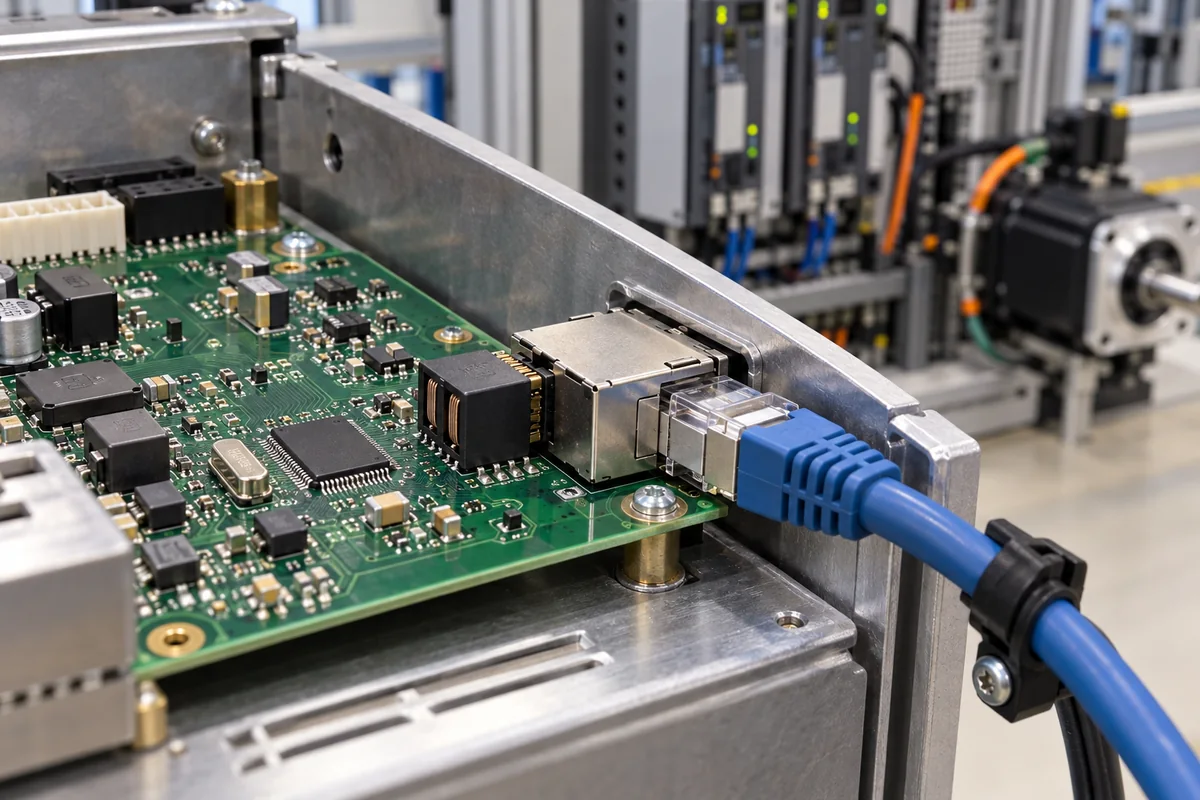
The physical layer interface component within a motion control chip that handles the electrical signaling and data transmission protocols for communication with external devices.
Product Specifications

Technical details and manufacturing context for Communication PHY

Definition
Communication PHY (Physical Layer) is an essential component integrated into motion control chips that manages the lowest-level hardware interface for data communication. It converts digital data from the chip's logic into electrical signals suitable for transmission over physical media (such as cables or traces) and vice versa, implementing the timing, voltage levels, encoding schemes, and synchronization required by specific communication standards (e.g., Ethernet, CAN, RS-485, or proprietary industrial protocols). Within the motion control system, it enables reliable, real-time exchange of command, feedback, and status data between the controller and drives, sensors, or higher-level systems.
Working Principle
The PHY operates by receiving parallel digital data from the chip's media access control (MAC) layer, serializing it, and applying line encoding (e.g., Manchester, NRZ) to create a transmit signal with embedded clock information. It drives this signal onto the physical medium at defined voltage/current levels. On reception, it amplifies and conditions the incoming analog signal, extracts the clock via a clock recovery circuit, decodes the data stream, converts it back to parallel digital data, and passes it to the MAC. It handles noise immunity, impedance matching, and error detection at the physical level.
Common Materials
Silicon (semiconductor substrate), Copper (interconnects), Dielectric materials (insulation)
Technical Parameters
  • Data transmission rate (e.g., 10/100/1000 Mbps for Ethernet PHY) (Mbps) Standard Spec
Components / BOM
  • Serializer/Deserializer (SerDes)
    Converts parallel data to serial for transmission and serial to parallel for reception
    Material: Silicon
  • Line Driver/Receiver
    Amplifies and conditions signals for transmission over the physical medium and receives incoming signals
    Material: Silicon with copper interconnects
  • Clock Data Recovery (CDR) Circuit
    Extracts clock timing from the incoming data stream to synchronize reception
    Material: Silicon
  • Impedance Matching Network
    Matches the PHY's output impedance to the transmission line to minimize signal reflections
    Material: Silicon, passive components (resistors/inductors/capacitors)
Engineering Reasoning
0.8-3.3 V differential signaling voltage, -40 to +125°C ambient temperature, 100 Mbps-1 Gbps data rate
Signal integrity degradation beyond 20% eye diagram closure at 10^-12 BER, junction temperature exceeding 150°C, common-mode voltage exceeding ±2 V
Design Rationale: Electromigration at current densities > 10^6 A/cm² causing conductor thinning, dielectric breakdown at electric fields > 10 MV/m, hot carrier injection at drain-source voltages > 3.6 V
Risk Mitigation (FMEA)
Trigger Electrostatic discharge exceeding 2 kV HBM
Mode: Gate oxide rupture in CMOS transistors
Strategy: Integrated ESD protection diodes with 8 kV HBM rating and 500 V CDM rating
Trigger Simultaneous switching noise generating 200 mV ground bounce
Mode: Timing violation causing data corruption
Strategy: On-die decoupling capacitance of 100 nF/mm² and dedicated power/ground planes with 0.5 mm spacing

Industry Taxonomies & Aliases

Commonly used trade names and technical identifiers for Communication PHY.

Applied To / Applications

This component is essential for the following industrial systems and equipment:

Industrial Ecosystem & Supply Chain DNA

Complementary Systems
Downstream Applications
Specialized Tooling

Application Fit & Sizing Matrix

Operational Limits
voltage: 1.8V to 3.3V
data rate: Up to 1 Gbps
temperature: -40°C to +125°C
Media Compatibility
✓ EtherCAT ✓ PROFINET ✓ CANopen
Unsuitable: High-voltage industrial welding environments
Sizing Data Required
  • Required communication protocol
  • Maximum data transmission rate
  • Operating voltage range

Reliability & Engineering Risk Analysis

Failure Mode & Root Cause
Signal degradation
Cause: Physical damage to cables or connectors from environmental factors (moisture, vibration, temperature extremes) or improper installation leading to impedance mismatches and signal loss.
Electromagnetic interference (EMI) disruption
Cause: Inadequate shielding or grounding, proximity to high-power electrical equipment, or non-compliance with electromagnetic compatibility (EMC) standards causing data corruption or communication failures.
Maintenance Indicators
  • Intermittent or complete loss of data transmission despite functional network equipment
  • Unusual error rates, packet loss, or signal attenuation readings in network diagnostics exceeding baseline thresholds
Engineering Tips
  • Implement regular inspection and testing of physical layer components (cables, connectors, transceivers) using tools like OTDRs or cable testers to detect early degradation.
  • Ensure proper installation with adequate separation from power lines, use shielded cabling in industrial environments, and maintain consistent grounding practices to minimize EMI risks.

Compliance & Manufacturing Standards

Reference Standards
ISO/IEC 11801-1:2017 (Generic cabling for customer premises) ANSI/TIA-568.2-D (Balanced twisted-pair telecommunications cabling and components) EN 50173-1:2018 (Information technology - Generic cabling systems)
Manufacturing Precision
  • Insertion Loss: +/-0.75 dB per 100m at 100 MHz
  • Return Loss: >20 dB across operating frequency range
Quality Inspection
  • Bit Error Rate Test (BERT)
  • Eye Diagram Analysis

Factories Producing Communication PHY

Verified manufacturers with capability to produce this product in China

✓ 95% Supplier Capability Match Found

T Technical Director from Brazil Jan 26, 2026
★★★★★
"Impressive build quality. Especially the technical reliability is very stable during long-term operation."
Technical Specifications Verified
P Project Engineer from Canada Jan 23, 2026
★★★★☆
"As a professional in the Computer, Electronic and Optical Product Manufacturing sector, I confirm this Communication PHY meets all ISO standards. (Delivery took slightly longer than expected, but technical support was excellent.)"
Technical Specifications Verified
S Sourcing Manager from United States Jan 20, 2026
★★★★★
"Standard OEM quality for Computer, Electronic and Optical Product Manufacturing applications. The Communication PHY arrived with full certification."
Technical Specifications Verified
Verification Protocol

“Feedback is collected from verified sourcing managers during RFQ (Request for Quote) and factory evaluation processes on CNFX. These reports represent historical performance data and technical audit summaries from our B2B manufacturing network.”

12 sourcing managers are analyzing this specification now. Last inquiry for Communication PHY from India (1h ago).

Supply Chain Compatible Machinery & Devices

Modular Industrial Edge Computing Device

Rugged computing platform for industrial data processing at the network edge

Explore Specs →
Industrial Smart Camera Module

Embedded vision system for industrial automation and quality inspection.

Explore Specs →
Industrial Wireless Power Transfer Module

Wireless power transfer module for industrial equipment applications

Explore Specs →
Industrial Smart Sensor Module

Modular industrial sensor with embedded processing and wireless connectivity

Explore Specs →

Frequently Asked Questions

What is the primary function of a Communication PHY in motion control systems?

The Communication PHY handles electrical signaling and data transmission protocols, converting digital signals from the motion control chip into physical signals for reliable communication with external devices like sensors, actuators, and other controllers.

How does the Clock Data Recovery (CDR) circuit improve communication reliability?

The CDR circuit extracts timing information from incoming data streams, synchronizing the receiver clock with the transmitter clock to minimize data errors, especially critical in high-speed industrial motion control applications where timing precision is essential.

What role does the impedance matching network play in PHY performance?

The impedance matching network ensures maximum power transfer and minimizes signal reflections by matching the transmission line impedance to the PHY circuit, reducing data corruption and improving signal integrity in electrically noisy industrial environments.

Can I contact factories directly on CNFX?

CNFX is an open directory, not a transaction platform. Each factory profile provides direct contact information and production details to help you initiate direct inquiries with Chinese suppliers.

Get Quote for Communication PHY

Request technical pricing, lead times, or customized specifications for Communication PHY directly from verified manufacturing units.

Your business information is encrypted and only shared with verified Communication PHY suppliers.

Thank you! Your message has been sent. We'll respond within 1–3 business days.

Need to Manufacture Communication PHY?

Connect with verified factories specializing in this product category

Add Your Factory Contact Us
Previous Product
Communication Module
Next Product
Communication Processor / Controller