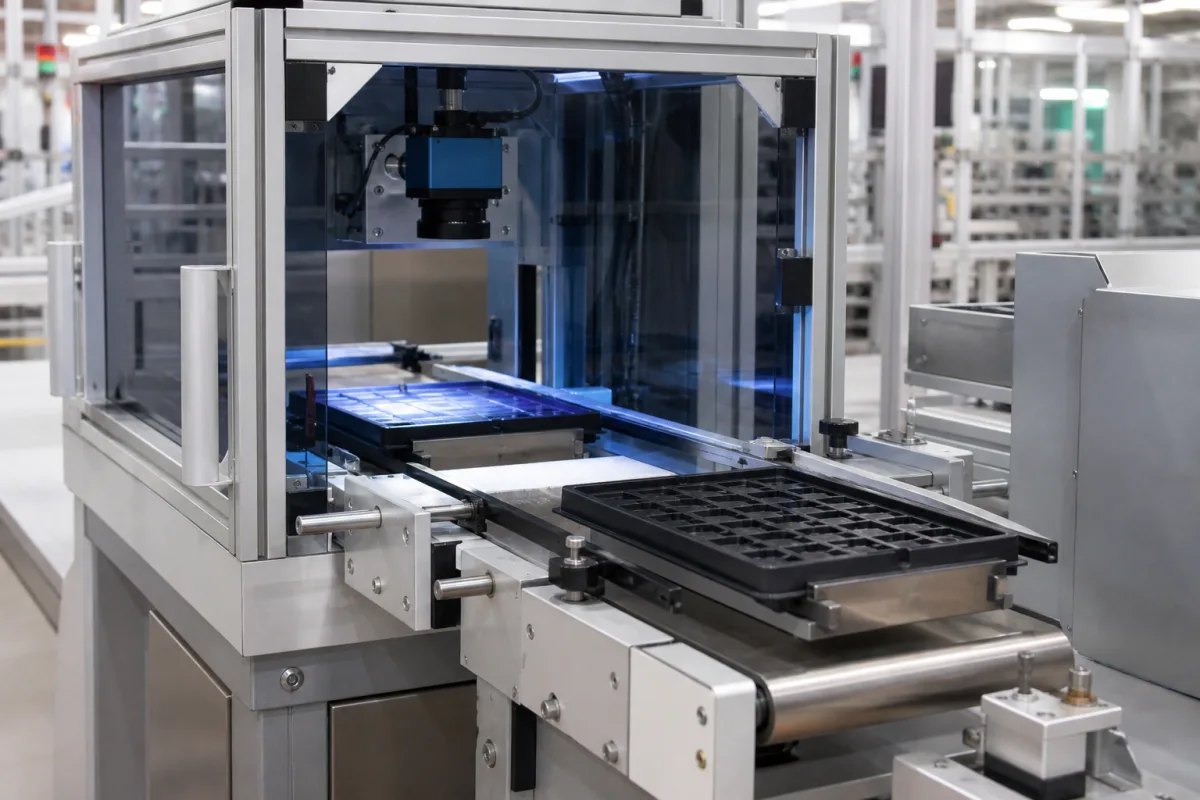
Conveyor mechanism for JEDEC component trays: the belt-and-rail transport that carries a matrix tray under an inspection camera, stops it and clamps it
JEDEC matrix-tray conveyors for inspection and handling cells · 322.6 × 135.9 mm trays, twin belts, stop and clamp under the camera, 2–4 s tray exchange
Packaged ICs leave the back end in black matrix trays of one standard outline, and inspection and pick-and-place cells take the trays rather than the parts. The conveyor in such a cell has one job: bring the next tray in from a stack, put it at the same place under the camera or pick head every time, hold it so only the parts move, and send it back out. Its width, guide rails and stop are set by the tray, and its cycle by how long the station spends on each tray.
Conveyor mechanisms that transport JEDEC-outline matrix trays of IC packages and other components inside vision-inspection, pick-and-place and test-handling cells: twin-belt or edge-belt tray conveyors, guide and clamping rails, stops and stop sensors, tray feed from and return to stacking bins, and the tray datums they work to. Edge-belt conveyors for printed circuit boards in SMT lines are covered on the PCB conveyor system page; AOI machines for PCB assemblies on the Automated optical inspection (AOI) system for PCB assembly page; XY axes that move a camera over the work on the Multi-axis positioning system for optical inspection page and the vision computer on the Image processing computer for PCB optical inspection page. Unit-load conveyors as a plant-wide category are covered on the Conveyor systems page, and modular sections on the Conveyor section page; the small-part assembly flexible-chain line on the Automated small-part assembly conveyor page and the switchgear roller line on the Cabinet assembly transport line page.
CNFX editorial research · Sources checked October 13, 2026 · 3 sources
322.6 × 135.9 mm and four stated thicknesses: the tray dimensions that fix rail width, belt spacing and stop height
The conveyor's width and its guide rails are set by the tray outline, which is the same for every JEDEC matrix tray: TopLine gives 12.7 × 5.35 in (322.6 × 136 mm) [2], and Renesas' tray drawing for a 24-pin FLGA gives 322.6 × 135.9 mm [3]. The thickness, which sets rail clearance and stop height, is stated differently by different sources.
Editorial calculation: 0.30 in is 7.62 mm and 0.48 in is 12.19 mm. The sources disagree on the thicknesses, so the conveyor builder should be given the drawings of the actual trays to be run, not a nominal JEDEC height.
Other tray features the conveyor and its datums have to work with: Laurier's patent describes four transfer notches, a spaced pair along each long side, for conveying and handling, plus an alignment feature for consistent orientation, and between about 4 and 200 pockets per tray. [1] TopLine describes a scalloped edge on one side for an orientation pin and a 45° chamfer at one corner marking pin 1, and says trays are stackable within one device family and maker's model, with mixing of brands not recommended. [2] The Renesas FLGA tray holds 14 × 35 = 490 parts, is moulded in carbon-filled PPE, is rated for 135 °C maximum and has a surface resistance below 1 × 10¹² Ω. [3]
Source
Thinner tray
Thicker tray
TopLine
Low profile 0.25 in (6.35 mm), for BGA, CSP, QFP, TQFP, QFN, TSOP and SOIC [2]
High profile 0.40 in (10.16 mm), for PLCC, CERQUAD, PGA, modules [2]
Send the conveyor builder the drawing of every tray to be run, with outline, thickness, notch and chamfer positions and maximum stack height, and say whether trays of different makers will be mixed.
02
Twin belts to a stop sensor, a quarter-second overrun and PTFE-faced rails that sandwich the tray
Laurier's US 6,283,703 (filed 1999) describes a tray conveyor in detail. A pneumatic pusher feeds one tray at a time from a supply bin onto the first section of the conveyor; conveyor belts driven by one motor carry it to the work area at the far end, where it is held in a restrained position while parts are taken from it or placed in it; the belts then reverse and return it to a collection bin. [1]
The belts run until a switch S1 is activated, which the patent puts at about 3 to 4 seconds, enough to load a tray and carry it fully against the stop member; the run can be extended by about a quarter of a second to make sure the leading end of the tray abuts the stop. A stop sensor signals the controller to stop the conveyor motor. [1]
The tray is clamped by being sandwiched between an upper pair of opposed guide rails and the upward-facing surfaces of the belts. The patent states this holds the tray firmly at the work area so that the pick tool cannot lift the tray itself, only the parts in it, and suggests a PTFE anti-friction coating on the inward-facing rail surfaces so the tray still slides along them. [1]
Laurier gives a feed cycle of a few seconds, for example 2 to 4 s, and contrasts it with batch systems in which an operator has to stop the machine and open a door to replace emptied trays. [1] Editorial calculation: on a tray of 490 parts like the Renesas FLGA tray, a 4 s tray exchange happens once per 490 parts; at the 2–4 s stated, the exchange time per part is about 4 to 8 ms. [1][3]
Ask how the tray is located at the station (stop, datum pins, notches), how it is clamped, what stops the camera or pick tool lifting the tray, and how long one tray exchange takes from stop to stop.
03
Stacks of 5 to 7, a top cover tray and bake ratings: feeding the conveyor from a tray stack
The conveyor's input and output are tray stacks, so stack height and tray condition are part of its design. TopLine states that in normal practice stacks are limited to 5 to 7 trays, with an empty tray as cover on top, and that stacks are strapped with ESD-grade straps or conductive bands. [2]
Laurier's conveyor uses one bin above the conveyor and one below: in one embodiment full trays come from the upper bin and emptied trays go to the lower, and in the other empty trays come from the lower bin and filled trays go to the upper, both bins accessible from outside the machine so that trays can be replenished without stopping it. [1]
Trays that have been baked arrive at the conveyor after dry packing. TopLine gives 125 °C as the normal bake temperature, a maximum bake temperature stamped into each tray, ratings for bakeable trays of 140 °C, 150 °C and 180 °C (typ.), and non-bakeable trays rated at 50–75 °C; exceeding the stamped temperature changes the tray's dimensions. [2] Editorial calculation: Renesas' 135 °C rating leaves 10 °C above the 125 °C bake TopLine gives. [3][2]
State the stack height the input and output bins must hold, whether a cover tray is used, and the bake rating of the trays to be run.
04
Data for a JEDEC tray conveyor
Paste it into your enquiry below or into an email to a maker, then replace every bracket.
Trays: [drawings; outline; thickness; pocket matrix; maker; mixed or single brand]
Station: [camera inspection, pick-and-place or test; work position; datum method]
Transport: [twin belt or edge belt; speed; stop sensor; overrun]
Clamping: [guide rails; pneumatic clamps; rail coating]
Stacks: [input and output bin heights; cover tray; replenishment without stopping]
Cycle: [tray exchange time; parts per tray; station time per tray]
ESD: [belt and rail materials; grounding]
Explore company information and manufacturing capabilities, then discuss the scope of your project with a relevant supplier.
Share this page
Compiled and source-reviewed by the CNFX editorial team.
Each manufacturer above links to the page on that company's own website where the product is listed, with the date we checked it. How we source and review
· Page last updated 13 October 2026
Buyer questions
What size is a JEDEC matrix tray?
TopLine gives 12.7 × 5.35 in (322.6 × 136 mm) and Renesas' tray drawing 322.6 × 135.9 mm; thicknesses are given as 6.35 and 10.16 mm by TopLine and as about 7.62 and 12.19 mm in Laurier's patent citing JEDEC 95-1. [2][3][1]
How does a tray conveyor stop a tray at the work position?
In Laurier's US 6,283,703 the belts run about 3 to 4 s until a switch is activated, with an optional quarter-second overrun to seat the tray against a stop member. [1]
How is the tray kept from being picked up with the parts?
Laurier's conveyor sandwiches the tray between upper guide rails and the belts, so the pick tool takes only the parts; the rails can be PTFE-coated. [1]
How many trays go in a stack?
TopLine states stacks are limited to 5 to 7 trays in normal practice, with an empty tray as a cover on top. [2]
Sources and what still needs a direct check
Sources checked 2026-10-13. Laurier Incorporated's tray conveying patent (belts, stop, clamping rails, feed cycle, tray dimensions under JEDEC 95-1), TopLine's guide to JEDEC trays (outline, profiles, orientation features, stacking, bake ratings) and a Renesas tray drawing (outline, thickness, 490-pocket matrix, material and temperature rating).