Editorial Technical Reference

Decoder Circuit

This page explains how Decoder Circuit is classified within Computer, Electronic and Optical Product Manufacturing. Technical values and manufacturer relationships are research references; confirm the current specification and supplier evidence for each order.

Technical Definition & Core Assembly

Electronic circuit that interprets and converts scanned barcode/QR code patterns into digital data.
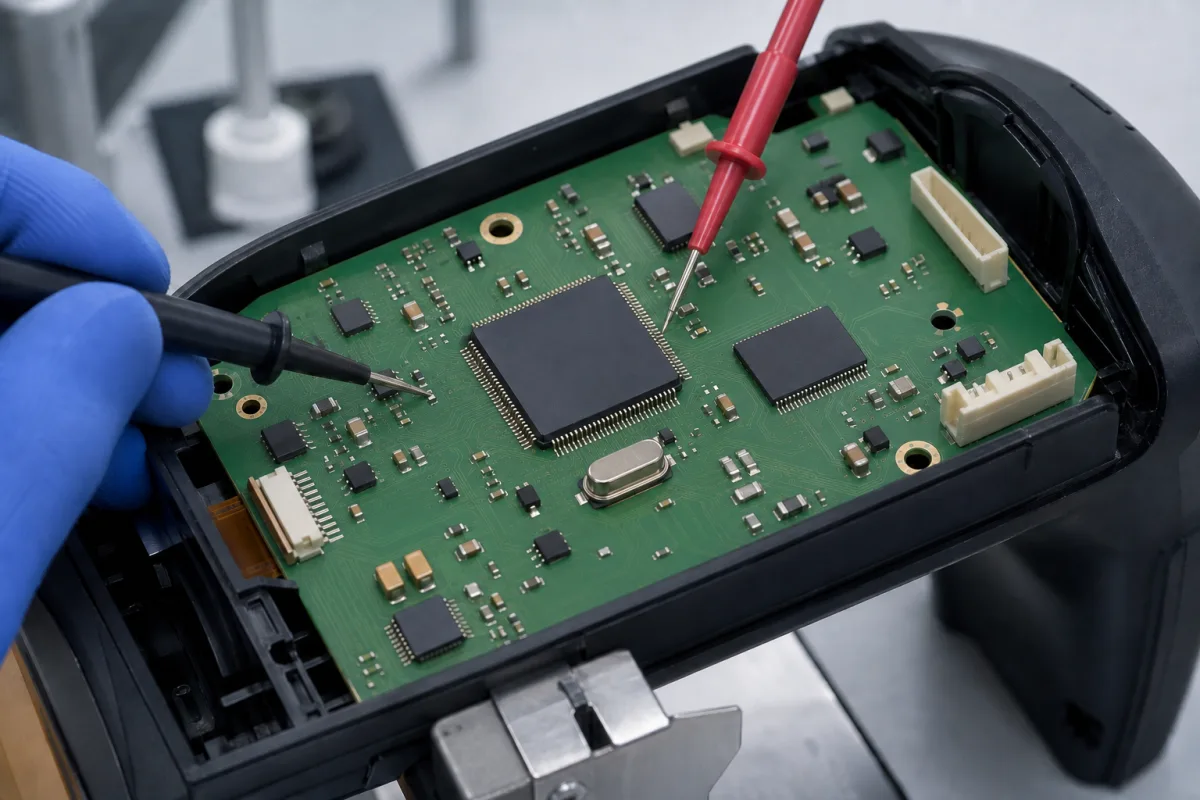
Representative product image. Confirm appearance and specifications with the manufacturer.

Product Specifications

Technical details and manufacturing context for Decoder Circuit

Definition
A decoder circuit is a specialized electronic component used within barcode and QR code scanners. Its primary function is to process the raw analog signal received from an image sensor or photodetector, converting the optical pattern into standardized digital data. The circuit conditions the incoming signal through amplification and filtering, then analyzes the pattern of light and dark bars (for barcodes) or the matrix pattern (for QR codes). It applies error correction algorithms, such as Reed-Solomon for QR codes, and outputs the encoded information as digital data (e.g., ASCII text, numbers) for transmission to a host system via interfaces like USB, RS-232, or keyboard wedge.

This component is part of the Computer, Electronic and Optical Product Manufacturing industry. It is typically implemented on a printed circuit board (PCB) using materials such as silicon (for integrated circuits), FR-4 (for the PCB substrate), copper (for traces), and solder. The circuit operates within specified electrical and environmental parameters, including a supply voltage of 3.3–5 V DC, an operating temperature range of -20 to 70 °C, and a storage temperature range of -40 to 85 °C. It supports input signal frequencies up to 10 MHz and output data rates between 1 and 12 Mbps, depending on the interface. Under ideal conditions, it achieves a decoding accuracy of 99.9%. Power consumption ranges from 0.5 to 1.5 W at a 3.3 V supply. The input and output voltage levels are 0–3.3 V, compatible with CMOS logic. The circuit operates in non-condensing humidity of 10–90% RH and provides ESD protection of ±2 kV (HBM model) per IEC 61000-4-2. The typical PCB footprint is 20×15 mm.

When selecting or verifying a decoder circuit, it is essential to confirm model-specific values and standards with the legal manufacturer or supplier, as the listed parameters are reference ranges for directory purposes. The circuit's performance may vary based on the specific scanner design and application conditions.
Working Principle
The decoder circuit receives an analog waveform representing the scanned optical pattern. It first conditions the signal through amplification and filtering. For barcodes, it measures the timing and width of pulses to distinguish bars and spaces according to the symbology specification (e.g., Code 128, UPC). For QR codes, it locates finder patterns, aligns the image, samples data modules, and performs Reed-Solomon error correction. The decoded data is then formatted and sent via a digital interface such as USB, RS-232, or keyboard wedge.
Common Materials
Silicon (for integrated circuits), FR-4 (for PCB substrate), Copper (for traces), Solder
Technical Parameters
ParameterTypical rangeNotes & selection driver
Supply Voltage3.3–5 V DCLogic levels compatible with TTL/CMOS
Operating Temperature-20–70 °CExtended range available for industrial use
Storage Temperature-40–85 °CNon-condensing environment
Input Signal Frequency0–10 MHzMaximum scan rate supported
Output Data Rate1–12 MbpsDepends on interface (UART, USB, etc.)
Decoding Accuracy99.9 %Under ideal conditions
Power Consumption0.5–1.5 WAt 3.3V supply
Input Voltage Range0–3.3 VFor digital input signals
Output Voltage Level0–3.3 VCMOS logic levels
Humidity Range10–90 % RHNon-condensing
ESD Protection±2 kVHBM modelIEC 61000-4-2
PCB Size20×15 mmTypical footprint

Ranges are indicative industry figures for RFQ preparation, not a supplier commitment. Confirm every value and standard with the legal manufacturer before ordering.

Components / BOM
  • Decoder IC / Microcontroller
    Core processing unit that executes the decoding algorithms and manages data flow.
    Material: Silicon
  • PCB (Printed Circuit Board) Part
    Provides mechanical support and electrical connections between all circuit elements.
    Material: FR-4 with copper traces
  • Signal Conditioning Circuit
    Amplifies and filters the analog input signal from the sensor for clean digital processing.
    Material: Operational amplifiers, resistors, capacitors
  • Interface Connector Part
    Physical port for power input and data output to the host system.
    Material: Plastic, metal contacts

Applied To / Applications

This component is essential for the following industrial systems and equipment:

Industrial Ecosystem & Supply Chain Structure

Complementary Systems
Downstream Applications
Specialized Tooling

Application Fit & Sizing Matrix

Operational Limits
pressure: N/A (non-pressure application)
other spec: Scanning distance: 5-50 cm, Decoding speed: ≤100 ms per code
temperature: -20°C to +70°C (operating), -40°C to +85°C (storage)
Media Compatibility
✓ Packaging lines (cardboard/plastic labels) ✓ Inventory management systems (paper labels) ✓ Electronic assembly tracking (PCB markings)
Unsuitable: High-vibration industrial environments (e.g., heavy machinery)
Sizing Data Required
  • Required barcode/QR code symbology types
  • Minimum readable code size (mm)
  • Maximum conveyor speed (m/s) for moving items

Reliability & Engineering Risk Analysis

Failure Mode & Root Cause
Signal Decoding Errors
Cause: Component degradation (e.g., capacitor aging, transistor drift) leading to incorrect voltage thresholds and timing mismatches in logic gates.
Overheating and Thermal Stress
Cause: Poor thermal management, excessive current draw, or ambient temperature extremes causing solder joint fatigue, semiconductor junction failure, or PCB delamination.
Maintenance Indicators
  • Intermittent or garbled output signals under normal operating conditions
  • Audible buzzing or high-pitched whine from components, or visible discoloration/swelling of capacitors/ICs
Engineering Tips
  • Implement periodic thermal imaging inspections to identify hot spots and ensure adequate cooling (e.g., heat sinks, forced air) for high-power components.
  • Use conformal coating on the PCB to protect against moisture, dust, and corrosive atmospheres, and maintain stable, clean power supply with proper filtering to reduce electrical stress.

Indicative industry ranges for design and RFQ preparation. Confirm the exact figures and applicable standard with the manufacturer before specifying.

Compliance & Manufacturing Standards

Applicable Standards
IEC 61000-6-2 - Electromagnetic Compatibility (EMC) UL 508 - Industrial Control Equipment Safety

Quoted from the published standard.

Manufacturing Precision
  • Component Placement: +/-0.1mm
  • Signal Timing: +/-5ns
Quality Inspection
  • Functional Testing - Signal Decoding Verification
  • Environmental Stress Screening (ESS) - Thermal Cycling

Manufacturers of Decoder Circuit

Manufacturer profiles associated with Decoder Circuit.

Sourcing Decoder Circuit from China?
Tell us your specification and target quantity — we will match it against manufacturer records and come back with the factories that fit.
Request manufacturers We manufacture this

Manufacturer listings support early research and capability understanding. They are not certification, ranking, or transaction guarantees.

Technical documentation
Request current drawings, revision history, and a signed specification sheet.
Manufacturing capability
Verify equipment lists, process limits, capacity, and representative production evidence.
Inspection readiness
Confirm test methods, calibrated equipment, sampling plans, and traceable reports.
Supplier transparency
Check the legal entity, factory address, ownership, certifications, and direct contacts.

CNFX does not score or rank suppliers. Buyers must verify all claims and documents with the legal manufacturer before ordering.

Supply Chain Compatible Machinery & Devices

Industrial IoT Gateway

The Industrial IoT Gateway is a ruggedized edge computing device designed for industrial environments.

Explore Specs →
Modular Industrial Edge Computing Device

This modular industrial edge computing device is a ruggedized system designed for deployment in harsh industrial environments to perform real-time data processing, analytics, and control functions at the network edge.

Explore Specs →
Industrial Smart Camera Module

The Industrial Smart Camera Module is a compact, self-contained vision processing unit designed for integration into industrial machinery and production lines.

Explore Specs →
Surface Mount Resistor

Passive electronic component for current limiting and voltage division in circuits

Explore Specs →

Frequently Asked Questions

What is the primary function of a decoder circuit?

The decoder circuit processes the raw analog signal from a barcode or QR scanner's image sensor, converting the optical pattern into digital data. It conditions the signal, decodes the pattern according to the symbology, applies error correction, and outputs the data via a digital interface.

What are the typical supply voltage and operating temperature ranges?

The supply voltage is typically 3.3–5 V DC, and the operating temperature range is -20 to 70 °C. Storage temperature range is -40 to 85 °C. These are reference values; confirm with the manufacturer for the specific model.

How does the circuit handle error correction for QR codes?

For QR codes, the circuit locates finder patterns, aligns the image, samples data modules, and performs Reed-Solomon error correction to recover data even if the code is partially damaged or obscured.

What interfaces can the decoder circuit use to output data?

The circuit can output data via digital interfaces such as USB, RS-232, or keyboard wedge. The output data rate depends on the interface, typically ranging from 1 to 12 Mbps.

Data Basis

Editorial classification, named public sources where available, and source-reviewed manufacturer records.

Preliminary Technical Classification
This page supports structured research, RFQ preparation, and supplier evaluation. It does not replace buyer-led supplier qualification, standards review, or technical approval.
Buyer enquiry

Request manufacturing insight for Decoder Circuit

Ask for use case, specification boundaries, supplier type, and RFQ preparation information for this product.

Where it goes
Straight to the CNFX editorial desk, and to the manufacturer if this product is linked to a claimed profile. Nothing is broadcast to a supplier list.
Your details stay here
We do not sell or rent enquiry data, and we do not add you to a mailing list. Used only to answer this request.
No commission, no middleman
CNFX is a directory. We take no cut of any order and never negotiate on a supplier's behalf.
What we don't claim
A listing is not an endorsement. Qualify every supplier and verify every figure yourself before ordering.

Your business information is used only to process this request.

Thank you! Your message has been sent. We'll respond within 1–3 business days.
Sorry, we couldn't send your message. Please try again, or email us at contact@cnfx.com.

Need to Manufacture Decoder Circuit?

Compare manufacturer profiles with relevant product and process capability.

Previous Product
Data Acquisition Unit (DAU)
Next Product
Delay line
Get QuotesChat