Industry-Verified Manufacturing Data (2026)

Digital Signal Processor (DSP)

Based on aggregated insights from multiple verified factory profiles within the CNFX directory, the standard Digital Signal Processor (DSP) used in the Computer, Electronic and Optical Product Manufacturing sector typically supports operational capacities ranging from standard industrial configurations to heavy-duty production requirements.

Technical Definition & Core Assembly

A canonical Digital Signal Processor (DSP) is characterized by the integration of Arithmetic Logic Unit (ALU) and Multiplier-Accumulator (MAC). In industrial production environments, manufacturers listed on CNFX commonly emphasize Silicon construction to support stable, high-cycle operation across diverse manufacturing scenarios.

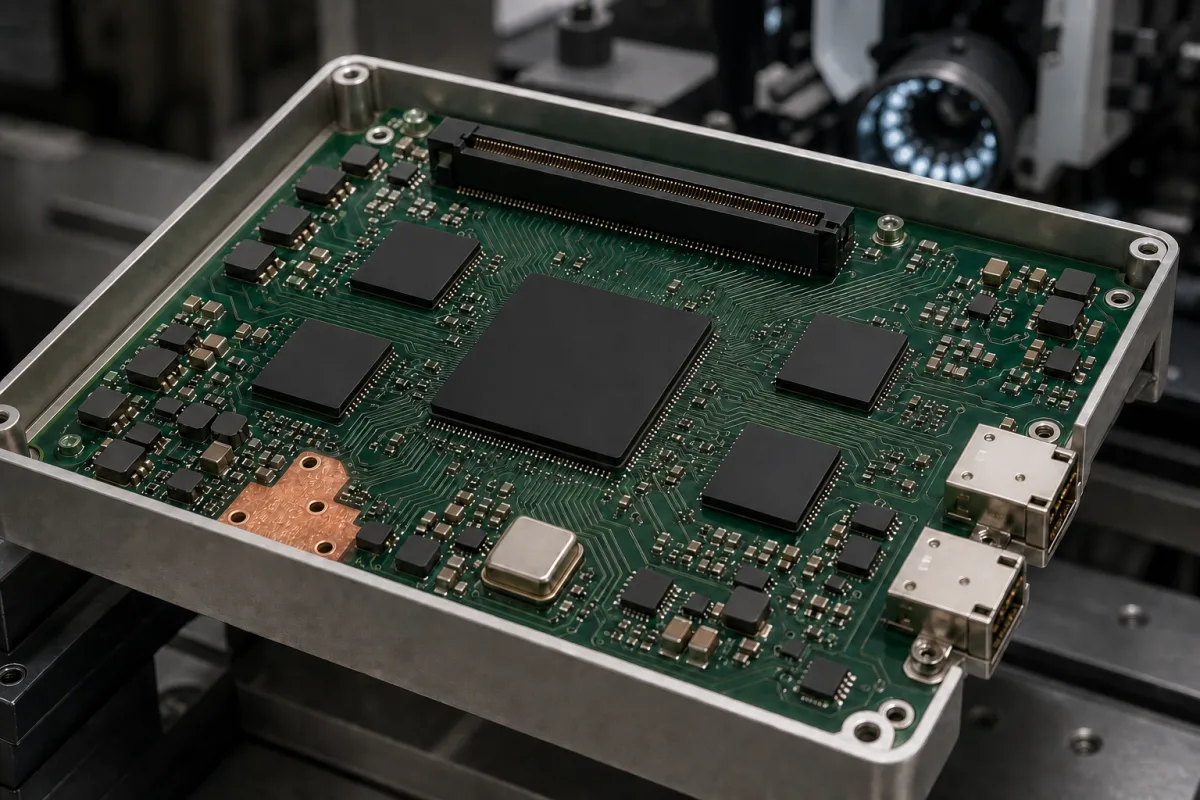
A specialized microprocessor optimized for real-time digital signal processing operations.
Product Specifications

Technical details and manufacturing context for Digital Signal Processor (DSP)

Definition
A Digital Signal Processor (DSP) is a specialized microprocessor chip designed to perform high-speed, numerically intensive calculations on digitized signals. As a core part of Signal Processing Circuitry, it executes algorithms for filtering, compression, modulation, and analysis of audio, video, sensor, and communication signals with high efficiency and low latency.
Working Principle
The DSP receives analog signals converted to digital data via an ADC. It processes this data stream using optimized arithmetic logic units (ALUs), hardware multipliers, and specialized instruction sets to execute signal processing algorithms (e.g., FFT, FIR filters) in real-time. Processed digital data can then be output directly or converted back to analog via a DAC.
Common Materials
Silicon
Technical Parameters
  • Clock speed indicating the processor's operational frequency. (MHz) Standard Spec
Components / BOM
  • Arithmetic Logic Unit (ALU)
    Performs mathematical and logical operations on data.
    Material: silicon
  • Multiplier-Accumulator (MAC)
    Specialized hardware for fast multiply-accumulate operations, core to DSP algorithms.
    Material: silicon
  • Program Memory
    Stores the firmware and processing algorithms for the DSP to execute.
    Material: silicon
  • Data Memory
    Holds the input, intermediate, and output signal data during processing.
    Material: silicon
Engineering Reasoning
0.9-1.2 V core voltage, -40°C to 125°C junction temperature, 100-1000 MHz clock frequency
1.35 V core voltage (electromigration threshold), 150°C junction temperature (silicon degradation point), 1.2 GHz clock frequency (timing violation limit)
Design Rationale: Electromigration at high current densities (Black's equation: MTF ∝ J⁻ⁿ exp(Eₐ/kT)), thermal runaway from power density exceeding 2.5 W/mm², dielectric breakdown at electric fields >10 MV/cm
Risk Mitigation (FMEA)
Trigger Latch-up from substrate injection exceeding 100 mA
Mode: Permanent short-circuit between power rails
Strategy: Guard rings with 5 μm spacing, epitaxial substrate with 10 Ω·cm resistivity
Trigger Clock jitter exceeding 50 ps RMS
Mode: Pipeline synchronization failure in multiply-accumulate units
Strategy: Phase-locked loop with 0.1% jitter attenuation, on-chip decoupling capacitors >100 pF/mm²

Industry Taxonomies & Aliases

Commonly used trade names and technical identifiers for Digital Signal Processor (DSP).

Applied To / Applications

This component is essential for the following industrial systems and equipment:

Industrial Ecosystem & Supply Chain DNA

Complementary Systems
Downstream Applications
Specialized Tooling

Application Fit & Sizing Matrix

Operational Limits
pressure: N/A (solid-state semiconductor device)
other spec: Clock frequency: 100 MHz to 1.5 GHz typical, Power consumption: 0.5W to 15W typical, Operating voltage: 0.8V to 1.2V core, 3.3V I/O
temperature: -40°C to +85°C (industrial grade), -40°C to +125°C (extended automotive grade)
Media Compatibility
✓ Embedded control systems ✓ Audio/video processing equipment ✓ Telecommunications infrastructure
Unsuitable: High-radiation environments (e.g., space applications, nuclear facilities) without specialized hardening
Sizing Data Required
  • Required processing throughput (MIPS/MFLOPS)
  • Real-time latency constraints
  • Power budget and thermal dissipation limits

Reliability & Engineering Risk Analysis

Failure Mode & Root Cause
Thermal overstress
Cause: Excessive heat generation due to high processing loads, inadequate cooling, or ambient temperature extremes, leading to semiconductor degradation, solder joint fatigue, or thermal runaway.
Electrostatic discharge (ESD) damage
Cause: Accumulation and sudden discharge of static electricity during handling, installation, or operation, resulting in latent or catastrophic failure of sensitive integrated circuits and signal paths.
Maintenance Indicators
  • Intermittent or distorted output signals (e.g., audio artifacts, data corruption) indicating processing errors or clock instability
  • Unusual audible buzzing or high-pitched whine from the device, suggesting power supply issues or oscillator malfunction
Engineering Tips
  • Implement robust thermal management: Ensure adequate airflow, use heat sinks or active cooling, and monitor operating temperatures to prevent thermal cycling stress.
  • Enforce strict ESD protection protocols: Use grounded workstations, anti-static packaging, and proper handling procedures during all maintenance and installation activities.

Compliance & Manufacturing Standards

Reference Standards
ISO 9001:2015 - Quality Management Systems IEC 60747-14-1:2010 - Semiconductor devices - Digital integrated circuits CE Marking - EMC Directive 2014/30/EU
Manufacturing Precision
  • Clock Frequency Stability: +/- 50 ppm
  • Operating Temperature Range: -40°C to +85°C
Quality Inspection
  • Automated Optical Inspection (AOI) for solder joints and component placement
  • Functional Test with DSP-specific algorithms for signal processing accuracy

Factories Producing Digital Signal Processor (DSP)

Verified manufacturers with capability to produce this product in China

✓ 95% Supplier Capability Match Found

S Sourcing Manager from Brazil Feb 01, 2026
★★★★★
"The technical documentation for this Digital Signal Processor (DSP) is very thorough, especially regarding technical reliability."
Technical Specifications Verified
P Procurement Specialist from Canada Jan 29, 2026
★★★★☆
"Reliable performance in harsh Computer, Electronic and Optical Product Manufacturing environments. No issues with the Digital Signal Processor (DSP) so far. (Delivery took slightly longer than expected, but technical support was excellent.)"
Technical Specifications Verified
T Technical Director from United States Jan 26, 2026
★★★★★
"Testing the Digital Signal Processor (DSP) now; the technical reliability results are within 1% of the laboratory datasheet."
Technical Specifications Verified
Verification Protocol

“Feedback is collected from verified sourcing managers during RFQ (Request for Quote) and factory evaluation processes on CNFX. These reports represent historical performance data and technical audit summaries from our B2B manufacturing network.”

7 sourcing managers are analyzing this specification now. Last inquiry for Digital Signal Processor (DSP) from Mexico (15m ago).

Supply Chain Compatible Machinery & Devices

Modular Industrial Edge Computing Device

Rugged computing platform for industrial data processing at the network edge

Explore Specs →
Industrial Smart Camera Module

Embedded vision system for industrial automation and quality inspection.

Explore Specs →
Industrial Wireless Power Transfer Module

Wireless power transfer module for industrial equipment applications

Explore Specs →
Industrial Smart Sensor Module

Modular industrial sensor with embedded processing and wireless connectivity

Explore Specs →

Frequently Asked Questions

What makes a Digital Signal Processor different from a general-purpose microprocessor?

A DSP is specifically optimized for real-time mathematical operations like filtering and Fourier transforms, featuring dedicated hardware like Multiplier-Accumulator (MAC) units and efficient memory architectures, whereas general-purpose microprocessors handle broader computing tasks.

How does the silicon material affect DSP performance in electronic manufacturing?

Silicon provides excellent semiconductor properties for high-speed signal processing, enabling efficient integration of ALU, MAC, and memory components, which ensures reliability and performance in computer and optical product applications.

What are the key applications of DSPs in the optical product manufacturing industry?

DSPs are crucial for real-time image processing, signal filtering in optical sensors, and data compression in devices like cameras and medical imaging equipment, leveraging their optimized architecture for high-speed calculations.

Can I contact factories directly on CNFX?

CNFX is an open directory, not a transaction platform. Each factory profile provides direct contact information and production details to help you initiate direct inquiries with Chinese suppliers.

Get Quote for Digital Signal Processor (DSP)

Request technical pricing, lead times, or customized specifications for Digital Signal Processor (DSP) directly from verified manufacturing units.

Your business information is encrypted and only shared with verified Digital Signal Processor (DSP) suppliers.

Thank you! Your message has been sent. We'll respond within 1–3 business days.

Need to Manufacture Digital Signal Processor (DSP)?

Connect with verified factories specializing in this product category

Add Your Factory Contact Us
Previous Product
Digital Signal Processor
Next Product
Digital Signal Processor (DSP) / Microcontroller