Industry-Verified Manufacturing Data (2026)

Electrical Feedthroughs

Based on aggregated insights from multiple verified factory profiles within the CNFX directory, the standard Electrical Feedthroughs used in the Computer, Electronic and Optical Product Manufacturing sector typically supports operational capacities ranging from standard industrial configurations to heavy-duty production requirements.

Technical Definition & Core Assembly

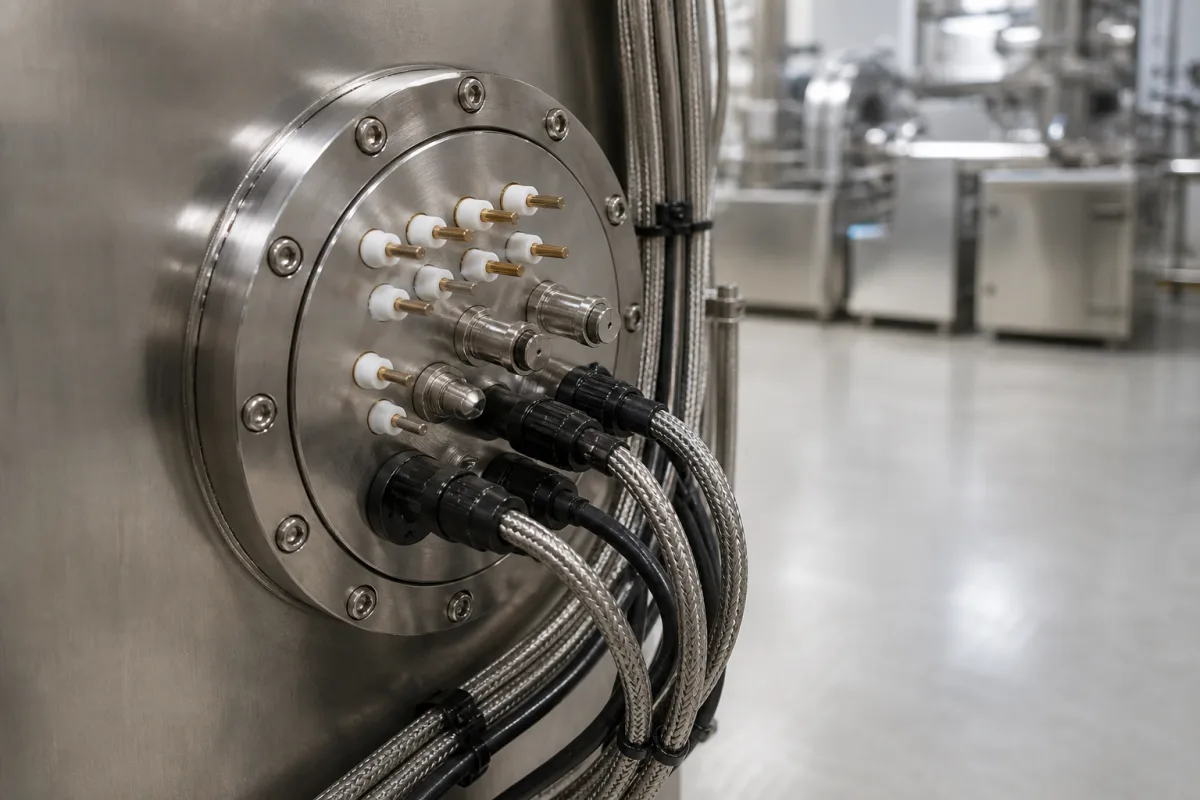
A canonical Electrical Feedthroughs is characterized by the integration of Conductor Pins and Insulation Seal. In industrial production environments, manufacturers listed on CNFX commonly emphasize Stainless steel (flange) construction to support stable, high-cycle operation across diverse manufacturing scenarios.

Specialized vacuum-tight connectors that allow electrical power and signals to pass through the chamber wall while maintaining vacuum integrity.

Product Specifications

Technical details and manufacturing context for Electrical Feedthroughs

Definition
Electrical feedthroughs are critical components in vacuum processing chambers that enable the transmission of electrical power, signals, and data from external sources to internal devices (such as heaters, sensors, or electrodes) while maintaining the chamber's vacuum seal. They prevent gas leakage and contamination, ensuring stable vacuum conditions for processes like semiconductor manufacturing, thin-film deposition, and surface analysis.
Working Principle
Electrical feedthroughs use hermetic sealing techniques (e.g., glass-to-metal or ceramic-to-metal seals) around conductive pins or cables. The seal material is fused to both the conductor and the chamber flange, creating a vacuum-tight barrier. Electrical insulation between conductors and the chamber wall is maintained via dielectric materials, while mechanical strength withstands pressure differentials.
Common Materials
Stainless steel (flange), Copper or alloy conductors, Glass or ceramic insulation, Kovar or nickel-iron alloys (for matched thermal expansion)
Technical Parameters
  • Flange diameter or standard size (e.g., CF, ISO-K) (mm) Per Request
Components / BOM
  • Conductor Pins
    Transmit electrical current or signals through the feedthrough
    Material: Copper, nickel-plated copper, or stainless steel
  • Insulation Seal
    Provide electrical insulation and vacuum seal between conductors and flange
    Material: Glass, ceramic (alumina), or epoxy
  • Mounting Flange
    Interface for welding or bolting to the vacuum chamber wall
    Material: Stainless steel (304, 316)
Engineering Reasoning
1e-9 to 1e-3 mbar (ultra-high vacuum to rough vacuum), -40 to 200°C
Leak rate exceeding 1e-9 mbar·L/s (helium leak test threshold), dielectric breakdown at 15 kV/mm for alumina insulators
Design Rationale: Thermal expansion mismatch between metal flange (CTE ~17 μm/m·K for 304 stainless steel) and ceramic insulator (CTE ~7 μm/m·K for alumina) causing microcrack formation at 150°C differential
Risk Mitigation (FMEA)
Trigger Voltage transient exceeding 25 kV for 100 μs
Mode: Dielectric breakdown through alumina insulator creating conductive carbon track
Strategy: Integrate gas-filled spark gap protection with 20 kV breakdown rating in feedthrough design
Trigger Cyclic thermal stress from 100°C temperature swings at 0.1 Hz frequency
Mode: Metal-ceramic braze joint fatigue crack propagation reaching 0.5 mm length
Strategy: Implement graded CTE transition layers using kovar alloy (CTE 5.5 μm/m·K) between stainless steel and alumina

Industry Taxonomies & Aliases

Commonly used trade names and technical identifiers for Electrical Feedthroughs.

Applied To / Applications

This component is essential for the following industrial systems and equipment:

Industrial Ecosystem & Supply Chain DNA

Complementary Systems
Downstream Applications
Specialized Tooling

Application Fit & Sizing Matrix

Operational Limits
pressure: High vacuum (10^-9 mbar) to 100 bar (depending on design)
other spec: Voltage rating: 1-100 kV, Current rating: 1-1000 A, Leak rate: <10^-9 mbar·l/s
temperature: -200°C to +450°C (typical), up to +1000°C with special materials
Media Compatibility
✓ High vacuum environments ✓ Plasma processing chambers ✓ Semiconductor fabrication equipment
Unsuitable: High-pressure water or steam environments (>100 bar with thermal cycling)
Sizing Data Required
  • Number and type of electrical connections required
  • Operating pressure differential across the feedthrough
  • Maximum voltage and current requirements

Reliability & Engineering Risk Analysis

Failure Mode & Root Cause
Electrical tracking/arcing
Cause: Contamination buildup (dust, moisture, oil) on insulating surfaces creating conductive paths, leading to insulation breakdown and short circuits.
Seal degradation/leakage
Cause: Thermal cycling, chemical attack, or mechanical stress compromising gaskets/O-rings, resulting in loss of pressure integrity or environmental ingress.
Maintenance Indicators
  • Visible discoloration, carbon tracking, or sparking around the feedthrough insulator during operation
  • Audible corona discharge, buzzing, or hissing sounds indicating partial discharge or arcing
Engineering Tips
  • Implement regular cleaning and inspection protocols using appropriate solvents to prevent contamination buildup on insulating surfaces
  • Ensure proper torque application during installation and use compatible sealing materials rated for the specific operating environment (temperature, pressure, chemicals)

Compliance & Manufacturing Standards

Reference Standards
IEC 60529 (IP Code for Ingress Protection) ANSI/UL 94 (Flammability of Plastic Materials) ISO 9001 (Quality Management Systems)
Manufacturing Precision
  • Bore Diameter: +/-0.05mm
  • Parallelism of Faces: 0.02mm
Quality Inspection
  • High Voltage Leakage Test (Dielectric Strength)
  • Helium Leak Test (Hermeticity)

Factories Producing Electrical Feedthroughs

Verified manufacturers with capability to produce this product in China

✓ 93% Supplier Capability Match Found

P Project Engineer from Germany Feb 18, 2026
★★★★★
"Testing the Electrical Feedthroughs now; the technical reliability results are within 1% of the laboratory datasheet."
Technical Specifications Verified
S Sourcing Manager from Brazil Feb 15, 2026
★★★★★
"Impressive build quality. Especially the technical reliability is very stable during long-term operation."
Technical Specifications Verified
P Procurement Specialist from Canada Feb 12, 2026
★★★★★
"As a professional in the Computer, Electronic and Optical Product Manufacturing sector, I confirm this Electrical Feedthroughs meets all ISO standards."
Technical Specifications Verified
Verification Protocol

“Feedback is collected from verified sourcing managers during RFQ (Request for Quote) and factory evaluation processes on CNFX. These reports represent historical performance data and technical audit summaries from our B2B manufacturing network.”

19 sourcing managers are analyzing this specification now. Last inquiry for Electrical Feedthroughs from USA (1h ago).

Supply Chain Compatible Machinery & Devices

Industrial Smart Camera Module

Embedded vision system for industrial automation and quality inspection.

Explore Specs →
Industrial Wireless Power Transfer Module

Wireless power transfer module for industrial equipment applications

Explore Specs →
Industrial Smart Sensor Module

Modular industrial sensor with embedded processing and wireless connectivity

Explore Specs →
Surface Mount Resistor

Passive electronic component for current limiting and voltage division in circuits

Explore Specs →

Frequently Asked Questions

What materials are used in electrical feedthroughs for optimal vacuum performance?

Our feedthroughs use stainless steel flanges for durability, copper or alloy conductors for conductivity, and glass or ceramic insulation to maintain vacuum integrity, with Kovar alloys for thermal expansion matching.

How do electrical feedthroughs maintain vacuum integrity in optical manufacturing chambers?

They create vacuum-tight seals using precisely engineered insulation materials like ceramic or glass between conductors and mounting flanges, preventing gas leakage while allowing electrical transmission.

What are the key components in an electrical feedthrough assembly?

The main components are conductor pins for power/signal transmission, insulation seals (ceramic/glass) for vacuum integrity, and mounting flanges (stainless steel) for secure chamber installation.

Can I contact factories directly on CNFX?

CNFX is an open directory, not a transaction platform. Each factory profile provides direct contact information and production details to help you initiate direct inquiries with Chinese suppliers.

Get Quote for Electrical Feedthroughs

Request technical pricing, lead times, or customized specifications for Electrical Feedthroughs directly from verified manufacturing units.

Your business information is encrypted and only shared with verified Electrical Feedthroughs suppliers.

Thank you! Your message has been sent. We'll respond within 1–3 business days.

Need to Manufacture Electrical Feedthroughs?

Connect with verified factories specializing in this product category

Add Your Factory Contact Us
Previous Product
Electrical Connection Head
Next Product
Electrical Test Fixture