Industry-Verified Manufacturing Data (2026)

Electrical Test Fixture/Probes

Based on aggregated insights from multiple verified factory profiles within the CNFX directory, the standard Electrical Test Fixture/Probes used in the Computer, Electronic and Optical Product Manufacturing sector typically supports operational capacities ranging from standard industrial configurations to heavy-duty production requirements.

Technical Definition & Core Assembly

A canonical Electrical Test Fixture/Probes is characterized by the integration of Probe Pin and Spring Mechanism. In industrial production environments, manufacturers listed on CNFX commonly emphasize Beryllium Copper construction to support stable, high-cycle operation across diverse manufacturing scenarios.

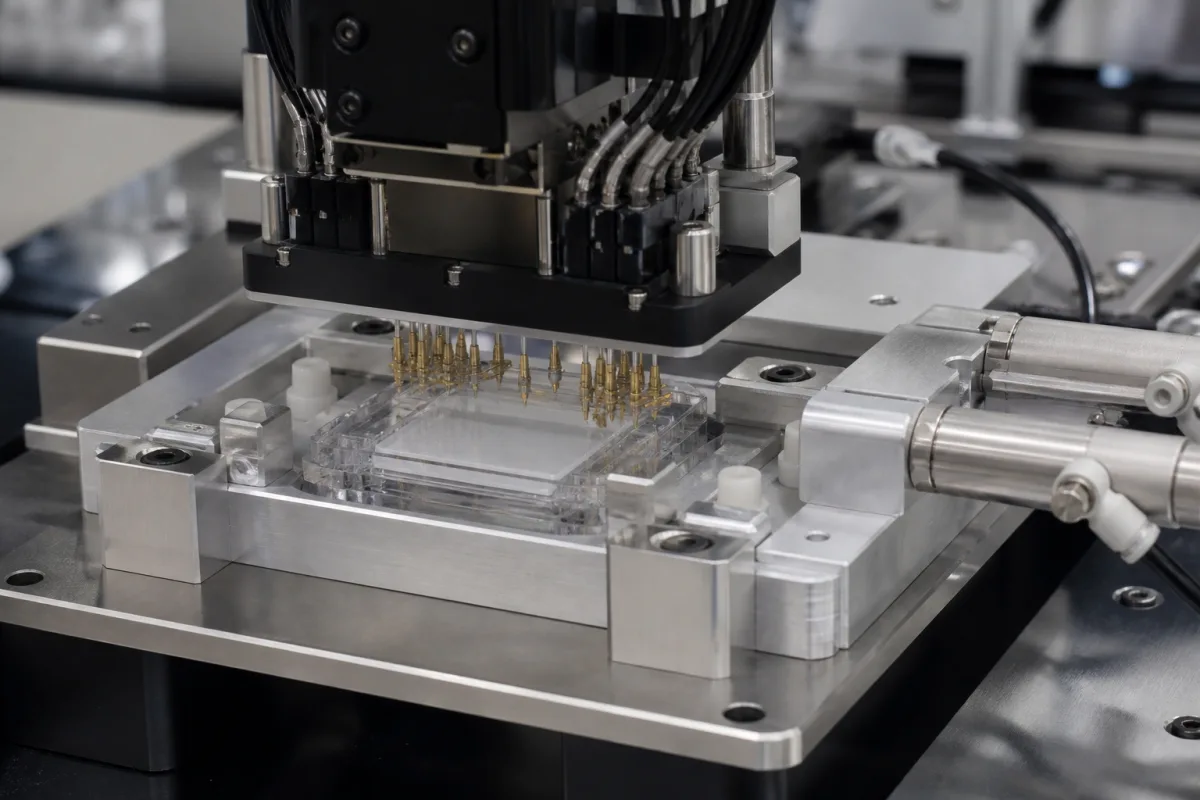
A precision interface component used to establish electrical contact with microfluidic chips or cell sorting cartridges for signal transmission and testing.
Product Specifications

Technical details and manufacturing context for Electrical Test Fixture/Probes

Definition
Within an Automated Cell Sorting Station, the Electrical Test Fixture/Probes serve as the critical interface for electrical connectivity. They physically and electrically connect the station's control and analysis systems to the disposable microfluidic chip or cartridge that contains the cell sample. This enables the application of electrical signals for cell manipulation (e.g., dielectrophoresis) and the measurement of impedance or other electrical properties for cell identification and sorting validation.
Working Principle
The fixture precisely aligns and holds a microfluidic chip. Spring-loaded or micromanipulated conductive probes (often made of gold-plated tungsten or beryllium copper) extend from the fixture to make contact with specific electrode pads on the chip. This creates a closed electrical circuit, allowing the station to deliver controlled voltages/currents for cell actuation and to receive sensor feedback signals from the chip.
Common Materials
Beryllium Copper, Gold-Plated Tungsten, PEEK (Polyether Ether Ketone), Stainless Steel
Technical Parameters
  • Number of independent probe channels/contacts, typically matching the electrode layout on the target microfluidic chip. (count) Customizable
Components / BOM
  • Probe Pin
    The conductive needle that makes physical and electrical contact with the chip's electrode pad.
    Material: Gold-Plated Tungsten or Beryllium Copper
  • Spring Mechanism
    Provides the compliant force behind each probe pin to maintain consistent contact pressure and compensate for minor surface variations.
    Material: Stainless Steel
  • Guide Plate
    A precision-machined plate with holes that align and guide each probe pin, ensuring accurate positioning.
    Material: PEEK or Ceramic
  • Fixture Body/Housing
    The main structural frame that holds all components, provides mounting points to the sorter, and houses electrical connectors.
    Material: Aluminum or Stainless Steel
Engineering Reasoning
0.1-10 N contact force, 0.5-5.0 mm probe travel, 1-1000 Hz test frequency
Contact resistance exceeding 50 mΩ, probe tip wear exceeding 50 μm, spring force degradation below 0.05 N
Design Rationale: Electrochemical migration at probe-chip interface due to galvanic potential differences exceeding 0.25 V, fretting corrosion at contact points under cyclic loading above 10⁶ cycles, plastic deformation of probe tips under contact forces exceeding 12 N
Risk Mitigation (FMEA)
Trigger Electrostatic discharge exceeding 500 V during handling
Mode: Dielectric breakdown of probe insulation causing short circuits
Strategy: Integrated spark gap protection with 200 V breakdown voltage, conductive polymer shielding with surface resistivity <10⁴ Ω/sq
Trigger Mechanical misalignment exceeding 25 μm during cartridge insertion
Mode: Scoring of gold-plated contact surfaces increasing resistance to >100 mΩ
Strategy: Self-aligning kinematic coupling with ±5 μm repeatability, diamond-like carbon coating with hardness >20 GPa

Industry Taxonomies & Aliases

Commonly used trade names and technical identifiers for Electrical Test Fixture/Probes.

Applied To / Applications

This component is essential for the following industrial systems and equipment:

Industrial Ecosystem & Supply Chain DNA

Complementary Systems
Downstream Applications
Specialized Tooling

Application Fit & Sizing Matrix

Operational Limits
pressure: 0 to 30 psi
other spec: Contact resistance < 50 mΩ, Signal frequency up to 1 GHz
temperature: -20°C to +85°C
Media Compatibility
✓ Aqueous buffers (PBS, saline) ✓ Cell culture media ✓ Non-corrosive biological fluids
Unsuitable: Corrosive chemicals (strong acids/bases, organic solvents)
Sizing Data Required
  • Number of electrical contacts required
  • Target device footprint/dimensions
  • Required signal type (DC, AC, RF) and bandwidth

Reliability & Engineering Risk Analysis

Failure Mode & Root Cause
Contact Resistance Degradation
Cause: Oxidation, contamination, or wear on probe tips due to repeated use, environmental exposure, or improper cleaning, leading to poor electrical contact and inaccurate measurements.
Mechanical Fatigue or Breakage
Cause: Repeated mechanical stress from insertion/retraction cycles, misalignment, or over-torquing, resulting in bent, cracked, or broken probe components.
Maintenance Indicators
  • Inconsistent or fluctuating electrical readings during testing, indicating poor probe contact or internal damage.
  • Visible physical damage such as bent probe tips, cracks in insulation, or loose connections.
Engineering Tips
  • Implement regular cleaning and inspection protocols using appropriate solvents and tools to remove contaminants and check for wear or damage.
  • Use proper alignment fixtures and controlled insertion force to minimize mechanical stress, and calibrate probes periodically to ensure accuracy.

Compliance & Manufacturing Standards

Reference Standards
ISO 9001:2015 - Quality management systems ANSI/ESD S20.20 - Electrostatic discharge control DIN EN 61010-1 - Safety requirements for electrical equipment
Manufacturing Precision
  • Probe tip diameter: +/-0.01mm
  • Contact resistance variation: +/-5% of nominal value
Quality Inspection
  • Electrical continuity and insulation resistance test
  • Dimensional verification with coordinate measuring machine (CMM)

Factories Producing Electrical Test Fixture/Probes

Verified manufacturers with capability to produce this product in China

✓ 93% Supplier Capability Match Found

S Sourcing Manager from Germany Feb 05, 2026
★★★★★
"Reliable performance in harsh Computer, Electronic and Optical Product Manufacturing environments. No issues with the Electrical Test Fixture/Probes so far."
Technical Specifications Verified
P Procurement Specialist from Brazil Feb 02, 2026
★★★★☆
"Testing the Electrical Test Fixture/Probes now; the technical reliability results are within 1% of the laboratory datasheet. (Delivery took slightly longer than expected, but technical support was excellent.)"
Technical Specifications Verified
T Technical Director from Canada Jan 30, 2026
★★★★★
"Impressive build quality. Especially the technical reliability is very stable during long-term operation."
Technical Specifications Verified
Verification Protocol

“Feedback is collected from verified sourcing managers during RFQ (Request for Quote) and factory evaluation processes on CNFX. These reports represent historical performance data and technical audit summaries from our B2B manufacturing network.”

5 sourcing managers are analyzing this specification now. Last inquiry for Electrical Test Fixture/Probes from India (24m ago).

Supply Chain Compatible Machinery & Devices

Industrial IoT Gateway

Edge computing device connecting industrial equipment to cloud platforms.

Explore Specs →
Modular Industrial Edge Computing Device

Rugged computing platform for industrial data processing at the network edge

Explore Specs →
Industrial Smart Camera Module

Embedded vision system for industrial automation and quality inspection.

Explore Specs →
Industrial Wireless Power Transfer Module

Wireless power transfer module for industrial equipment applications

Explore Specs →

Frequently Asked Questions

What materials are used in these electrical test fixtures and probes?

Our test fixtures and probes are constructed from high-performance materials including Beryllium Copper for spring mechanisms, Gold-Plated Tungsten for probe pins, PEEK (Polyether Ether Ketone) for insulation, and Stainless Steel for durable housings and guide plates.

How do these test fixtures interface with microfluidic chips and cell sorting cartridges?

The fixtures establish precise electrical contact through specialized probe pins that align with microfluidic chip or cartridge contact points, enabling accurate signal transmission for testing and validation in electronic and optical product manufacturing.

What components are included in the BOM for these electrical test fixtures?

The bill of materials includes Probe Pins for electrical contact, Spring Mechanisms for consistent pressure, Guide Plates for alignment, and Fixture Body/Housing for structural integrity and protection of internal components.

Can I contact factories directly on CNFX?

CNFX is an open directory, not a transaction platform. Each factory profile provides direct contact information and production details to help you initiate direct inquiries with Chinese suppliers.

Get Quote for Electrical Test Fixture/Probes

Request technical pricing, lead times, or customized specifications for Electrical Test Fixture/Probes directly from verified manufacturing units.

Your business information is encrypted and only shared with verified Electrical Test Fixture/Probes suppliers.

Thank you! Your message has been sent. We'll respond within 1–3 business days.

Need to Manufacture Electrical Test Fixture/Probes?

Connect with verified factories specializing in this product category

Add Your Factory Contact Us
Previous Product
Electrical Test Fixture
Next Product
Electrical Test Probe Array