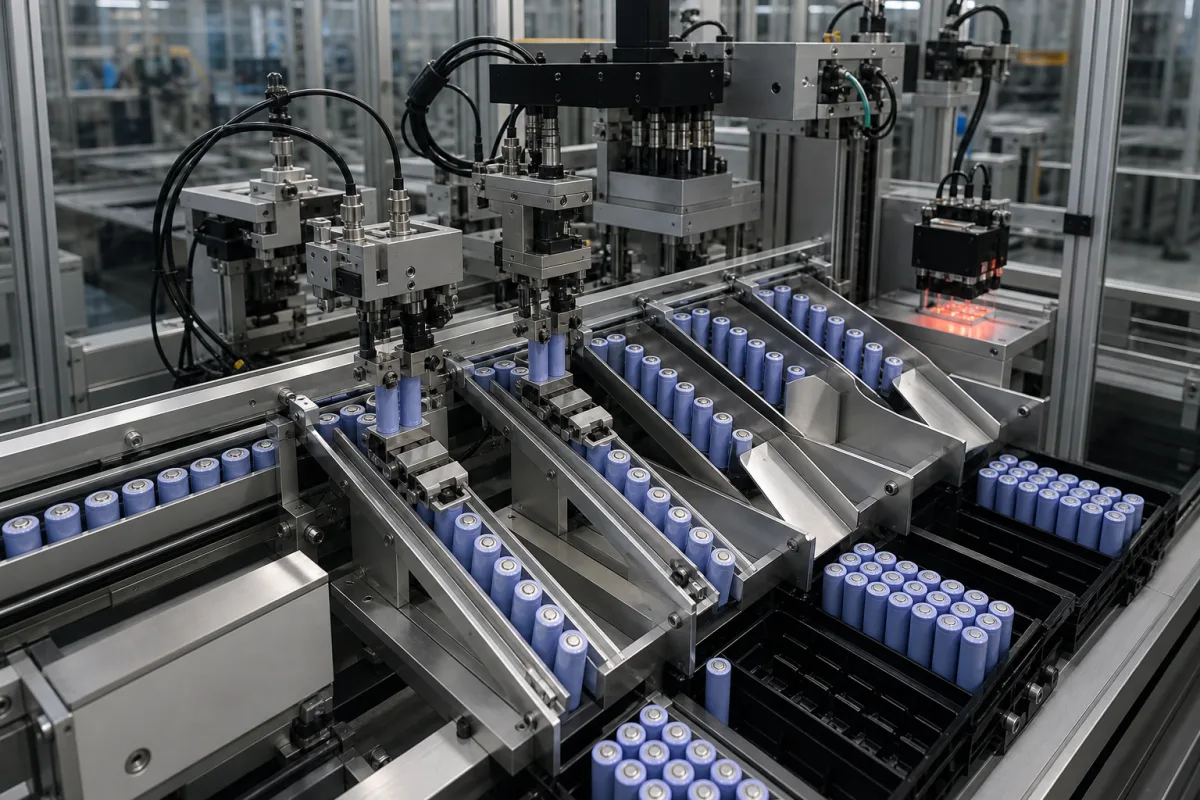
Battery cell sorting station (lithium-ion cell sorting machine)
Automated sorting and grading of lithium-ion cells before module and pack assembly · open-circuit voltage, AC and DC internal resistance and case-voltage testing, NG (reject) sorting, MES data links, and why cell-to-cell variation in capacity and temperature matters in packs
A cell sorting station takes lithium-ion cells from the formation and grading line, measures their electrical properties, and sorts them into grades or rejects them before they are built into modules and packs. Ask three things first: which cell format it must handle (prismatic, pouch or cylindrical), which measurements and grade limits it must apply, and what throughput and factory data system it must connect to.
Automated stations and machines that test and sort lithium-ion cells by open-circuit voltage, internal resistance and similar measurements, including reject (NG) sorters, as part of formation, grading and module assembly lines. Battery management systems, complete pack assembly lines and electrode-making machines have their own pages.
CNFX editorial research · Sources checked October 12, 2026 · 4 sources
Zocono (Shenzhen Zhijianeng Automation), a maker of formation and grading lines, describes back-end lines for prismatic aluminium-case, pouch and cylindrical lithium cells. They combine formation, grading, testing, sorting, stand-alone machines, logistics and software. [1]
Its OCV tester automatically loads cells, scans codes, and measures open-circuit voltage, AC internal resistance and case voltage. It then unloads the cells, and can read from and upload data to MES and WMS systems; the company lists capacity of ≥20 PPM, a ≥99.98% good rate and probe accuracy of ±0.015 mΩ. Its DCIR tester scans trays and measures DC internal resistance, storing and uploading the data; it lists ≥12 PPM, ±2 mV voltage accuracy and ±0.05% FS current accuracy. Its NG sorter reads cell information from each incoming tray and picks out defective cells automatically, listed at ≥6 PPM with ±0.05 mm repeat positioning accuracy. [1]
Zocono describes these machines as parts of a complete back-end line with logistics and software systems. Its DCIR tester consists of an automatic loading mechanism, a tray code-scanning mechanism and a DC internal resistance test mechanism, and the NG sorter works from trays whose cell information is read by scanning. Ask how cell identity is carried from formation and grading through to the sorter, so that each measurement stays linked to the right cell. [1]
Give the supplier the cell format and dimensions, the measurements and limits for each grade, the number of grades and reject bins, the throughput, the tray or conveyor interface upstream and downstream, the MES/WMS data format, and the accuracy you need for voltage and resistance.
02
Understand why cells are sorted
In a 2012 paper indexed by the US Department of Energy, Santhanagopalan and White write that reducing cell-to-cell and lot-to-lot variation has been identified as a major means to reduce the rejection rate when building packs and to improve pack durability. They propose using impedance spectroscopy to set quality-control specifications for cell components without imposing costly uniformity limits that have little effect on performance. [2]
Idaho National Laboratory and Penn State researchers note that the temperature and capacity of individual cells affect current distribution in a pack. Uneven current among parallel-connected cells can lead to capacity imbalance and premature aging. In their test of three parallel lithium iron phosphate cells over 1,500 hybrid-vehicle cycles, holding the higher-capacity cells at 40 °C and the lower-capacity cell at 20 °C reduced capacity mismatch by 48%. [3]
A 2024 study by Stanford, Oak Ridge and SLAC researchers built a model of a 192-cell pack based on the first-generation (2012) Nissan Leaf, simulating the electrical, thermal and aging behaviour of every cell. It examined how a Gaussian (normal-distribution) initial cell-to-cell capacity variation affects pack voltage and module temperatures. It also examined how inserting cells with lower than nominal capacity affects the pack's ability to deliver energy over time. The authors also studied how parallel-connected cells can reduce the effects of cell-to-cell variation, at the expense of increased aging of the pack overall. [4]
These studies explain why buyers ask for cells to be measured and grouped before assembly; the grade limits themselves come from the cell and pack specification, not from the sorting machine. [2][4]
03
Tray handling, code scanning, probes and NG picking
Every row comes from Zocono's descriptions of its OCV tester, DCIR tester and NG sorter; code scanning is the part that keeps each measurement tied to the right cell.
Component
Role
Fix in the order
Loading and tray handling
Automatic loading and unloading of cells or trays. [1]
Cell format, measurement list and grade bins to agree before ordering
Grade limits are not in this table because, as the studies above note, they come from your cell and pack specification rather than from the sorting machine.
Explore company information and manufacturing capabilities, then discuss the scope of your project with a relevant supplier.
Share this page
Compiled and source-reviewed by the CNFX editorial team.
Each manufacturer above links to the page on that company's own website where the product is listed, with the date we checked it. How we source and review
· Page last updated 13 October 2026
Buyer questions
What does a cell sorting station measure?
One maker's OCV tester measures open-circuit voltage, AC internal resistance and case voltage, and its DCIR tester measures DC internal resistance; both upload data to MES. [1]
Why sort cells before building packs?
Researchers link lower cell-to-cell variation to fewer rejected packs and better durability, and show that capacity and temperature differences unbalance current in parallel cells. [2][3]
How does cell-to-cell variation affect a battery pack?
A 192-cell pack model showed effects of capacity variation on pack voltage, module temperatures and energy delivery over time; parallel connection reduced the effects at the cost of faster pack aging. [4]
Sources and what still needs a direct check
Sources checked 2026-10-12. The Zocono page is a maker's own product description (in Chinese). The three research records are summaries indexed by the DOE Office of Scientific and Technical Information.