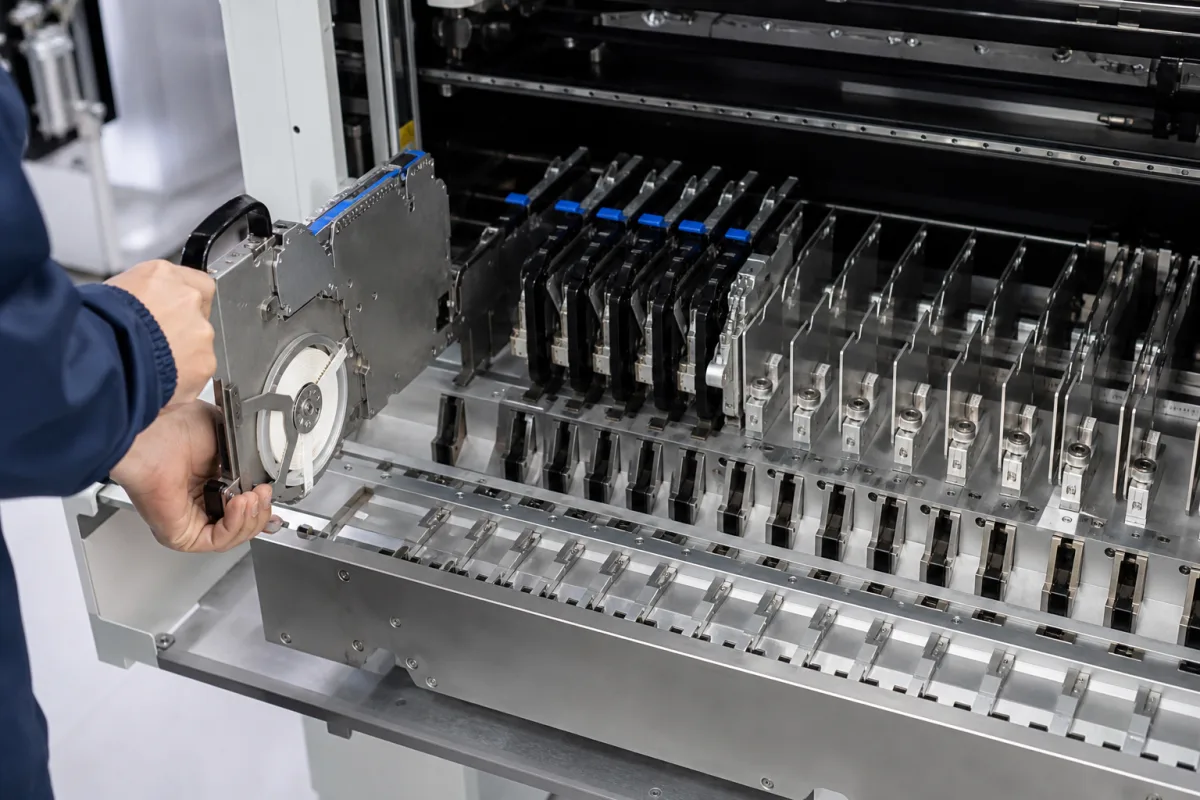
Feeder base for SMT placement machines (feeder bank and exchange cart)
SMT feeder base · the bank, plate or exchange cart that locates tape feeders on a pick-and-place machine: slot pitch, fixing pins, loaded weight and offline setup
A feeder base is the structure on or beside an SMT pick-and-place machine that holds a row of tape feeders in fixed slots and locates each one at its pick position. It may be a fixed bank on the machine, or a removable bank on an exchange cart that is loaded offline and docked as a whole at changeover. Ask three things first: which machine and feeder family the slots and fixing pins must fit, how many positions each feeder width takes, and how much the loaded bank weighs and how the cart lifts and locates it.
Feeder bases for SMT placement machines: fixed feeder banks and plates, removable component supply units, and the exchange carts or trolleys that carry them, with their slots, locating pins, guides and lifting gear. The tape feeders themselves are covered on the Component feeder (SMT tape feeder) page. Vibratory bowl feeder bases, stick and tray feeders, and the placement machine itself are outside this page.
CNFX editorial research · Sources checked October 12, 2026 · 3 sources
Size the bank and cart for loaded weight and docking
Panasonic's US patent 7,066,704 (filed by Matsushita, priority 1999) describes a cart for changing a whole component supply unit on a placement machine. It states that large reels had raised the weight of a single cassette to 3 kg or 5 kg, that the number of cassettes on one component supply unit had increased to 20 or 30, and that the unit therefore needs the rigidity to carry 50 kg to as much as 200 kg in total. [1]
In the patent's prior-art cart, an operator works a lift pedal on the base frame that drives a hydraulic jack to raise the holder with the supply unit, rolls the cart forward until U-shaped slots on the unit engage locating pins on the machine's fixing device, then lowers it. The claimed design instead uses a positioning pin that fits into a V-shaped slot on the supply unit, so that pushing the unit in a single direction positions it in two directions. [1]
Editorial calculation: 30 cassettes at 5 kg each is 150 kg of feeders alone (30 × 5 kg), inside the patent's 50–200 kg range for a loaded unit; ask the supplier for the rated load of the bank and of the cart lift, not only the empty weight. [1]
Give the supplier the placement machine model and feeder family, the number of slots, the feeder widths and mix, the loaded weight, whether the bank is fixed or exchanged on a cart, the locating and clamping method, the power and signal connection for electric feeders, and the floor and docking height.
02
Match the slots and fixing pins to the feeder widths
JUKI's electric and mechanical feeder brochure tables how many bank positions each feeder occupies. In its RF series, an 8 mm feeder occupies one position and a 56 mm feeder six, in the column headed 12 mm for RS-1 and RX-7 machines; in the column headed 17 mm for RX-6 and KE-3000 machines the same feeders occupy one and four. [2]
JUKI states that its dual-lane EF feeder holds two 8 mm reels in the space of a single 17 mm feeder, that EF feeders (other than EF72FS and EF88FS, for which it asks buyers to consult sales) and stick feeders used in the RF bank need a separate attachment, and that mechanical tape feeders come in one-fixing-pin or two-fixing-pin types to be selected for the feeder bank in use. [2]
For offline preparation, JUKI lists a feeder stocker storing up to 80 electric feeders (based on 8 mm size) and an electric trolley power station that powers electric feeders while they are off the machine. [2]
03
Compare fixed banks and exchange carts
Feeder bases differ in whether the feeders stay on the machine or arrive on a cart; the data below come from the cited documents.
Europlacer's announcement of its ii-Feed cart states that reels can be prepared offline in magazines for up to 11 references, that the cart receives three magazines, that elements can be placed at any trolley location without stopping production, and that previous and updated trolley generations can be used on the same machine. [3] Editorial calculation: three magazines of 11 references give 33, equal to the stated channel count (3 × 11 = 33). [3]
Up to 33 channels; 8, 12, 16 or 24 mm elements. [3]
04
Frame, slots, pins and lift: what a feeder base is built from
Each part below is tied to the source that describes it: the slots and fixing pins from JUKI's feeder tables, the locating pin, lift and loaded frame from the Panasonic exchange-cart patent.
Paste it into your enquiry below or into an email to a maker, then replace every bracket.
Machine: [model; feeder family]
Slots: [count; pitch; fixing-pin type]
Feeders: [widths and mix; electric or mechanical]
Load: [loaded weight]
Changeover: [fixed bank or exchange cart; lift; docking]
Connection: [power and signal for electric feeders]
Documents: [drawing; load rating]
Explore company information and manufacturing capabilities, then discuss the scope of your project with a relevant supplier.
Share this page
Compiled and source-reviewed by the CNFX editorial team.
Each manufacturer above links to the page on that company's own website where the product is listed, with the date we checked it. How we source and review
· Page last updated 13 October 2026
Buyer questions
How heavy is a loaded feeder bank?
Panasonic's US 7,066,704 describes units carrying 20 or 30 cassettes of 3 kg or 5 kg each and needing to withstand 50–200 kg in total. [1]
How many slots does a wide feeder take?
In JUKI's RF table an 8 mm feeder takes one position and a 56 mm feeder six (12 mm column) or four (17 mm column). [2]
How many channels can a feeder cart hold?
Europlacer lists its ii-Feed cart at up to 33 channels, taking any mix of 8, 12, 16 or 24 mm elements. [3]
Sources and what still needs a direct check
Sources checked 2026-10-12. The Panasonic patent describes an exchange cart and positioning mechanism; JUKI and Europlacer are placement machine makers describing their own feeders, banks and carts. Bank geometry differs by machine, so use the maker's drawing for the exact unit.