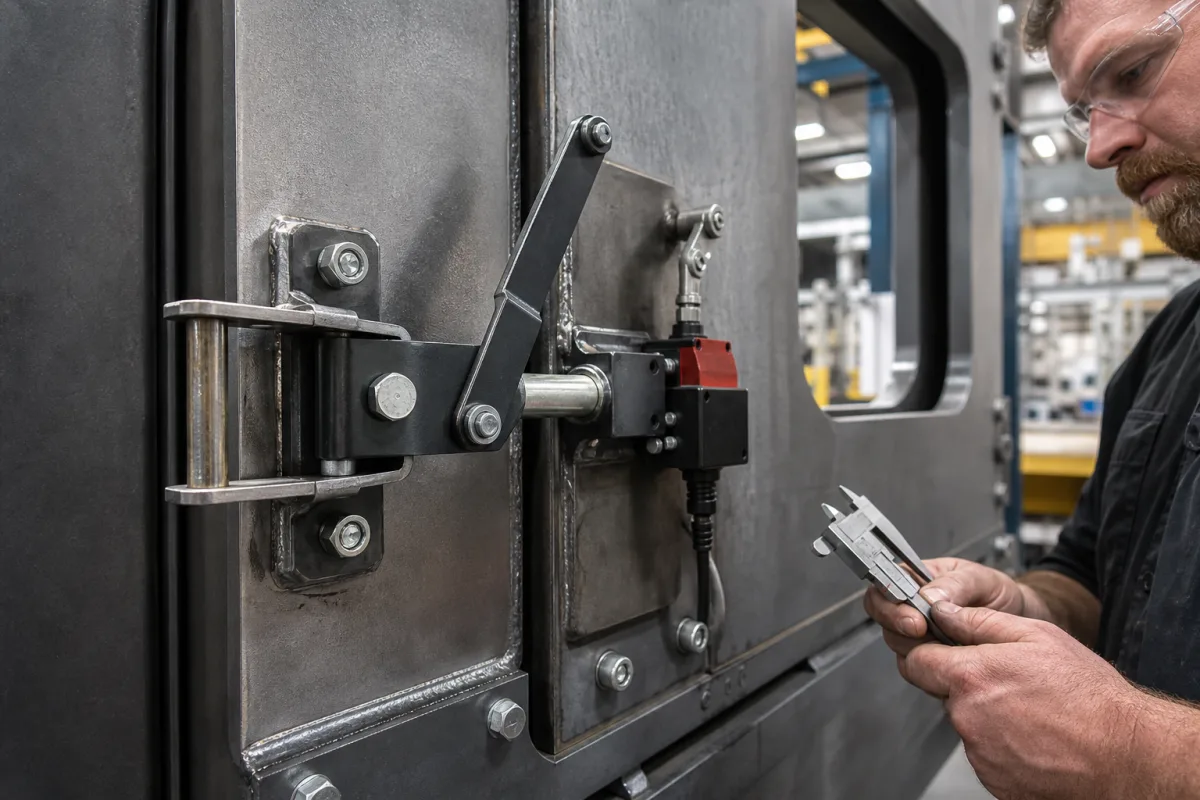
Locking mechanism for heavy machine doors: a bolt thrown into a guard-locking device, rated 7,500–10,000 N, and the padlock that keeps the bolt out while someone is inside
Bolt-type guard locking on heavy machine doors · holding force FZh against Fmax, handle-module derating, door gap and misalignment, lateral load on the bolt, padlocking the bolt out
In a bolt-type guard lock the part that holds a heavy steel door shut is a steel bolt, driven out of the locking device into an actuator or striker on the door and held there until the machine is safe to enter. This page covers that bolt: the force it is rated to hold, how much the door may be out of line before it jams, what loads shorten its life, and how a person going into the machine padlocks it so the door cannot be shut and locked behind them.
Bolt-type guard locking mechanisms (motor- or magnet-driven locking bolts, their strikers or actuators, door handle modules and lockout bars) on heavy hinged or sliding doors of machines, cells and test enclosures. Hinged perimeter-fence doors with their panels, hinges and escape releases are covered on the Hinged access door for machine guarding page, and tongue, coded non-contact and trapped-key interlock switches on the Safety interlock switch for machine guard doors page. Aluminium die-cast housings and parts, including connector housings, are covered on the Aluminium die casting page, and welded aluminium structural housings on the Aluminium shell page. Padlockable energy-isolating devices (disconnect switches, valves) are outside this page except where OSHA's definitions are quoted.
CNFX editorial research · Sources checked October 13, 2026 · 3 sources
10,000 N FZh against 13,000 N Fmax, and 3,000 N once a handle module carries the load
Two forces appear on a bolt lock's data sheet, and only one is the rating. Schmersal lists its AZM400 bistable, motor-driven bolt interlock with a holding force FZh of 10,000 N in accordance with EN ISO 14119 and a maximum holding force Fmax of 13,000 N. [1] Editorial calculation: Fmax is 1.3 times FZh; compare locks on FZh.
Pilz gives a safe holding force of up to 7,500 N for PSENmlock with its actuator, but 3,000 N on swing doors and 2,000 N on sliding doors when the door handle module, with its integrated actuator and escape release, is fitted. [2] Editorial calculation: with the handle module the rated holding force is 40% of the bare actuator figure on a swing door and about 27% on a sliding door, so the force to quote is the one for the parts actually fitted. The 30 N figure is listed separately as an integrated latching force; it is not one of the holding-force ratings. [2]
Both devices state PL e for interlocking and for guard locking: Schmersal gives PL e / Cat. 4 / SIL 3 for both functions, [1] Pilz safe interlocking and safe guard locking up to PL e / SIL 3. [2] Both lock bistably: the AZM400 is motor-driven, [1] and PSENmlock uses a bistable magnet so that the guard locking holds without voltage. [2]
State the force the door can see when locked (people pushing, a falling part, a pressure pulse) and whether a handle module transmits it; ask for FZh to EN ISO 14119 for that arrangement.
02
1 to 7 mm gap, 2° angle, ±3 mm vertical offset, and what 100 N of side load does to the bolt's life
A bolt has to find its hole every time the door closes, so the data sheet sets the window. Schmersal allows 1 to 7 mm between the AZM400 and its actuator and up to 2° angular misalignment; Pilz allows a maximum vertical offset of ±3 mm for PSENmlock, and offers a 10° actuator adapter for small doors of 300 to 500 mm. [1][2]
Side load on the bolt is the life-limiting case. Schmersal gives the AZM400 a minimum mechanical life of 1,000,000 operations, but 100,000 operations where the bolt sees a lateral force of 100 N; the bolt can still be withdrawn against a lateral force of up to 300 N on a locked door, a limit that does not apply to the emergency exit, Bowden cable or manual release. [1] Editorial calculation: 100 N of side load cuts the rated life to a tenth. A door locked and unlocked 200 times a day reaches 100,000 operations in 500 days, about 1.4 years, against about 13.7 years at 1,000,000.
The motor sets a cycle limit as well: Schmersal gives a minimum open/close cycle of 3 s, a minimum average cycle time of 20 s in continuous operation, a 600 mA peak for 100 ms while the bolt moves, and an ambient range of −20 to +55 °C. [1] Pilz gives 0 to 55 °C for PSENmlock and IP67. [2] Editorial calculation: a 20 s average cycle allows at most 180 lock–unlock cycles per hour in continuous operation, enough for a manned door but a constraint if an automatic door is locked every machine cycle.
Measure the door's sag and the gap between door and frame at the lock position when the door is pushed and pulled; if it falls outside 1–7 mm or ±3 mm, fix the hinges or striker before fitting the lock.
03
Padlocking the bolt out: Pilz's lockout bar for five locks, and where OSHA draws the line
A person who goes through the door into the machine needs to stop anyone from closing and locking it behind them. Pilz's PSENmlock door handle module has a lockout bar for up to five locks to prevent restart, a yellow outer handle that extends the actuator, and a red inner handle that works the escape release. [2]
Pilz notes a reset rule that follows from EN ISO 14119: on PSENmlock versions with automatic reset, an external emergency release cannot be used, because the emergency release must always be reset with a tool or another measure such as a power reset. [2]
A padlocked bolt is not lockout in OSHA's sense. 29 CFR 1910.147 defines an energy isolating device as a mechanical device that physically prevents the transmission or release of energy, such as a disconnect switch or line valve, and states that push buttons, selector switches and other control circuit type devices are not energy isolating devices; lockout means a lock placed on an energy isolating device. [3] Editorial note: a bolt lock reports to the safety controller and acts through the control circuit, so for servicing under the OSHA standard the energy isolating devices still have to be locked out, each authorized employee with a personal lock where a group lockout is used. [3]
OSHA also sets what a lock attachment must withstand: lockout devices must be substantial enough to prevent removal without excessive force or tools such as bolt cutters, and tagout attachment means must have a minimum unlocking strength of no less than 50 pounds. [3] Editorial calculation: 50 lb is about 222 N.
04
Data for a bolt-type door locking mechanism
Paste it into your enquiry below or into an email to a maker, then replace every bracket.
Door: [hinged or sliding; weight; leaf width; profile size]
Load on the locked door: [N, from people, parts or pressure]
Required FZh: [N to EN ISO 14119, for the parts fitted]
Alignment: [gap door to frame at the lock; sag; angular misalignment]
Operation rate: [lock–unlock cycles per day; continuous automatic cycling?]
Release: [manual release; escape release from inside; emergency release; reset by tool or power reset]
Lockout: [number of padlock positions on the handle or bolt]
Safety level: [PL / category / SIL for interlocking and for guard locking]
Environment: [temperature range; IP rating]
Explore company information and manufacturing capabilities, then discuss the scope of your project with a relevant supplier.
Share this page
Compiled and source-reviewed by the CNFX editorial team.
Each manufacturer above links to the page on that company's own website where the product is listed, with the date we checked it. How we source and review
· Page last updated 13 October 2026
Buyer questions
What holding force does a bolt-type guard lock have?
Schmersal rates the AZM400 at FZh 10,000 N (Fmax 13,000 N); Pilz rates PSENmlock at 7,500 N with its actuator. [1][2]
Does a door handle module change the holding force?
Yes. Pilz gives 3,000 N on swing doors and 2,000 N on sliding doors when the PSENmlock door handle module is fitted. [2]
How far out of line may the door be?
Schmersal allows a 1–7 mm gap and 2° angular misalignment for the AZM400; Pilz allows ±3 mm vertical offset for PSENmlock. [1][2]
What does side load do to the bolt?
Schmersal's minimum life of 1,000,000 operations drops to 100,000 with a 100 N lateral force on the bolt. [1]
Is padlocking the door bolt the same as lockout?
No. OSHA 29 CFR 1910.147 says control circuit type devices are not energy isolating devices, and lockout means a lock on an energy isolating device. [3]
Sources and what still needs a direct check
Sources checked 2026-10-13. Schmersal's product data for the AZM400Z-ST-1P2P solenoid interlock, Pilz's PSENmlock safety gate system presentation, and OSHA's control of hazardous energy standard, 29 CFR 1910.147, from eCFR.