Industry-Verified Manufacturing Data (2026)

Automated Component Feeder

Based on aggregated insights from multiple verified factory profiles within the CNFX directory, the standard Automated Component Feeder used in the Computer, Electronic and Optical Product Manufacturing sector typically supports operational capacities ranging from standard industrial configurations to heavy-duty production requirements.

Technical Definition & Core Assembly

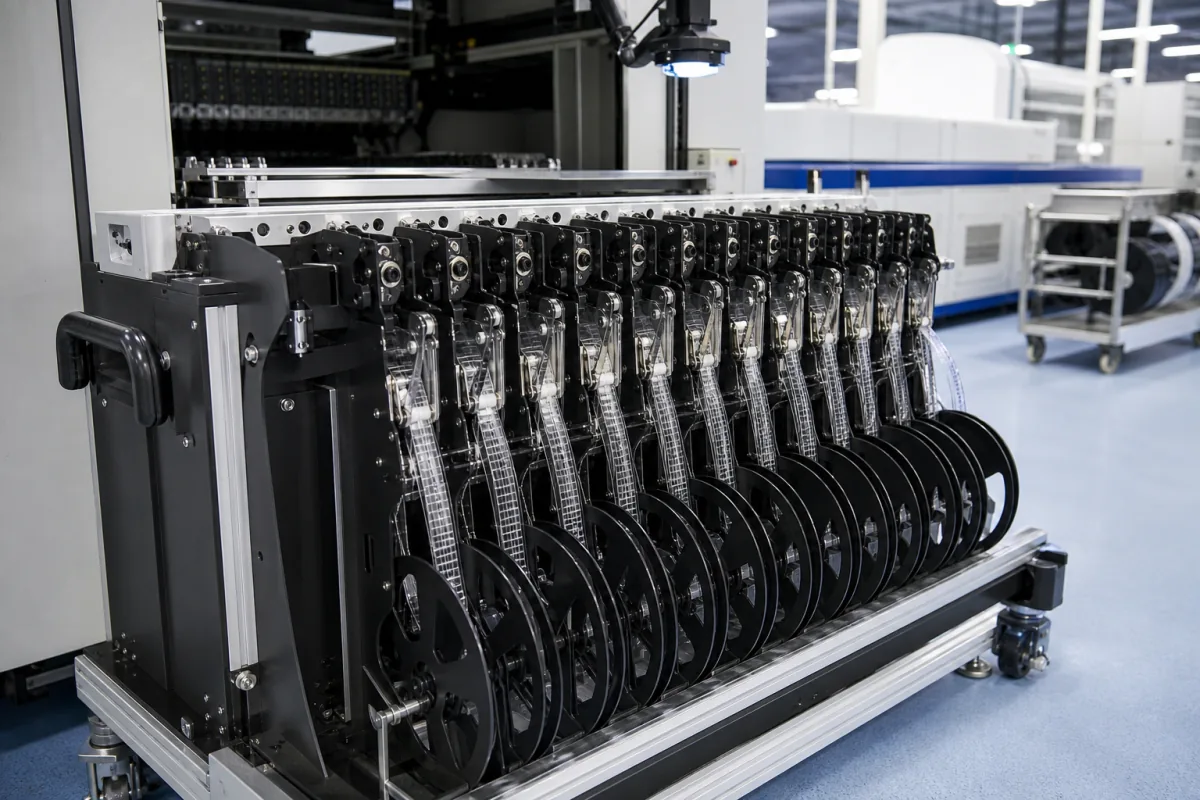
A canonical Automated Component Feeder is characterized by the integration of Tape Advance Mechanism and Cover Tape Peeler. In industrial production environments, manufacturers listed on CNFX commonly emphasize Aluminum alloy construction to support stable, high-cycle operation across diverse manufacturing scenarios.

A precision electromechanical device that automatically supplies electronic components to pick-and-place machines in PCB assembly lines.
Product Specifications

Technical details and manufacturing context for Automated Component Feeder

Definition
An automated component feeder is a critical subsystem within modular printed circuit board assembly systems that stores, organizes, and sequentially presents electronic components (such as resistors, capacitors, ICs, connectors) to robotic pick-and-place heads. It ensures continuous, reliable component supply during high-speed PCB assembly operations by managing component reels, trays, or sticks and feeding them to precise pickup positions with minimal human intervention.
Working Principle
The feeder uses a combination of mechanical indexing mechanisms (for tape-and-reel components), vibration systems (for bulk components), or robotic handling (for tray components) to advance components to a designated pickup location. Sensors detect component presence and orientation, while control systems coordinate with the main assembly machine to synchronize feeding cycles with pick-and-place operations.
Common Materials
Aluminum alloy, Stainless steel, Engineering plastics, Precision bearings
Technical Parameters
  • Component pitch (spacing between components on tape) (mm) Standard Spec
Components / BOM
  • Tape Advance Mechanism
    Precisely advances component carrier tape to present components at pickup position
    Material: Stainless steel
  • Cover Tape Peeler
    Removes protective cover tape from component carrier tape before component pickup
    Material: Engineering plastic
  • Component Sensor
    Detects presence and proper positioning of components at pickup location
    Material: Electronic components
  • Feeder Base
    Provides structural support and mounting interface to the assembly machine
    Material: Aluminum alloy
Engineering Reasoning
0.5-2.0 m/s feed velocity, 0.01-0.05 mm positioning accuracy, 0.1-1.0 N component contact force
Feed velocity exceeds 2.5 m/s causing component misalignment >0.1 mm, or contact force drops below 0.05 N causing component slippage
Design Rationale: Inertial overshoot at high velocities (Newton's First Law: F=ma) causing positional error beyond servo resolution, or insufficient static friction (μ<0.1) at low contact forces causing Coulomb friction failure
Risk Mitigation (FMEA)
Trigger Stepper motor microstepping resolution loss due to driver thermal drift exceeding 50°C
Mode: Positional accuracy degradation beyond 0.1 mm tolerance, causing pick-and-place misalignment
Strategy: Integrated Peltier cooling with PID control maintaining driver temperature at 25±2°C, plus optical encoder feedback with 0.001 mm resolution
Trigger Vibrational resonance at 120 Hz matching feeder structural natural frequency
Mode: Component tray oscillation amplitude exceeding 0.5 mm, causing feed jams and component damage
Strategy: Active vibration damping using piezoelectric actuators with 0-200 Hz frequency response, plus structural stiffening to shift natural frequency to 180 Hz

Industry Taxonomies & Aliases

Commonly used trade names and technical identifiers for Automated Component Feeder.

Industrial Ecosystem & Supply Chain DNA

Complementary Systems
Downstream Applications
Specialized Tooling

Application Fit & Sizing Matrix

Operational Limits
pressure: Atmospheric operation only, no pressurized media
other spec: Component size range: 0201 to 30mm, Feed rate: 10,000-60,000 components/hour, Vibration tolerance: <0.5g RMS
temperature: 15°C to 35°C (operating), 0°C to 50°C (storage)
Media Compatibility
✓ SMD resistors/capacitors (0201-1210) ✓ IC packages (QFP, BGA, SOIC) ✓ Passive components in tape-and-reel packaging
Unsuitable: Wet or corrosive environments (solder paste application areas)
Sizing Data Required
  • Maximum component feed rate required (components/hour)
  • Component size range (smallest to largest dimensions)
  • Required feeder bank capacity (number of component types simultaneously available)

Reliability & Engineering Risk Analysis

Failure Mode & Root Cause
Component jamming
Cause: Accumulation of debris, misaligned parts, or worn feed mechanisms causing irregular component flow
Sensor failure
Cause: Contamination from dust/oil, electrical interference, or mechanical damage disrupting component detection
Maintenance Indicators
  • Irregular feeding rhythm or audible skipping/grinding noises
  • Visible component misalignment or accumulation of debris around feed path
Engineering Tips
  • Implement regular cleaning schedules with compressed air and approved solvents to prevent debris buildup
  • Establish vibration analysis and thermal monitoring to detect early mechanical wear in feed mechanisms

Compliance & Manufacturing Standards

Reference Standards
ISO 12100:2010 - Safety of machinery ANSI B11.19 - Performance criteria for safeguarding CE Marking - Machinery Directive 2006/42/EC
Manufacturing Precision
  • Feeding accuracy: +/-0.05mm
  • Repeatability: +/-0.02mm
Quality Inspection
  • Functional safety test (EN ISO 13849-1)
  • Dimensional verification with CMM

Factories Producing Automated Component Feeder

Verified manufacturers with capability to produce this product in China

✓ 96% Supplier Capability Match Found

P Project Engineer from Australia Jan 05, 2026
★★★★★
"The technical documentation for this Automated Component Feeder is very thorough, especially regarding technical reliability."
Technical Specifications Verified
S Sourcing Manager from Singapore Jan 02, 2026
★★★★★
"Reliable performance in harsh Computer, Electronic and Optical Product Manufacturing environments. No issues with the Automated Component Feeder so far."
Technical Specifications Verified
P Procurement Specialist from Germany Dec 30, 2025
★★★★★
"Testing the Automated Component Feeder now; the technical reliability results are within 1% of the laboratory datasheet."
Technical Specifications Verified
Verification Protocol

“Feedback is collected from verified sourcing managers during RFQ (Request for Quote) and factory evaluation processes on CNFX. These reports represent historical performance data and technical audit summaries from our B2B manufacturing network.”

19 sourcing managers are analyzing this specification now. Last inquiry for Automated Component Feeder from Brazil (31m ago).

Supply Chain Compatible Machinery & Devices

Modular Industrial Edge Computing Device

Rugged computing platform for industrial data processing at the network edge

Explore Specs →
Industrial Smart Camera Module

Embedded vision system for industrial automation and quality inspection.

Explore Specs →
Industrial Wireless Power Transfer Module

Wireless power transfer module for industrial equipment applications

Explore Specs →
Industrial Smart Sensor Module

Modular industrial sensor with embedded processing and wireless connectivity

Explore Specs →

Frequently Asked Questions

What types of electronic components can this automated feeder handle?

This automated component feeder is designed to handle various surface-mount electronic components supplied in tape-and-reel packaging, including resistors, capacitors, ICs, and other SMD components commonly used in PCB assembly.

How does the cover tape peeler mechanism work in this feeder?

The cover tape peeler uses a precision mechanical system to gently lift and remove the protective cover tape from component carrier tapes, exposing components for pick-up by the placement machine while maintaining component orientation and preventing damage.

What maintenance is required for the automated component feeder?

Regular maintenance includes cleaning of the tape path, lubrication of precision bearings, inspection of the component sensor, and calibration of the tape advance mechanism to ensure consistent feeding accuracy and prevent production downtime.

Can I contact factories directly on CNFX?

CNFX is an open directory, not a transaction platform. Each factory profile provides direct contact information and production details to help you initiate direct inquiries with Chinese suppliers.

Get Quote for Automated Component Feeder

Request technical pricing, lead times, or customized specifications for Automated Component Feeder directly from verified manufacturing units.

Your business information is encrypted and only shared with verified Automated Component Feeder suppliers.

Thank you! Your message has been sent. We'll respond within 1–3 business days.

Need to Manufacture Automated Component Feeder?

Connect with verified factories specializing in this product category

Add Your Factory Contact Us
Previous Product
Automated Assembly Station
Next Product
Automated Computer Chassis Assembly System