Industry-Verified Manufacturing Data (2026)

High-Frequency RF Connector

Based on aggregated insights from multiple verified factory profiles within the CNFX directory, the standard High-Frequency RF Connector used in the Computer, Electronic and Optical Product Manufacturing sector typically supports operational capacities ranging from standard industrial configurations to heavy-duty production requirements.

Technical Definition & Core Assembly

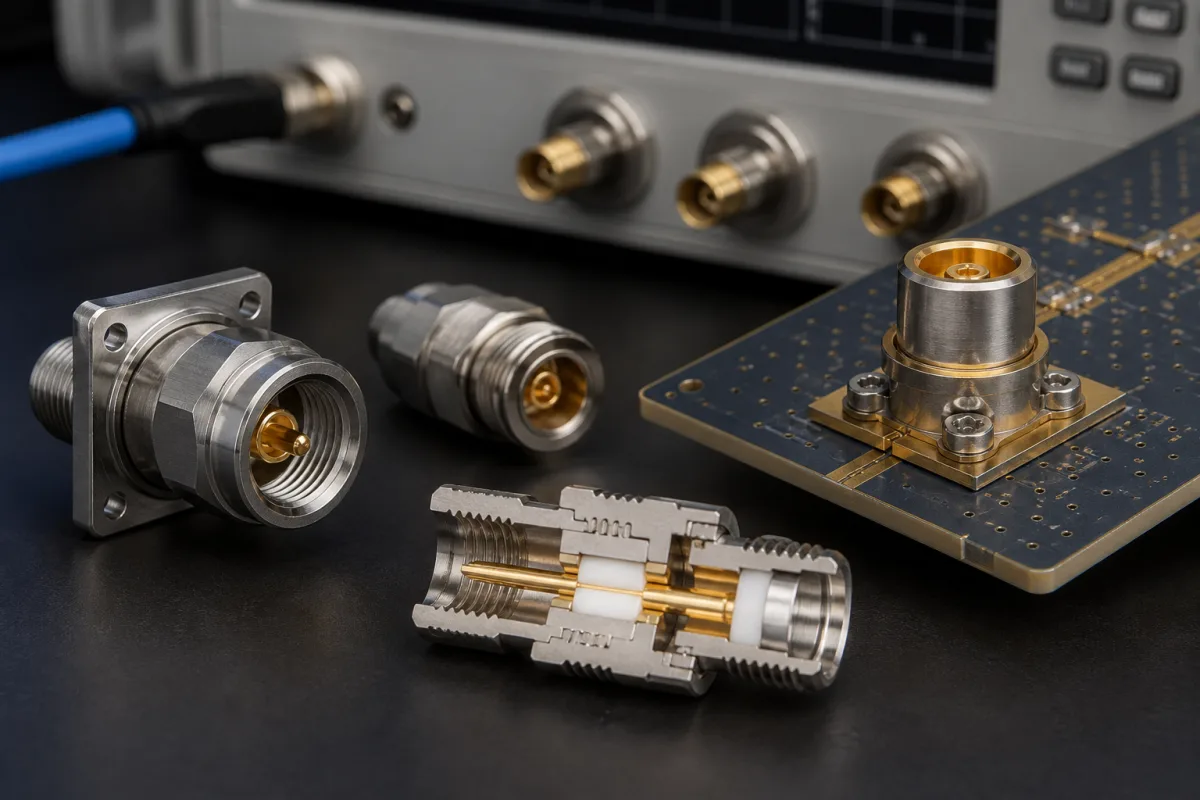
A canonical High-Frequency RF Connector is characterized by the integration of Center Contact and Dielectric Insulator. In industrial production environments, manufacturers listed on CNFX commonly emphasize Beryllium Copper construction to support stable, high-cycle operation across diverse manufacturing scenarios.

Precision connector for transmitting radio frequency signals in electronic assemblies
Product Specifications

Technical details and manufacturing context for High-Frequency RF Connector

Definition
A high-frequency RF connector is a critical electronic component designed to maintain signal integrity while transmitting radio frequency signals between circuit boards, modules, or subsystems. It provides reliable electrical connections with minimal signal loss and reflection across microwave frequency ranges. These connectors are essential in telecommunications equipment, radar systems, test instruments, and wireless infrastructure where precise impedance matching is required. Their robust construction ensures stable performance in demanding industrial environments with vibration, temperature variations, and repeated mating cycles.
Working Principle
Uses precisely engineered conductive interfaces and dielectric materials to maintain controlled impedance along the signal path, minimizing signal reflection and loss through impedance matching at microwave frequencies.
Common Materials
Beryllium Copper, Polytetrafluoroethylene (PTFE), Stainless Steel
Technical Parameters
  • Characteristic impedance rating (Ω) Per Request
  • Maximum operating frequency range (GHz) Per Request
Components / BOM
  • Center Contact
    Primary signal conductor
    Material: Beryllium Copper
  • Dielectric Insulator
    Maintains impedance and isolates conductors
    Material: PTFE
  • Outer Shell
    Provides mechanical support and shielding
    Material: Stainless Steel
  • Coupling Mechanism
    Secures connection between mating connectors
    Material: Stainless Steel
Engineering Reasoning
0-40 GHz frequency range, -55°C to +125°C temperature range, 50 Ω impedance tolerance ±0.5 Ω
VSWR exceeding 1.15:1 at 40 GHz, insertion loss >0.3 dB at 40 GHz, return loss <23 dB at 40 GHz
Design Rationale: Dielectric breakdown at electric field strength >3×10⁶ V/m, skin effect resistance increase at δ<1.6 μm (40 GHz), thermal expansion mismatch (CTE difference >10 ppm/°C) causing contact separation
Risk Mitigation (FMEA)
Trigger Dielectric contamination (particles >5 μm) at mating interface
Mode: Impedance discontinuity causing signal reflection >-20 dB
Strategy: Implement ISO Class 5 cleanroom assembly with 0.1 μm filtration
Trigger Torque application exceeding 8 N·m during mating
Mode: Plastic deformation of gold-plated beryllium copper contacts
Strategy: Integrate torque-limiting wrench with 5-7 N·m calibration

Industry Taxonomies & Aliases

Commonly used trade names and technical identifiers for High-Frequency RF Connector.

Industrial Ecosystem & Supply Chain DNA

Complementary Systems
Downstream Applications
Specialized Tooling

Application Fit & Sizing Matrix

Operational Limits
pressure: Up to 30 psi (sealed), atmospheric (unsealed)
other spec: Frequency range: DC to 40 GHz, VSWR: ≤1.5, Impedance: 50Ω
temperature: -65°C to +165°C
Media Compatibility
✓ Coaxial cable assemblies ✓ Printed circuit boards (PCBs) ✓ Test and measurement equipment
Unsuitable: High-pressure hydraulic systems
Sizing Data Required
  • Operating frequency (GHz)
  • Connector interface type (e.g., SMA, N, BNC)
  • Cable diameter or PCB mounting requirements

Reliability & Engineering Risk Analysis

Failure Mode & Root Cause
Signal Degradation
Cause: Wear of mating surfaces due to repeated connect/disconnect cycles, leading to increased insertion loss and VSWR.
Mechanical Failure
Cause: Over-torquing during installation, causing thread damage, misalignment, or cracked dielectric insulators.
Maintenance Indicators
  • Intermittent signal dropouts or increased noise during operation
  • Visible physical damage such as bent pins, cracked housing, or corrosion on connector surfaces
Engineering Tips
  • Use calibrated torque wrenches during installation to prevent over-tightening and ensure proper mating force
  • Implement regular cleaning with approved solvents and inspection of contact surfaces to prevent contamination and oxidation

Compliance & Manufacturing Standards

Reference Standards
IEC 61169-1: Radio-frequency connectors - Part 1: Generic specification MIL-PRF-39012: General Specification for RF Connectors DIN 47223: Radio-frequency connectors - Part 23: Sectional specification for RF coaxial connectors with screw coupling
Manufacturing Precision
  • Center conductor concentricity: +/-0.02mm
  • VSWR (Voltage Standing Wave Ratio): <1.15 at 18 GHz
Quality Inspection
  • Vector Network Analyzer (VNA) testing for impedance and return loss
  • Helium leak test for hermetic sealing integrity

Factories Producing High-Frequency RF Connector

Verified manufacturers with capability to produce this product in China

✓ 98% Supplier Capability Match Found

P Project Engineer from Singapore Feb 19, 2026
★★★★★
"Standard OEM quality for Computer, Electronic and Optical Product Manufacturing applications. The High-Frequency RF Connector arrived with full certification."
Technical Specifications Verified
S Sourcing Manager from Germany Feb 16, 2026
★★★★★
"Great transparency on the High-Frequency RF Connector components. Essential for our Computer, Electronic and Optical Product Manufacturing supply chain."
Technical Specifications Verified
P Procurement Specialist from Brazil Feb 13, 2026
★★★★★
"The High-Frequency RF Connector we sourced perfectly fits our Computer, Electronic and Optical Product Manufacturing production line requirements."
Technical Specifications Verified
Verification Protocol

“Feedback is collected from verified sourcing managers during RFQ (Request for Quote) and factory evaluation processes on CNFX. These reports represent historical performance data and technical audit summaries from our B2B manufacturing network.”

5 sourcing managers are analyzing this specification now. Last inquiry for High-Frequency RF Connector from Germany (1h ago).

Supply Chain Commonly Integrated Components

Stereo Camera Array

A multi-camera system that captures synchronized images from multiple perspectives to enable 3D depth perception and pattern recognition.

Explore Specs →
Structured Light Projector

Optical device that projects precisely controlled light patterns onto surfaces for 3D scanning applications

Explore Specs →
Main Processor Board

The central computing and control unit of a 5-axis CNC controller that processes motion commands, executes algorithms, and coordinates all system operations.

Explore Specs →
Alignment Sensor Array

A multi-sensor component that detects and measures positional alignment in industrial systems.

Explore Specs →

Frequently Asked Questions

What is the frequency range of this high-frequency RF connector?

This RF connector is designed for high-frequency applications, with a frequency range specified in GHz. Please refer to the detailed product specifications for the exact range based on your model requirements.

How many mating cycles can this RF connector withstand?

The connector is engineered for durability, supporting a high number of mating cycles as specified in cycles. The exact count depends on the model and usage conditions, ensuring reliable performance in repeated connections.

What materials are used in this RF connector and why?

It uses Beryllium Copper for the center contact for excellent conductivity and spring properties, PTFE as the dielectric insulator for low loss and stability, and Stainless Steel for the outer shell for strength and corrosion resistance.

Can I contact factories directly on CNFX?

CNFX is an open directory, not a transaction platform. Each factory profile provides direct contact information and production details to help you initiate direct inquiries with Chinese suppliers.

Get Quote for High-Frequency RF Connector

Request technical pricing, lead times, or customized specifications for High-Frequency RF Connector directly from verified manufacturing units.

Your business information is encrypted and only shared with verified High-Frequency RF Connector suppliers.

Thank you! Your message has been sent. We'll respond within 1–3 business days.

Need to Manufacture High-Frequency RF Connector?

Connect with verified factories specializing in this product category

Add Your Factory Contact Us
Previous Product
High-Frequency RF Coaxial Connector
Next Product
High-Purity Gallium Arsenide Wafer Substrate