Industry-Verified Manufacturing Data (2026)

High-Speed Memory Module

Based on aggregated insights from multiple verified factory profiles within the CNFX directory, the standard High-Speed Memory Module used in the Computer, Electronic and Optical Product Manufacturing sector typically supports operational capacities ranging from standard industrial configurations to heavy-duty production requirements.

Technical Definition & Core Assembly

A canonical High-Speed Memory Module is characterized by the integration of Memory ICs and PCB Substrate. In industrial production environments, manufacturers listed on CNFX commonly emphasize FR-4 PCB substrate construction to support stable, high-cycle operation across diverse manufacturing scenarios.

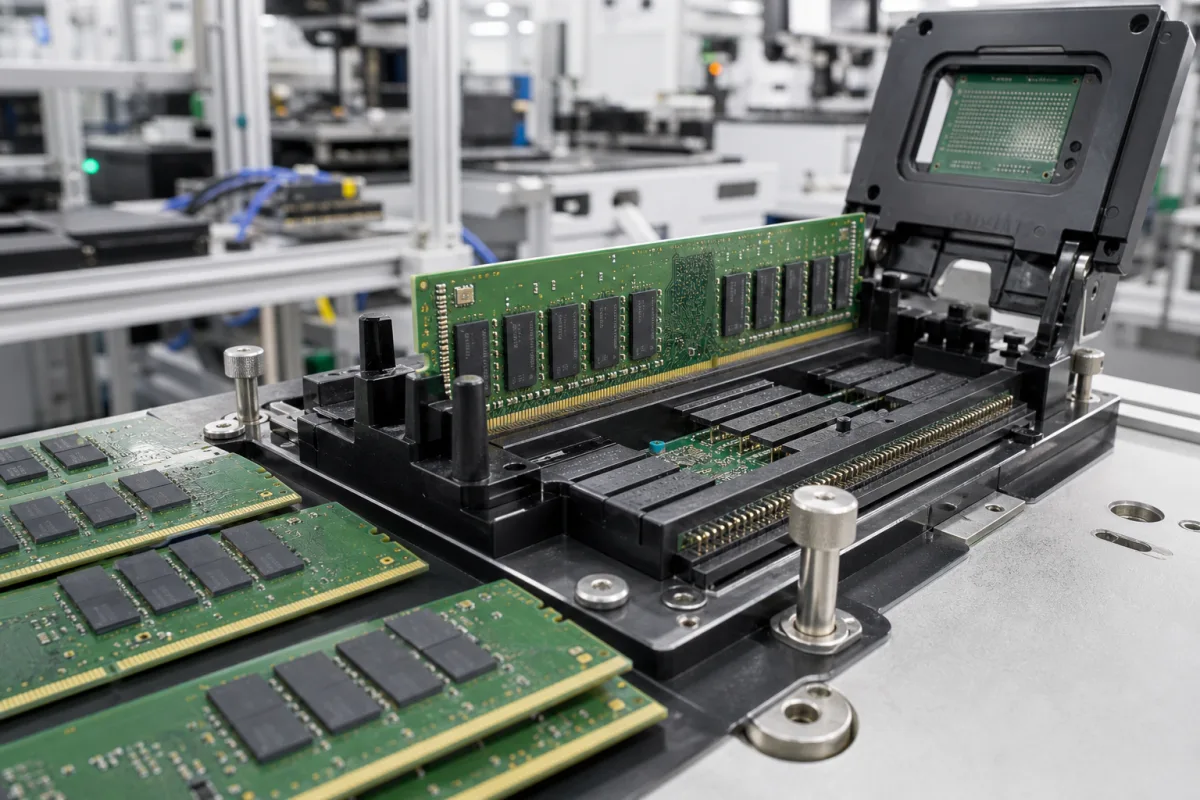
Printed circuit board with integrated memory chips for temporary data storage in computing devices.
Product Specifications

Technical details and manufacturing context for High-Speed Memory Module

Definition
A high-speed memory module is a critical component in computer manufacturing that provides volatile data storage for processors. It consists of multiple memory chips mounted on a printed circuit board with standardized connectors for system integration. These modules enable rapid data access and processing in servers, workstations, and consumer computing devices. Manufacturers integrate them into motherboards as essential sub-assemblies for system performance optimization.
Working Principle
Memory chips store data as electrical charges in capacitors, with controller logic managing read/write operations through synchronized clock signals and data buses.
Common Materials
FR-4 PCB substrate, DRAM silicon chips, Gold-plated copper contacts
Technical Parameters
  • Total data storage capacity (GB) Per Request
  • Maximum data transfer speed (MT/s) Per Request
Components / BOM
  • Memory ICs
    Data storage cells
    Material: Silicon semiconductor
  • PCB Substrate
    Circuit board foundation
    Material: FR-4 laminate
  • SPD Chip
    Serial presence detection
    Material: EEPROM silicon
  • Edge Connector
    Electrical interface to motherboard
    Material: Gold-plated copper alloy
Engineering Reasoning
0.9-1.1 V (core voltage), 0-85°C (ambient temperature), 0-95% relative humidity (non-condensing)
1.2 V (dielectric breakdown voltage), 125°C (junction temperature), 1.5×10^11 read/write cycles (NAND flash endurance)
Design Rationale: Electromigration at current densities exceeding 1×10^6 A/cm², thermal expansion mismatch between silicon (2.6×10^-6/K) and FR-4 substrate (13×10^-6/K) causing solder joint fatigue
Risk Mitigation (FMEA)
Trigger Alpha particle flux exceeding 0.001 particles/cm²·s from packaging materials
Mode: Single-event upset causing bit flip in SRAM cells
Strategy: Error-correcting code with Hamming distance 4, silicon-on-insulator substrate with 200 nm buried oxide layer
Trigger Thermal cycling between -40°C and 125°C at 10 cycles/hour
Mode: Solder joint fracture due to coefficient of thermal expansion mismatch
Strategy: Underfill epoxy with 25×10^-6/K CTE, copper pillar bumps with 100 μm diameter

Industry Taxonomies & Aliases

Commonly used trade names and technical identifiers for High-Speed Memory Module.

Industrial Ecosystem & Supply Chain DNA

Complementary Systems
Downstream Applications
Specialized Tooling

Application Fit & Sizing Matrix

Operational Limits
pressure: Atmospheric pressure only (not pressure-sensitive)
other spec: Voltage: 1.2V-1.35V (DDR4), 1.1V (DDR5); Clock Speed: 1600-6400 MHz; Humidity: 5-95% non-condensing
temperature: 0°C to 85°C (operating), -40°C to 100°C (storage)
Media Compatibility
✓ Desktop computer motherboards ✓ Server racks with ECC support ✓ High-performance gaming systems
Unsuitable: Outdoor industrial environments with extreme vibration/EMI
Sizing Data Required
  • Required memory capacity (GB)
  • System memory bus speed compatibility (MHz)
  • Form factor constraints (DIMM/SODIMM)

Reliability & Engineering Risk Analysis

Failure Mode & Root Cause
Thermal stress-induced solder joint fatigue
Cause: Cyclic thermal expansion/contraction from power cycling or ambient temperature fluctuations, leading to micro-cracks in BGA/CSP solder connections
Electromigration in interconnects
Cause: High current density and elevated temperatures causing gradual atom migration in copper traces/vias, eventually creating opens or shorts
Maintenance Indicators
  • Intermittent system crashes or memory errors under load (audible through system beep codes or visual via diagnostic LEDs)
  • Unusual thermal patterns on module surface visible via thermal imaging (hot spots >10°C above adjacent components)
Engineering Tips
  • Implement active thermal management with directed airflow >2 m/s across module surface and maintain ambient temperature below 40°C
  • Utilize underfill encapsulation for BGA packages and apply conformal coating to prevent tin whisker growth and moisture ingress

Compliance & Manufacturing Standards

Reference Standards
ISO/IEC 7810:2019 (Identification cards - Physical characteristics) ANSI/EIA-364-1000 (Electrical Connector/Socket Test Procedures) DIN EN 60793-2-10 (Optical fibres - Product specifications)
Manufacturing Precision
  • PCB trace width: +/-0.02mm
  • Component placement accuracy: +/-0.1mm
Quality Inspection
  • Thermal cycling test (-40°C to +85°C, 1000 cycles)
  • Signal integrity test (eye diagram analysis at rated speed)

Factories Producing High-Speed Memory Module

Verified manufacturers with capability to produce this product in China

✓ 95% Supplier Capability Match Found

S Sourcing Manager from Brazil Feb 21, 2026
★★★★★
"Standard OEM quality for Computer, Electronic and Optical Product Manufacturing applications. The High-Speed Memory Module arrived with full certification."
Technical Specifications Verified
P Procurement Specialist from Canada Feb 18, 2026
★★★★☆
"Great transparency on the High-Speed Memory Module components. Essential for our Computer, Electronic and Optical Product Manufacturing supply chain. (Delivery took slightly longer than expected, but technical support was excellent.)"
Technical Specifications Verified
T Technical Director from United States Feb 15, 2026
★★★★★
"The High-Speed Memory Module we sourced perfectly fits our Computer, Electronic and Optical Product Manufacturing production line requirements."
Technical Specifications Verified
Verification Protocol

“Feedback is collected from verified sourcing managers during RFQ (Request for Quote) and factory evaluation processes on CNFX. These reports represent historical performance data and technical audit summaries from our B2B manufacturing network.”

17 sourcing managers are analyzing this specification now. Last inquiry for High-Speed Memory Module from Mexico (1h ago).

Supply Chain Commonly Integrated Components

Stereo Camera Array

A multi-camera system that captures synchronized images from multiple perspectives to enable 3D depth perception and pattern recognition.

Explore Specs →
Structured Light Projector

Optical device that projects precisely controlled light patterns onto surfaces for 3D scanning applications

Explore Specs →
Main Processor Board

The central computing and control unit of a 5-axis CNC controller that processes motion commands, executes algorithms, and coordinates all system operations.

Explore Specs →
Alignment Sensor Array

A multi-sensor component that detects and measures positional alignment in industrial systems.

Explore Specs →

Frequently Asked Questions

What is CAS latency and why does it matter for this memory module?

CAS latency (CL) measures the delay between a memory controller request and data availability. Lower CL values in our high-speed modules mean faster response times, improving overall system performance in computing applications.

How does the FR-4 PCB substrate benefit this memory module?

FR-4 PCB substrate provides excellent thermal stability, electrical insulation, and mechanical strength. This ensures reliable operation in various computing environments while maintaining signal integrity for high data transfer rates.

What is the purpose of the SPD chip in this memory module?

The SPD (Serial Presence Detect) chip stores the module's specifications, including timing parameters and capacity. This allows computer systems to automatically configure optimal settings for compatibility and performance during boot-up.

Can I contact factories directly on CNFX?

CNFX is an open directory, not a transaction platform. Each factory profile provides direct contact information and production details to help you initiate direct inquiries with Chinese suppliers.

Get Quote for High-Speed Memory Module

Request technical pricing, lead times, or customized specifications for High-Speed Memory Module directly from verified manufacturing units.

Your business information is encrypted and only shared with verified High-Speed Memory Module suppliers.

Thank you! Your message has been sent. We'll respond within 1–3 business days.

Need to Manufacture High-Speed Memory Module?

Connect with verified factories specializing in this product category

Add Your Factory Contact Us
Previous Product
High-Speed Capture Module
Next Product
High-Speed Pick-and-Place Machine