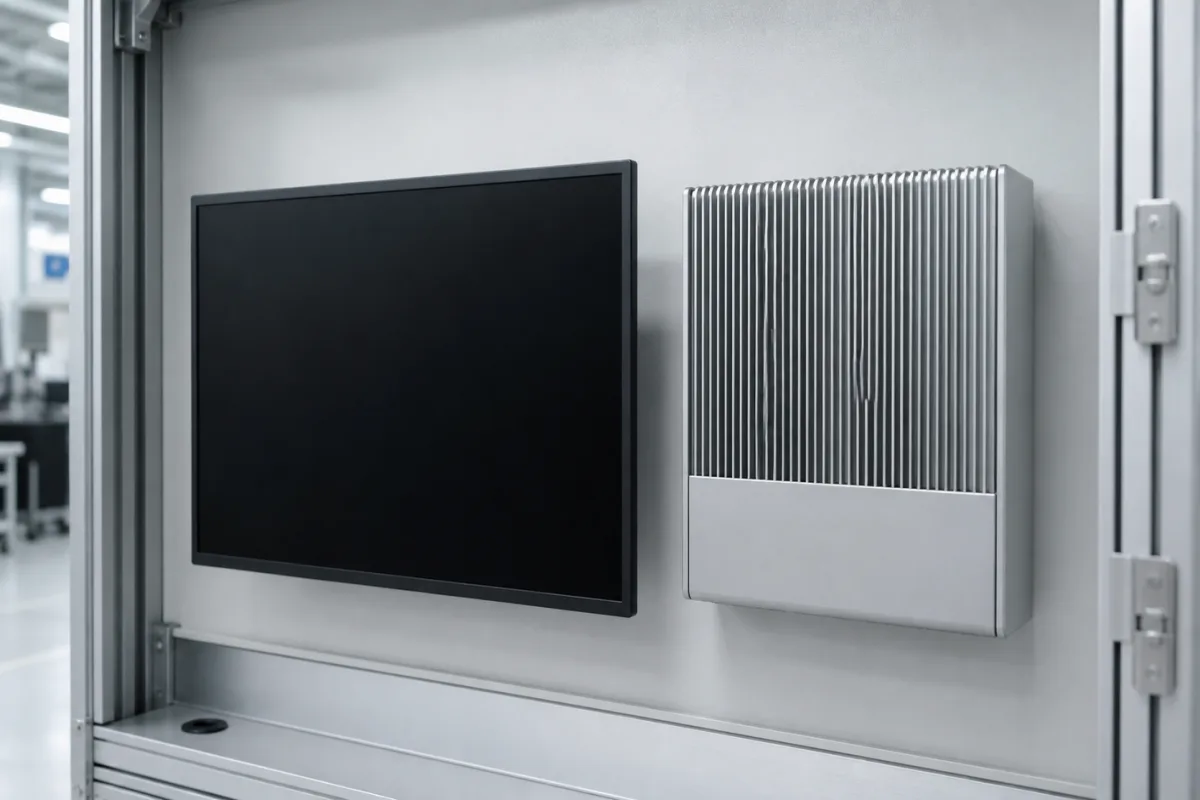
Industrial computing · Cooling, temperature, shock, sealing and power
An industrial computer earns the name by surviving the site, not by its processor. Specify the temperature range, the shock and vibration test method and levels, the IP rating that applies to the part exposed, the storage type and the power input, then choose the CPU, memory and I/O.
Box PCs, panel PCs, embedded and ARM-based industrial computers and edge controllers for machines, inspection and process control. Industrial monitors without a computer, PLCs and sheet-metal cabinets are outside this page.
CNFX editorial research · Sources checked October 11, 2026 · 4 sources
Premio, a rugged PC manufacturer, explains that removing the fan "gets rid of a common failure point, allows the system to be fully sealed for stronger IP protection", with heat conducted from the CPU, memory and chipset through interface materials, heat pipes and aluminium spreaders to the chassis. It says wide-temperature performance comes from the whole design (fanless cooling, industrial-grade components and the chassis) and cites −40 °C to 70 °C as its rugged validation range. [1]
Ask for the temperature range of the exact configuration (CPU, storage and expansion cards change it), and whether the processor throttles at the top of the range.
Give the supplier the installation (cabinet, machine-mounted, vehicle, washdown area), ambient temperature range, vibration and shock sources, the power available, the software and the I/O and network ports needed.
02
Ask for shock and vibration by test method and level
Premio states its rugged PCs are validated to MIL-STD-810H Method 514.8 Procedure I (vibration) and Method 516.8 Procedure I (shock), with 50 G, 11 ms half-sine shock and 5 Grms random vibration from 5 to 500 Hz, using SSD storage. [1]
Compare like with like: a shock or vibration claim means little without the method, levels, axes, duration and whether the unit was operating. Ask for the test report for the configuration you will buy.
03
Match the IP rating to the exposed part
The IEC explains that the IP code's first numeral grades protection against solids from 0 to 6 (no ingress of dust) and the second against liquids from 0 to 9 (high-pressure hot water from different angles), with tests defined in IEC 60529. [2]
A panel PC's IP rating may apply to the front only; CESIPC, for example, lists panel PCs with an IP65 front. Check whether the rating covers the front, the whole housing or neither, and how the unit is sealed to the cabinet cut-out. [3]
04
Specify storage and power input
Premio notes that hard disks use spinning platters and an actuator arm that can mistrack under vibration, while SSDs have no moving parts, making them the baseline for rugged use. [1]
CESIPC, for example, lists 9–36 V DC with auto power-on after power recovery on its panel PCs. Ask for input range, protection against reverse polarity and surges, and behaviour after power loss. [3]
05
Compare what suppliers offer
Suppliers linked to this page list x86 and ARM box PCs, panel PCs, edge AI computers and industrial motherboards. [3][4]
CESIPC lists 7–24 inch fanless panel PCs with Intel Ethernet and serial ports; EDATEC lists Raspberry Pi CM5-based industrial computers with digital I/O and CAN; Advantech, ADLINK and ARBOR list fanless embedded and edge AI computers; BLIIoT and IOTRouter list ARM-based computers and edge controllers; GIFA lists industrial motherboards and computers; GDCOMPT lists fanless panel PCs; EVOC lists industrial computing on a Chinese-language site. Ask each for lifecycle and supply commitments. [3][4]
06
Trace the industrial computer components
This is a functional reference built from the sources cited; it is not one maker's parts list.
Fill the specification fields with values for your application
An industrial computer quotation needs values for your site and software. The table explains each field, gives published values where a reviewed source states them, and says what to obtain from the supplier.
Explore company information and manufacturing capabilities, then discuss the scope of your project with a relevant supplier.
Share this page
Compiled and source-reviewed by the CNFX editorial team.
Published product pages show what a company offers, not tested performance. Confirm the legal seller, factory and scope for your order. How we source and review
· Page last updated 13 October 2026
Buyer questions
Why choose a fanless industrial PC?
Premio notes that removing the fan "gets rid of a common failure point, allows the system to be fully sealed for stronger IP protection", with heat conducted to the chassis. [1]
What shock and vibration rating should an industrial PC have?
Ask for the test method and levels; Premio cites MIL-STD-810H with 50 G 11 ms shock and 5 Grms 5–500 Hz random vibration, with SSD storage. [1]
Does an IP65 panel PC mean the whole unit is waterproof?
Not necessarily; a panel PC may be rated at the front only. Check what the IP rating covers. [3][2]
Sources and what still needs a direct check
Sources checked 2026-10-11. Premio is a rugged industrial computer manufacturer; its article explains what makes a PC rugged. The IEC explains the IP code. Supplier pages describe their own offers. IEC 60529, IEC 60068 and MIL-STD-810H themselves were not read for this page.