Finding leaks in battery cells after the electrolyte is in
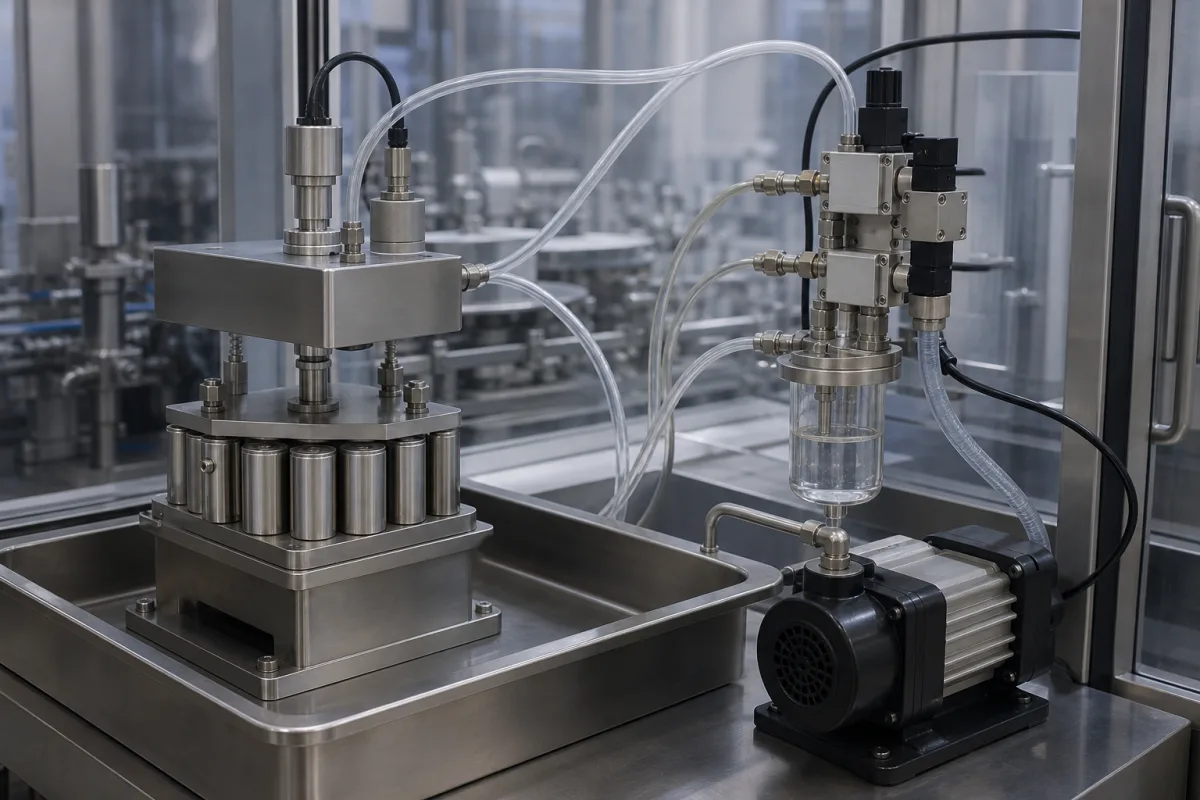
The illustrated station holds a batch of cylindrical cells under a sealed test head, with vacuum lines running to a valve block, a liquid trap and a pump. Once a cell is filled with electrolyte, the usual helium test no longer applies, and a leak that lets solvent out or moisture in decides the cell's life. Trade-press accounts of INFICON's direct electrolyte leak detection, in an electronics test magazine, an electronics news site and a product release, describe how filled cells are tested now.
Covers leak detection on lithium-ion and sodium-ion cells after electrolyte filling: limits of helium and pressure-decay methods on filled cells, direct detection of electrolyte solvent in a vacuum chamber, rejection leak rates, chambers for hard-case and pouch cells, calibration and in-line operation. Electrolyte filling systems are on 3613; electrolyte degassing chambers on 5221; prismatic cell fill-hole sealing and its leak range on 3614; general pressure-decay leak test modules on 2981; gas detection for flammable atmospheres on 9719. Helium leak testers for ceramic components and building water-leak alarms share the name and are outside this page.
CNFX editorial research · Sources checked October 13, 2026 · 3 sources
The eeNews Europe report sets out the conventional sequence: empty hard-case cells are filled with helium test gas and checked for leaks in a vacuum chamber, and electrolyte goes in only after this dry test.
The CET article explains why the leak matters beyond the electrolyte lost: moisture entering a cell reacts with the electrolyte to form hydrofluoric acid.
A dry helium test on the empty can still has a place: it checks the housing before filling, while the methods below check the filled and sealed cell (editorial reading).
Method on filled cells
Limitation reported
Source
Helium bombing: filled cells held in helium under pressure in a vacuum chamber, helium that entered through leaks measured as it escapes
Does not give the reliably consistent results needed for industry-wide standards (INFICON's assessment)
eeNews Europe
Pressure decay: test chamber pressurised with air to a few bar, watched for pressure change as air enters the cell
Limiting leak rates only down to 10⁻³ mbar·l/s; a temperature rise of fractions of a degree hides leaks, a fall creates phantom leaks
CET magazine
Leaving the cell at atmospheric pressure and 20 °C
Little pressure difference, so no electrolyte escapes; under-pressure in the cell can draw air in instead
CET magazine
02
Direct detection: let the solvent out in vacuum and measure it
In a vacuum chamber the situation reverses: the pressure difference drives solvent out of any leak, it evaporates, and a mass spectrometer detects it. CET describes the ELT3000 as three units: a gas detection unit with the mass spectrometer, a gas control unit that generates the vacuum, and the test chamber.
Against pressure decay's 10⁻³ mbar·l/s, 1·10⁻⁶ is a leak 1,000 times smaller, the figure eeNews reports from INFICON; the 2024 ELT Vmax figure is a further factor of 2 (Editorial calculation).
CET reports INFICON's reasoning for the rejection limit: testing against 1·10⁻⁶ mbar·l/s helps ensure that a service life of three to five years is achieved.
Item
Figure
Source
Solvents detected
DMC, DEC, EMC; also PP and others
CET; eeNews Europe
Equivalent leak rate (ELT3000, 2021)
1·10⁻⁶ mbar·l/s, a leak a few µm in diameter
CET magazine
Helium-equivalent leak rate (ELT Vmax, 2024)
5·10⁻⁷ mbar·l/s (helium-equivalent)
Business Wire release via Silicon UK
Pressure decay, for comparison
10⁻³ mbar·l/s
CET magazine
Cell formats
Prismatic, cylindrical (round), button and pouch cells; lithium-ion and sodium-ion
Silicon UK; CET
All figures originate with the equipment maker, INFICON, as reported by the trade press; the ELT Vmax figure is stated as a helium-equivalent rate.
03
Calibration, batches and pouch cells on a production line
The 2024 ELT Vmax release is about putting the method into automated test stations built by integrators, with the vacuum pumps supplied by the integrator.
The illustrated fixture follows the batch approach: a group of cylindrical cells under one test head, evacuated together, with a trap ahead of the pump (editorial reading of the image).
CET notes that for larger chambers additional pumps for quick evacuation keep cycle times, and that robots or pneumatic grippers can load a larger chamber with cells in batches.
Feature
Detail
Source
Calibration
E-Check 2.0 calibration leak filled with 100% DMC, built into the vacuum chamber; automatic calibration at set intervals in under 30 s
Silicon UK (Business Wire)
Throughput
Multi-chamber mode for near-constant measuring, removing waiting time for evacuation and venting; batch testing
Silicon UK (Business Wire)
Response
Adjustable carrier gas flow, for example 10 sccm, to shorten response time
Silicon UK (Business Wire)
Environment
Approved for dry rooms; 19-inch rack housing with fieldbus interfaces
Silicon UK (Business Wire)
Pouch cells
FTC3000 flexible chamber: a membrane hugs the cell during evacuation, stabilising it and reducing dead volume
CET magazine
Traceability
Barcode scanner links each cell's result to its part ID and a time stamp
CET magazine
04
What to give a cell leak-test supplier
Paste it into your enquiry below or into an email to a maker, then replace every bracket.
Give the cell format and size, electrolyte solvents, whether the test is on empty or filled cells, required rejection leak rate, cells per hour and batch size, dry-room conditions, and how results must be traced. Ask for the detection method, the stated rejection limit and whether it is helium-equivalent, chamber design for your format (rigid or flexible for pouch cells), calibration leak and interval, cycle time including evacuation and venting, and pump requirements.
Explore company information and manufacturing capabilities, then discuss the scope of your project with a relevant supplier.
Share this page
Compiled and source-reviewed by the CNFX editorial team.
Each manufacturer above links to the page on that company's own website where the product is listed, with the date we checked it. How we source and review
· Page last updated 13 October 2026
Buyer questions
Why can't filled battery cells be helium leak tested like empty ones?
Empty hard-case cells are tested with helium before filling; for filled cells INFICON reports that helium bombing and pressure decay do not give consistent results, pressure decay reaching only 10⁻³ mbar·l/s. [2][1]
How small a leak can direct electrolyte detection find?
CET reports 1·10⁻⁶ mbar·l/s for the ELT3000, a leak a few micrometres across; the 2024 ELT Vmax release states 5·10⁻⁷ mbar·l/s helium-equivalent. [1][3]
How is an electrolyte leak tester calibrated in-line?
INFICON's ELT Vmax uses a built-in calibration leak filled with 100% DMC, calibrating automatically at set intervals in under 30 seconds. [3]
Sources and what still needs a direct check
Sources checked 2026-10-13. Trade-press reports of INFICON's direct electrolyte leak detection: CET magazine (2021), eeNews Europe, and the 2024 ELT Vmax release as published by Silicon UK.