Industry-Verified Manufacturing Data (2026)

LED Array

Based on aggregated insights from multiple verified factory profiles within the CNFX directory, the standard LED Array used in the Computer, Electronic and Optical Product Manufacturing sector typically supports operational capacities ranging from standard industrial configurations to heavy-duty production requirements.

Technical Definition & Core Assembly

A canonical LED Array is characterized by the integration of LED chip/die and Substrate. In industrial production environments, manufacturers listed on CNFX commonly emphasize Gallium Arsenide (GaAs) semiconductor chips construction to support stable, high-cycle operation across diverse manufacturing scenarios.

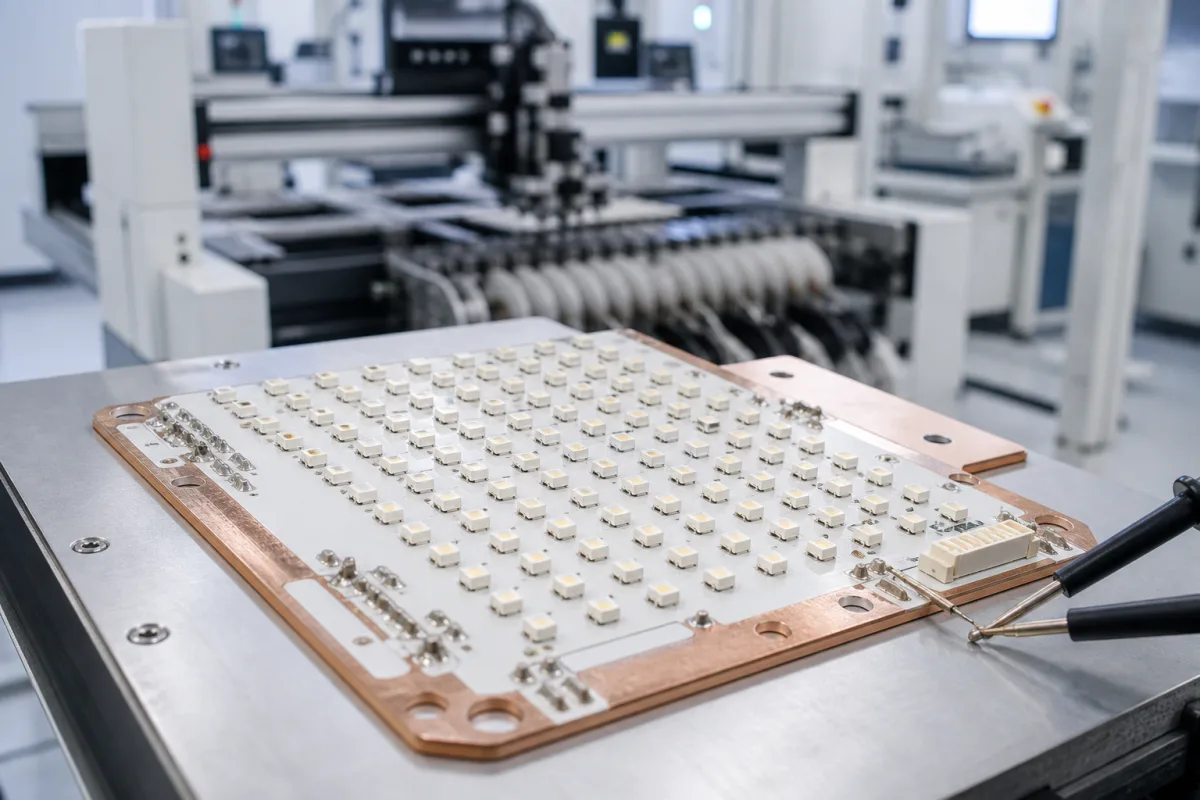
A structured arrangement of multiple LED chips mounted on a substrate to form a lighting module.
Product Specifications

Technical details and manufacturing context for LED Array

Definition
An LED Array is a core component of LED Illumination Systems consisting of multiple individual LED chips arranged in specific patterns (linear, matrix, circular, etc.) on a common substrate. It serves as the primary light-emitting element that determines the system's luminous output, beam pattern, and color characteristics. Within the LED Illumination System, the array interfaces with drivers, heat sinks, and optical elements to create controlled, efficient illumination.
Working Principle
LED chips in the array convert electrical energy into light through electroluminescence when forward-biased. The arrangement allows for collective operation, enabling higher luminous flux, uniform light distribution, and thermal management through shared substrate. Electrical connections (series/parallel) determine voltage/current requirements and failure modes.
Common Materials
Gallium Arsenide (GaAs) semiconductor chips, Aluminum or ceramic substrate, Gold/copper bonding wires, Phosphor coating (for white LEDs), Encapsulation epoxy/silicone
Technical Parameters
  • Array dimensions (length × width) and chip pitch spacing (mm) Per Request
Components / BOM
  • LED chip/die
    Semiconductor element that emits light when electrically excited
    Material: Gallium-based semiconductor (GaAs, GaN, etc.)
  • Substrate
    Base material providing mechanical support, electrical connections, and thermal dissipation
    Material: Aluminum, ceramic (Al2O3, AlN), or FR4 PCB
  • Bonding wires
    Create electrical connections between LED chips and substrate circuits
    Material: Gold or copper
  • Encapsulation
    Protects chips from environmental factors and provides optical control
    Material: Epoxy resin or silicone
Engineering Reasoning
2.8-3.6 V forward voltage per chip, 20-150 mA forward current per chip, -40°C to +85°C ambient temperature
Junction temperature exceeding 125°C causes permanent luminous flux degradation >30%, forward current exceeding 150% of rated value causes immediate catastrophic failure
Design Rationale: Thermal runaway due to negative temperature coefficient of forward voltage in semiconductor p-n junctions, leading to current crowding and localized overheating
Risk Mitigation (FMEA)
Trigger Electrostatic discharge exceeding 1000 V human body model
Mode: Gate oxide breakdown in LED driver IC, causing open circuit
Strategy: Integrated Zener diode clamping at each LED chip with 5 V breakdown voltage
Trigger Thermal interface material degradation with thermal resistance increase >2.5 K/W
Mode: Junction temperature rise to 140°C, causing phosphor layer carbonization
Strategy: Direct copper bonding substrate with thermal conductivity of 400 W/m·K

Industry Taxonomies & Aliases

Commonly used trade names and technical identifiers for LED Array.

Applied To / Applications

This component is essential for the following industrial systems and equipment:

Industrial Ecosystem & Supply Chain DNA

Complementary Systems
Downstream Applications
Specialized Tooling

Application Fit & Sizing Matrix

Operational Limits
pressure: Atmospheric to 1.5 bar (typical for sealed modules)
other spec: Humidity: 5-95% RH non-condensing, IP rating: IP65-IP68 depending on enclosure
temperature: -40°C to +85°C (operating), -55°C to +100°C (storage)
Media Compatibility
✓ Indoor ambient air ✓ Dry inert gases (e.g., nitrogen) ✓ Encapsulated in silicone or epoxy
Unsuitable: Direct immersion in water or corrosive chemicals without proper IP68 sealing
Sizing Data Required
  • Required luminous flux (lumens) or illuminance (lux)
  • Beam angle and optical distribution pattern
  • Input voltage and current (DC or AC) with driver compatibility

Reliability & Engineering Risk Analysis

Failure Mode & Root Cause
Thermal degradation
Cause: Inadequate heat dissipation leading to LED junction temperature exceeding rated limits, causing phosphor degradation and lumen depreciation.
Electrolytic capacitor failure
Cause: High operating temperatures or voltage spikes causing electrolyte evaporation or dielectric breakdown in power supply components.
Maintenance Indicators
  • Visible flickering or intermittent operation indicating driver circuit instability
  • Significant color shift (yellowing/bluing) or dark spots on LED chips showing thermal damage
Engineering Tips
  • Ensure proper thermal management with adequate heatsinking and maintain ambient temperature below manufacturer's specifications
  • Implement surge protection and voltage regulation to prevent electrical stress on driver components

Compliance & Manufacturing Standards

Reference Standards
ISO 9001:2015 - Quality management systems ANSI/IES LM-79-19 - Electrical and photometric measurements of solid-state lighting products CE Marking - Compliance with EU directives (e.g., Low Voltage Directive 2014/35/EU, RoHS 2011/65/EU)
Manufacturing Precision
  • LED placement accuracy: +/- 0.1mm
  • Color temperature uniformity: +/- 200K across array
Quality Inspection
  • Photometric testing (luminous flux, color rendering index, chromaticity)
  • Thermal cycling test (operational stability under temperature variations)

Factories Producing LED Array

Verified manufacturers with capability to produce this product in China

✓ 96% Supplier Capability Match Found

P Procurement Specialist from Australia Jan 08, 2026
★★★★★
"Found 23+ suppliers for LED Array on CNFX, but this spec remains the most cost-effective."
Technical Specifications Verified
T Technical Director from Singapore Jan 05, 2026
★★★★★
"The technical documentation for this LED Array is very thorough, especially regarding technical reliability."
Technical Specifications Verified
P Project Engineer from Germany Jan 02, 2026
★★★★★
"Reliable performance in harsh Computer, Electronic and Optical Product Manufacturing environments. No issues with the LED Array so far."
Technical Specifications Verified
Verification Protocol

“Feedback is collected from verified sourcing managers during RFQ (Request for Quote) and factory evaluation processes on CNFX. These reports represent historical performance data and technical audit summaries from our B2B manufacturing network.”

15 sourcing managers are analyzing this specification now. Last inquiry for LED Array from India (1h ago).

Supply Chain Compatible Machinery & Devices

Industrial Smart Camera Module

Embedded vision system for industrial automation and quality inspection.

Explore Specs →
Industrial Wireless Power Transfer Module

Wireless power transfer module for industrial equipment applications

Explore Specs →
Industrial Smart Sensor Module

Modular industrial sensor with embedded processing and wireless connectivity

Explore Specs →
Surface Mount Resistor

Passive electronic component for current limiting and voltage division in circuits

Explore Specs →

Frequently Asked Questions

What are the advantages of using ceramic substrates in LED arrays?

Ceramic substrates offer superior thermal conductivity, electrical insulation, and mechanical stability compared to aluminum, ensuring better heat dissipation and longer LED lifespan in demanding applications.

How does phosphor coating affect white LED array performance?

Phosphor coating converts blue LED light to white light through wavelength conversion. Quality phosphor coatings ensure consistent color temperature, high color rendering index (CRI), and stable light output over time.

What applications are these LED arrays suitable for in computer and optical manufacturing?

These LED arrays are ideal for backlighting displays, optical sensors, medical imaging equipment, industrial inspection systems, and precision lighting in electronic assembly where consistent, high-quality illumination is critical.

Can I contact factories directly on CNFX?

CNFX is an open directory, not a transaction platform. Each factory profile provides direct contact information and production details to help you initiate direct inquiries with Chinese suppliers.

Get Quote for LED Array

Request technical pricing, lead times, or customized specifications for LED Array directly from verified manufacturing units.

Your business information is encrypted and only shared with verified LED Array suppliers.

Thank you! Your message has been sent. We'll respond within 1–3 business days.

Need to Manufacture LED Array?

Connect with verified factories specializing in this product category

Add Your Factory Contact Us
Previous Product
Leak Detection System
Next Product
LED Array Module