Industry-Verified Manufacturing Data (2026)

Lens Fixture/Chuck

Based on aggregated insights from multiple verified factory profiles within the CNFX directory, the standard Lens Fixture/Chuck used in the Computer, Electronic and Optical Product Manufacturing sector typically supports operational capacities ranging from standard industrial configurations to heavy-duty production requirements.

Technical Definition & Core Assembly

A canonical Lens Fixture/Chuck is characterized by the integration of Collet / Jaw Set and Actuation Mechanism. In industrial production environments, manufacturers listed on CNFX commonly emphasize Stainless Steel construction to support stable, high-cycle operation across diverse manufacturing scenarios.

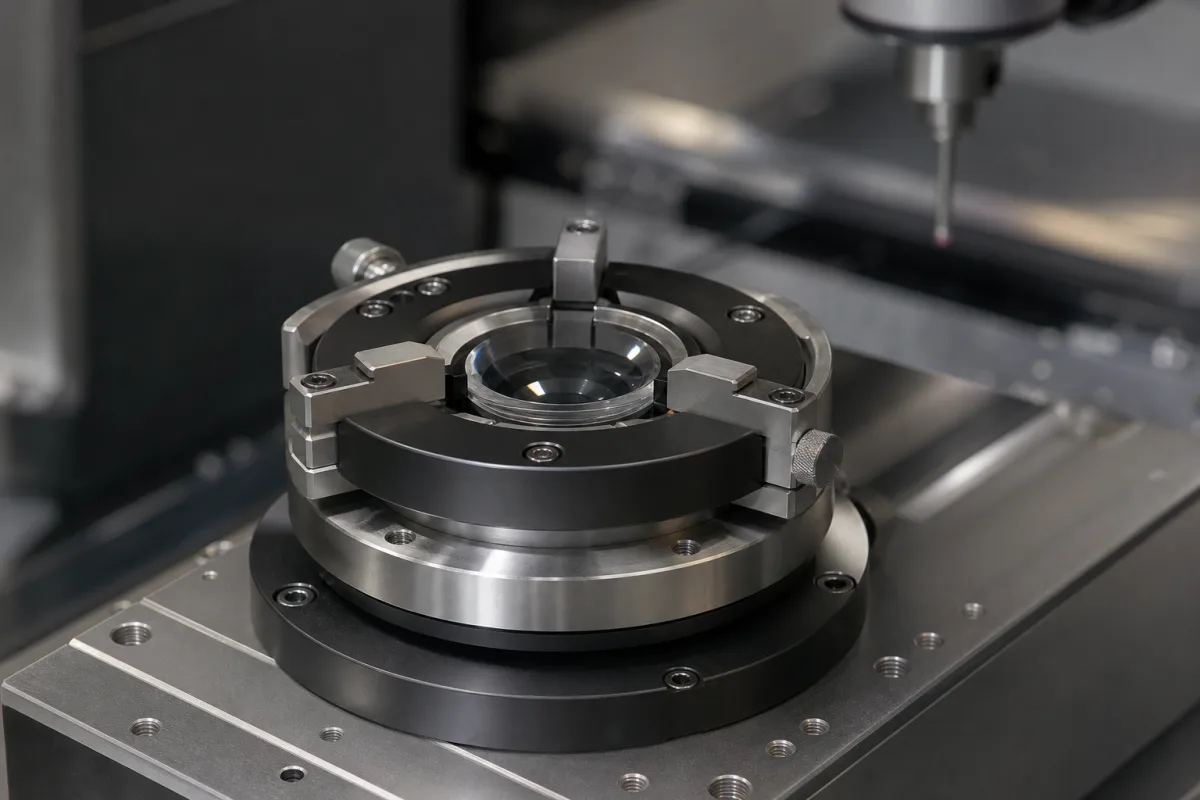
A precision holding device designed to secure and position optical lenses during automated measurement processes.
Product Specifications

Technical details and manufacturing context for Lens Fixture/Chuck

Definition
A critical component within an Automated Metrology Module, the Lens Fixture/Chuck is a precision mechanical device responsible for securely clamping, centering, and presenting optical lenses (or lens assemblies) to the module's measurement sensors. It ensures repeatable positioning and eliminates movement during high-precision dimensional, surface, or optical property inspections.
Working Principle
The fixture typically employs a mechanical, pneumatic, or vacuum-based clamping mechanism to grip the lens periphery or a dedicated mounting surface without damaging the optical elements. It interfaces with the module's motion system to present the lens at the correct focal plane and orientation for the metrology sensors (e.g., vision systems, laser scanners, interferometers).
Common Materials
Stainless Steel, Aluminum Alloy, Engineering Plastic (e.g., PEEK)
Technical Parameters
  • Fixture diameter and clamping range compatible with target lens sizes. (mm) Standard Spec
Components / BOM
  • Collet / Jaw Set
    The interchangeable contact surfaces that directly grip the lens. Often made of soft, non-marring material.
    Material: Delrin, Rubber, or Soft Metal Alloy
  • Actuation Mechanism
    The system (pneumatic cylinder, motor, manual lever) that opens and closes the collet/jaws.
    Material: Steel, Aluminum
  • Mounting Plate/Adapter
    Interface that connects the fixture to the Automated Metrology Module's motion stage.
    Material: Aluminum Alloy or Stainless Steel
Engineering Reasoning
0.5-5.0 N·m clamping torque, 0.1-0.5 μm radial runout tolerance, 20-25°C operating temperature
Clamping force exceeding 8.0 N·m causes permanent deformation of collet fingers, radial runout exceeding 1.0 μm induces measurement error >0.5 μm, temperature exceeding 40°C causes thermal expansion >2 μm
Design Rationale: Yield strength of 17-4PH stainless steel (1100 MPa) exceeded at 8.0 N·m torque, thermal expansion coefficient mismatch (α=11.5×10⁻⁶/°C for steel vs α=8.5×10⁻⁶/°C for ceramic lens) at ΔT>15°C
Risk Mitigation (FMEA)
Trigger Particulate contamination (≥5 μm particles) between collet and lens surface
Mode: Concentricity error of 2-10 μm due to uneven clamping pressure distribution
Strategy: Class 100 cleanroom environment with HEPA filtration, automated ultrasonic cleaning cycle every 50 operations
Trigger Cyclic loading at 2 Hz frequency with 4.5 N·m clamping torque
Mode: Fatigue crack initiation in collet fingers after 10⁶ cycles, leading to catastrophic fracture
Strategy: Shot peening treatment to induce compressive residual stress of -400 MPa, design with fatigue limit of 5.0 N·m at 10⁷ cycles

Industry Taxonomies & Aliases

Commonly used trade names and technical identifiers for Lens Fixture/Chuck.

Applied To / Applications

This component is essential for the following industrial systems and equipment:

Industrial Ecosystem & Supply Chain DNA

Complementary Systems
Downstream Applications
Specialized Tooling

Application Fit & Sizing Matrix

Operational Limits
pressure: 0 to 2 bar
other spec: Max lens diameter: 150mm, Positioning accuracy: ±5μm, Vibration tolerance: <0.5g RMS
temperature: -20°C to +80°C
Media Compatibility
✓ Optical glass lenses ✓ Polymer lenses (acrylic, polycarbonate) ✓ Silicon wafers
Unsuitable: Abrasive slurry environments with particles >10μm
Sizing Data Required
  • Lens diameter and geometry
  • Required positioning accuracy
  • Automation interface requirements (e.g., robotic arm compatibility)

Reliability & Engineering Risk Analysis

Failure Mode & Root Cause
Clamping force degradation
Cause: Wear of the chuck jaws or gripping surfaces due to repeated clamping cycles and abrasive particles from lenses, leading to insufficient holding force and potential lens slippage or misalignment.
Precision alignment loss
Cause: Accumulation of debris, lens residue, or coolant contamination on the fixture's reference surfaces and locating pins, compounded by thermal expansion from machining processes, causing runout and inaccurate lens positioning.
Maintenance Indicators
  • Visible lens slippage or rotation during operation, indicating loss of clamping force
  • Audible grinding or scraping noises during chuck actuation, suggesting contamination or mechanical wear in the jaw mechanism
Engineering Tips
  • Implement a regular cleaning protocol using non-abrasive solvents and lint-free wipes to remove lens residues and contaminants from all gripping and alignment surfaces, followed by verification of clamping force with a calibrated torque gauge.
  • Establish a preventive maintenance schedule for jaw inspection and replacement based on cycle count, and use precision alignment tools (e.g., dial indicators) to periodically check and recalibrate runout to within manufacturer specifications.

Compliance & Manufacturing Standards

Reference Standards
ISO 10110-7:2017 (Optics and photonics - Preparation of drawings for optical elements and systems - Part 7: Surface imperfection tolerances) ANSI/ASME B46.1-2019 (Surface Texture, Surface Roughness, Waviness, and Lay) DIN 3140-7:2019 (Optics and optical instruments - Preparation of drawings for optical elements and systems - Part 7: Tolerances for surface form errors)
Manufacturing Precision
  • Bore concentricity: ±0.005 mm
  • Mounting surface flatness: 0.01 mm over 50 mm diameter
Quality Inspection
  • Coordinate Measuring Machine (CMM) verification of critical dimensions and geometric tolerances
  • Surface roughness measurement using profilometer per specified Ra values

Factories Producing Lens Fixture/Chuck

Verified manufacturers with capability to produce this product in China

✓ 93% Supplier Capability Match Found

P Procurement Specialist from Germany Feb 04, 2026
★★★★★
"The technical documentation for this Lens Fixture/Chuck is very thorough, especially regarding technical reliability."
Technical Specifications Verified
T Technical Director from Brazil Feb 01, 2026
★★★★★
"Reliable performance in harsh Computer, Electronic and Optical Product Manufacturing environments. No issues with the Lens Fixture/Chuck so far."
Technical Specifications Verified
P Project Engineer from Canada Jan 29, 2026
★★★★★
"Testing the Lens Fixture/Chuck now; the technical reliability results are within 1% of the laboratory datasheet."
Technical Specifications Verified
Verification Protocol

“Feedback is collected from verified sourcing managers during RFQ (Request for Quote) and factory evaluation processes on CNFX. These reports represent historical performance data and technical audit summaries from our B2B manufacturing network.”

18 sourcing managers are analyzing this specification now. Last inquiry for Lens Fixture/Chuck from Brazil (1h ago).

Supply Chain Compatible Machinery & Devices

Modular Industrial Edge Computing Device

Rugged computing platform for industrial data processing at the network edge

Explore Specs →
Industrial Smart Camera Module

Embedded vision system for industrial automation and quality inspection.

Explore Specs →
Industrial Wireless Power Transfer Module

Wireless power transfer module for industrial equipment applications

Explore Specs →
Industrial Smart Sensor Module

Modular industrial sensor with embedded processing and wireless connectivity

Explore Specs →

Frequently Asked Questions

What materials are used in this lens fixture/chuck?

Our lens fixture/chuck is constructed from high-grade stainless steel for durability, aluminum alloy for lightweight strength, and engineering plastics like PEEK for precision components that require low thermal expansion and chemical resistance.

How does this fixture maintain precision during automated measurement?

The fixture features a precision collet/jaw set that securely holds optical lenses without deformation, combined with a precise actuation mechanism and stable mounting plate that ensures repeatable positioning within micron-level tolerances during automated measurement cycles.

Can this lens chuck be integrated with existing automated optical measurement systems?

Yes, the fixture includes a universal mounting plate/adapter compatible with standard automated measurement platforms. The modular BOM design allows for easy integration with various optical measurement systems in computer, electronic, and optical manufacturing environments.

Can I contact factories directly on CNFX?

CNFX is an open directory, not a transaction platform. Each factory profile provides direct contact information and production details to help you initiate direct inquiries with Chinese suppliers.

Get Quote for Lens Fixture/Chuck

Request technical pricing, lead times, or customized specifications for Lens Fixture/Chuck directly from verified manufacturing units.

Your business information is encrypted and only shared with verified Lens Fixture/Chuck suppliers.

Thank you! Your message has been sent. We'll respond within 1–3 business days.

Need to Manufacture Lens Fixture/Chuck?

Connect with verified factories specializing in this product category

Add Your Factory Contact Us
Previous Product
Lens Chuck Assembly
Next Product
Lens Holding Fixture