Automated MTF metrology module for lens assembly lines: 1.0 to 2.5 seconds per lens, 17 to 43 field positions and 0.8 to 3 % MTF accuracy
The image-quality check that sits inside a lens assembly line · how many seconds an automated MTF module spends per lens, how many field positions it measures, how accurate its MTF value is, and what parts it is built from
Miniature camera lenses are tested one by one after assembly, and the test that decides whether a lens ships is its modulation transfer function (MTF): how much contrast it keeps at a given line frequency, at the centre of the image and out towards the corners. An automated metrology module does this inside the line, taking a lens from a tray, measuring MTF at 25 to 43 field positions in 1.3 to 1.8 seconds on the testers below, and passing or rejecting it. Choosing one is a matter of cycle time, the number of field positions, the MTF accuracy and the range of lenses it can hold.
Automated and semi-automated MTF and image-quality measurement modules for production testing of lenses on assembly lines: production MTF testers for miniature camera lenses, wafer-level optics and displays, and bench MTF testers used for incoming and outgoing lens inspection, with their cycle time, field coverage, accuracy and lens envelope. Interferometers and centration, alignment and thickness test systems are covered on the Precision optical lens inspection and measurement system page; active alignment of camera modules on the Active optical alignment station page; lens loading robots and their sensors on the Automated lens loader and Vision/sensor system for lens loading pages; and camera-based defect inspection on the Machine vision system for inspection page.
CNFX editorial research · Sources checked October 13, 2026 · 4 sources
Seconds per lens against MTF accuracy: 1.0 s at 3 %, 1.3 s at 0.8 %, 1.8 s with 43 field positions
Trioptics publishes cycle time and accuracy side by side for its production testers, which shows the trade a buyer is making:
Editorial calculation: 3600 s ÷ 1.3 s is 2769 lenses per hour, slightly above the 2700 UPH Trioptics states, and 3600 ÷ 1.5 is 2400, matching its PRO X Compact figure; the gap on the PRO 10 is the time a stated UPH allows beyond the measurement itself. [1] At 2700 UPH a module tests about 21,600 lenses in an 8-hour shift.
For incoming inspection or lower-volume lines, a bench tester trades speed for range. Optikos rates its LensCheck VIS at better than 2 % MTF accuracy (1 % typ.) and better than 1 % repeatability (0.5 % typ.), and the LWIR version at better than 3 % (2 % typ.) to 40 lp/mm with better than 2 % repeatability (1 % typ.), all validated with a 50 mm f/5 audit lens. [2]
Model
Time per sample
MTF accuracy (on-axis / off-axis)
Field coverage
ImageMaster PRO 10
1.3 s (2700 UPH)
0.8 % / 1.5 %
Up to 53 points in 27 field positions; FOV up to 215° optional [1]
Up to 85 points in 43 field positions, dome with fixed cameras [1]
ImageMaster PRO 10 Wafer
1.3 s (2700 UPH)
0.8 % / 1.5 %
Wafers up to 8 in / 200 mm, with bow compensation [1]
ImageMaster PRO Display
1.0 s (one shot)
3.0 % / 3.0 %
Displays up to 11 in diagonal, for under-display cameras [1]
ImageMaster PRO SF (short finite distance)
2.0 s per scan (depends on sample)
—
Up to 99 points in 50 field positions; finite distance 1–140 mm set to < 5 µm [1]
State the line rate in lenses per hour, the MTF limits on the drawing and their tolerance, and the accuracy needed relative to those limits; ask for the cycle time with your lens handling included.
02
Field positions and off-axis angle: why a three- or five-point MTF check can miss a decentred lens
Lens defects from assembly, such as a tilted or decentred element, show up away from the centre of the image, so the number and placement of field positions decides what the module can catch.
Trioptics presents complete field coverage on its PRO HD as the way to catch local performance drops in a lens early. [1] Editorial calculation: moving from 25 to 43 field positions adds 72 % more positions (43 ÷ 25 = 1.72) for 0.3 s more per lens (1.8 s against 1.5 s). [1]
Item
Stated value
Production tester field positions
25 (PRO X Compact), 27 (PRO 10), 43 (PRO HD) field positions [1]
Production tester field of view
Up to 215° optional on PRO 10 and PRO X Compact; up to 24° on the telephoto PRO ST [1]
Bench tester off-axis rotation
Motorized lens platform ±100°, 0.0001° glass-scale encoder (Optikos LensCheck) [2]; ±60° on an earlier Optikos QC Bench [3]
Full-field MTF
Dube, Cicala, Closz and Rolland describe full rectangular-field MTF maps characterising misaligned systems with much higher accuracy than three- or five-field-point measurements [4]
Give the lens field of view, the field heights the drawing specifies MTF at, and whether the assembly process can decentre or tilt elements; ask for the field-position map the module will use.
03
What is inside a module: collimated target, lens holder, video microscope, and dividing out the camera's own MTF
Vision Systems Design describes the principle shared by the Optikos, Trioptics and Wells Research systems it reviewed: the lens under test sits between a collimated light source projecting a target and a video microscope that captures the image, on a mount that can rotate the lens for off-axis tests. [3] Optikos lists the parts in its bench:
The measured MTF is the product of the lens MTF and the camera's own MTF, so the camera's contribution has to be removed; Vision Systems Design notes that the camera MTF can be calculated from the sensor's pixel size and pitch and divided out. [3] Editorial calculation: if the system measures 0.45 at a given frequency and the camera MTF there is 0.90, the lens MTF is 0.45 ÷ 0.90 = 0.50; the two values here are examples, not figures from the sources.
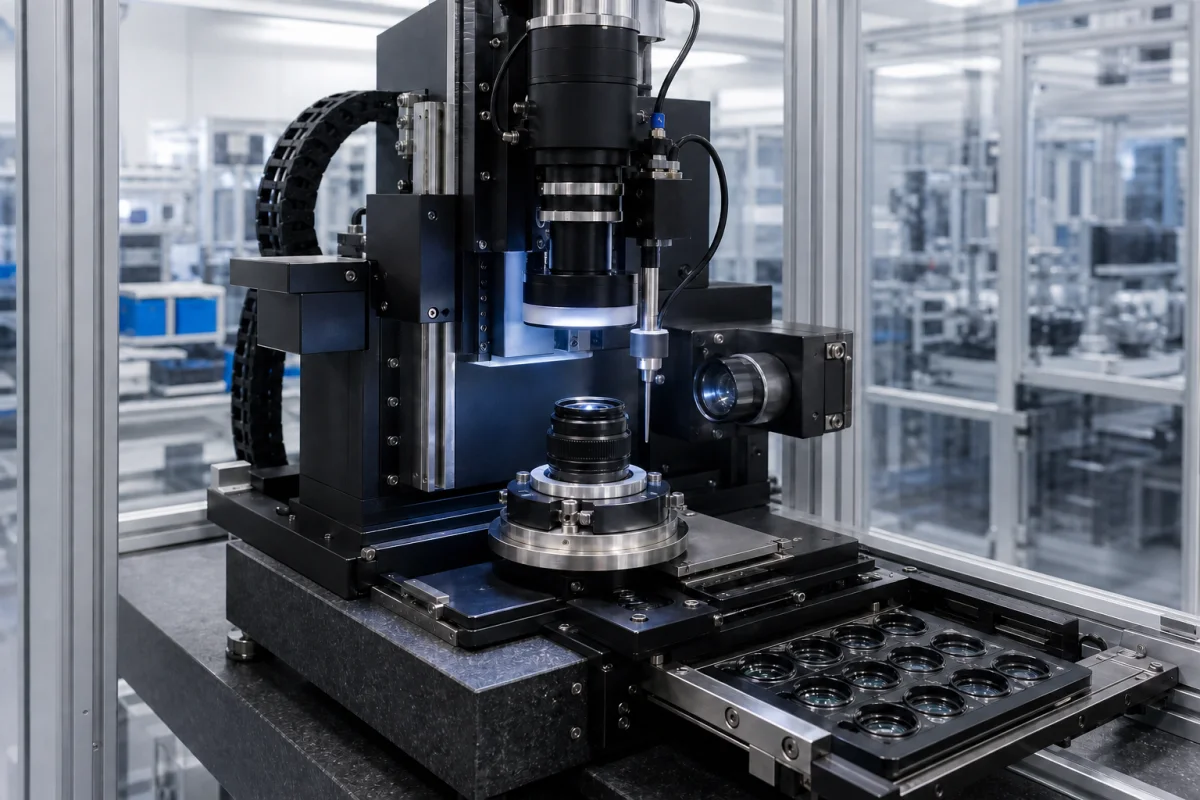
The image above shows a module of this kind on a granite base: a downward camera with ring light and a slender probe beside it, a lens held on a rotary chuck, a side-viewing optic and a tray of lenses waiting to be measured.
Part
Optikos LensCheck VIS
Collimator
Refractive, 355 mm EFL, 50 mm clear aperture; 400–700 nm fibre-optic source; 8-position target and filter wheels [2]
List the lens mounts and diameters to be held, the spectral band, the line frequencies of interest, and how lenses will be loaded (tray, robot, manual).
04
Data to give an MTF module supplier
Paste it into your enquiry below or into an email to a maker, then replace every bracket.
Lens: [EFL; f-number; FOV; mount; diameter]
Spec: [MTF limits; lp/mm; field heights]
Throughput: [lenses per hour; handling]
Accuracy: [% MTF on-axis and off-axis; repeatability]
Format: [single lenses; wafer-level; display]
Spectral band: [VIS; NIR; LWIR]
Integration: [tray; robot; line interface]
Explore company information and manufacturing capabilities, then discuss the scope of your project with a relevant supplier.
Share this page
Compiled and source-reviewed by the CNFX editorial team.
Each manufacturer above links to the page on that company's own website where the product is listed, with the date we checked it. How we source and review
· Page last updated 13 October 2026
Buyer questions
How fast is a production MTF tester?
Trioptics lists 1.3 s per sample (2700 UPH) for the ImageMaster PRO 10, 1.5 s for the PRO X Compact and 1.8 s for the PRO HD. [1]
How accurate is MTF measurement in production?
Trioptics states 0.8 % on-axis and 1.5 % off-axis MTF for the PRO 10; Optikos states better than 2 % (1 % typ.) for its LensCheck VIS bench. [1][2]
Why measure MTF across the full field rather than at a few points?
Full-field MTF maps characterise misaligned lenses with much higher accuracy than three- or five-field-point measurements, according to Dube and co-authors. [4]
Sources and what still needs a direct check
Sources checked 2026-10-13. Four sources from four publishers: Trioptics's ImageMaster PRO product page, Optikos's LensCheck datasheet, a 2008 Vision Systems Design article on lens test systems, and the abstract of a full-field MTF paper in Applied Optics listed by the Center for Freeform Optics.