Editorial Technical Reference

Microcontroller/Encoder

This page explains how Microcontroller/Encoder is classified within Computer, Electronic and Optical Product Manufacturing. Technical values and manufacturer relationships are research references; confirm the current specification and supplier evidence for each order.

Technical Definition & Core Assembly

Integrated component combining microcontroller processing with encoder signal conversion for control and communication.
Microcontroller/Encoder in a manufacturing environment
Representative product image. Confirm appearance and specifications with the manufacturer.

Product Specifications

Technical details and manufacturing context for Microcontroller/Encoder

Definition
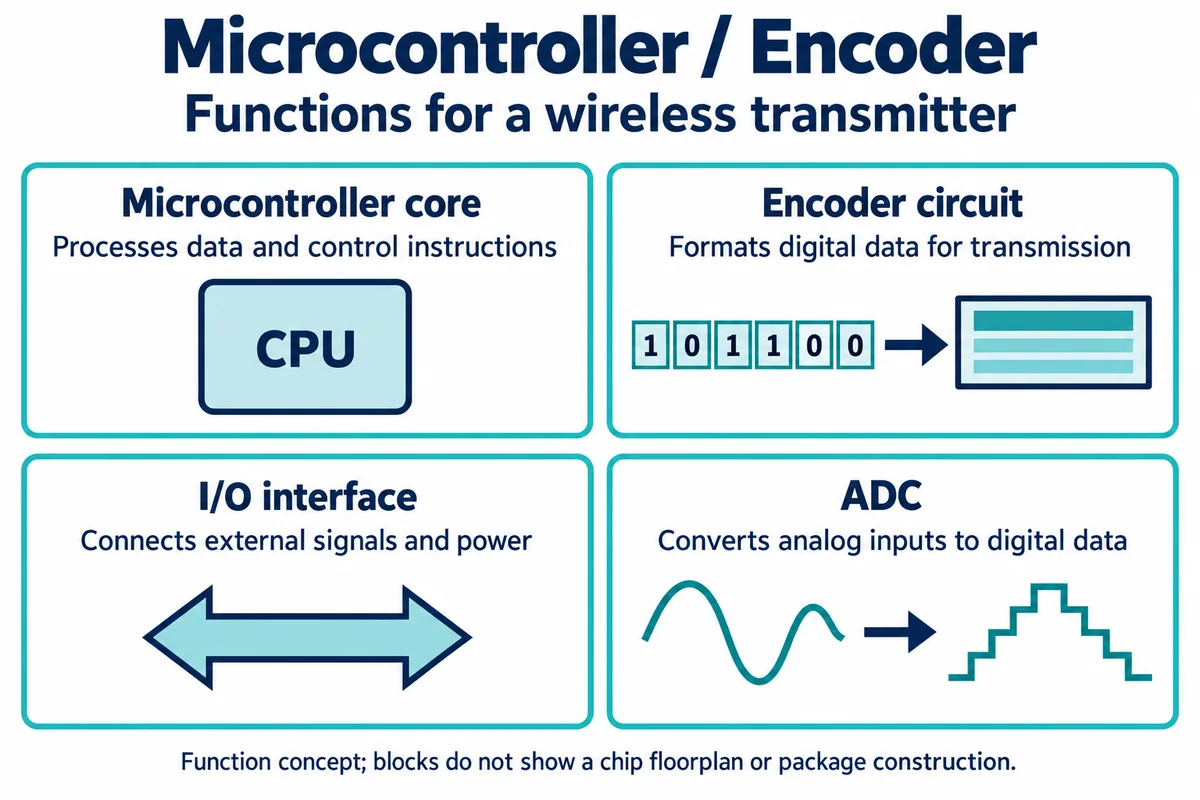
This product is an integrated electronic component that combines a microcontroller and an encoder in a single package, designed for use in wireless transmitters and similar control applications. The microcontroller serves as the central processing unit, executing programmed instructions for data handling, protocol management, and system control. The encoder converts digital signals into formats suitable for wireless transmission, such as pulse sequences or modulated signals, ensuring data integrity and efficient communication. The integration allows synchronized operation, where the microcontroller controls encoding parameters and timing based on transmission requirements.

The component is manufactured using silicon semiconductor technology with copper interconnects and a ceramic substrate, providing reliable electrical performance and thermal stability. It is available in surface-mount packages (QFN-32 to QFP-100) and operates within a supply voltage range of 3.3–5 V DC. The operating temperature range is -40 to 85 °C (industrial grade, with extended ranges available). The microcontroller supports clock frequencies from 8 to 80 MHz, with flash memory from 16 to 512 KB and SRAM from 2 to 64 KB. The encoder offers resolutions from 8 to 16 bits per channel, with an accuracy of ±0.5 degrees for position sensing. Communication interfaces include I2C, SPI, and UART, and the component provides 8 to 48 configurable GPIO pins. An analog-to-digital converter with 10 to 12-bit resolution is integrated. Power consumption in active mode at 3.3 V ranges from 1 to 50 mA. The component has an ingress protection rating of IP54 to IP65 (per IEC 60529) and weighs between 0.5 and 5 grams.

These specifications are typical reference ranges for the product family; actual values vary by specific model and application. Always verify model-specific parameters and standards with the legal manufacturer or supplier before procurement or integration.
Working Principle
The microcontroller executes programmed instructions to process input data and manage communication protocols. It controls the encoder's parameters and timing based on transmission requirements. The encoder converts the processed digital data into specific signal formats, such as pulse sequences or modulated signals, suitable for wireless transmission. The integrated design ensures synchronized operation, where the microcontroller and encoder work together to maintain data integrity and efficient communication. The component's interfaces (I2C, SPI, UART) allow external communication, and its GPIO pins enable configuration and control. The ADC converts analog signals for processing, and the encoder provides position or rotational data with specified resolution and accuracy.
Common Materials
Silicon semiconductor, Copper interconnects, Ceramic substrate
Technical Parameters
ParameterTypical rangeNotes & selection driver
Supply Voltage3.3–5 V DCOperating range for logic and encoder interface
Operating Temperature-40–85 °CIndustrial grade; extended range available
Clock Frequency8–80 MHzMaximum CPU clock speed
Flash Memory16–512 KBProgram storage capacity
SRAM2–64 KBData memory capacity
Encoder Resolution8–16 bitNumber of bits per channel
Encoder Accuracy±0.5 °Angular accuracy for position sensing
Interface ProtocolI2C, SPI, UARTCommunication interfaces supported
GPIO Pins8–48 pinsNumber of configurable I/O pins
ADC Resolution10–12 bitAnalog-to-digital converter resolution
Power Consumption1–50 mAActive mode current at 3.3 V
Ingress ProtectionIP54–IP65Dust and water resistanceIEC 60529
Package TypeQFN-32–QFP-100Surface-mount package options
Weight0.5–5 gTypical component weight

Ranges are indicative industry figures for RFQ preparation, not a supplier commitment. Confirm every value and standard with the legal manufacturer before ordering.

Components / BOM
  • Microcontroller Core Part
    Central processing unit for executing control algorithms and managing data flow
    Material: Silicon semiconductor
  • Encoder Circuit Part
    Converts digital signals from microcontroller into transmission-ready formats
    Material: Copper traces on silicon
  • I/O Interface
    Provides connection points for external sensors, power, and communication lines
    Material: Gold-plated copper pins
  • ADC
    Converts the analog inputs into digital form for the core to process.

Application & selection

Application Fit & Sizing Matrix

Operational Limits
pressure: Not applicable (electronic component, not fluid handling)
other spec: Operating voltage: 1.8V to 5.5V, Encoder resolution: 12-bit to 24-bit, Clock frequency: up to 200 MHz, ESD protection: ±8 kV HBM
temperature: -40°C to +85°C (industrial grade), -40°C to +125°C (extended automotive grade)
Media Compatibility
✓ Industrial automation control systems ✓ Robotic joint position feedback ✓ Precision motor control applications
Unsuitable: High-voltage arc welding environments (due to EMI/RFI interference and potential voltage transients)
Sizing Data Required
  • Required encoder resolution (bits/counts per revolution)
  • Processing speed requirements (MIPS/MHz for control algorithms)
  • Communication interface needs (SPI, I2C, UART, CAN, Ethernet)

Risk, maintenance & compliance

Reliability & Engineering Risk Analysis

Failure Mode & Root Cause
Signal degradation or loss
Cause: Contamination of optical/encoder disk (dust, oil, debris) or LED/photodetector failure due to thermal stress or aging
Mechanical wear or misalignment
Cause: Bearing failure in rotary encoders, shaft coupling wear, or mounting misalignment causing inconsistent pulse generation
Maintenance Indicators
  • Intermittent or erratic position/speed readings from the control system
  • Unusual audible noise (grinding, clicking) from rotary encoder assembly during operation
Engineering Tips
  • Implement regular cleaning of optical components using approved solvents and compressed air in controlled environments
  • Ensure proper alignment during installation and use vibration-isolating mounts to prevent mechanical stress

Indicative industry ranges for design and RFQ preparation. Confirm the exact figures and applicable standard with the manufacturer before specifying.

Compliance & Manufacturing Standards

Applicable Standards
IEC 60747-14-1:2020 - Semiconductor devices - Discrete devices and integrated circuits EN 55032:2015 - Electromagnetic compatibility of multimedia equipment

Quoted from the published standard.

Manufacturing Precision
  • Shaft Runout: +/-0.01mm
  • Mounting Flange Flatness: 0.05mm
Quality Inspection
  • Electrical Signal Integrity Test
  • Environmental Stress Screening (ESS)
Technical documentation
Request current drawings, revision history, and a signed specification sheet.
Manufacturing capability
Verify equipment lists, process limits, capacity, and representative production evidence.
Inspection readiness
Confirm test methods, calibrated equipment, sampling plans, and traceable reports.
Supplier transparency
Check the legal entity, factory address, ownership, certifications, and direct contacts.

Compare the published product scope and source details, then include your specifications and quantity in an enquiry.

Manufacturers of Microcontroller/Encoder

Manufacturer profiles associated with Microcontroller/Encoder.

Sourcing Microcontroller/Encoder from China?
Tell us your specification and target quantity — we will match it against manufacturer records and come back with the factories that fit.
Request manufacturers We manufacture this

Explore company information and manufacturing capabilities, then discuss the scope of your project with a relevant supplier.

Buyer enquiry

Request manufacturing insight for Microcontroller/Encoder

Ask for use case, specification boundaries, supplier type, and RFQ preparation information for this product.

Where it goes
Straight to the CNFX editorial desk, and to the manufacturer if this product is linked to a claimed profile. Nothing is broadcast to a supplier list.
Your details stay here
We do not sell or rent enquiry data, and we do not add you to a mailing list. Used only to answer this request.
No commission, no middleman
CNFX is a directory. We take no cut of any order and never negotiate on a supplier's behalf.
What to include
Share your product specifications, quantity, destination and target delivery date.

Your business information is used only to process this request.

Thank you! Your message has been sent. We'll respond within 1–3 business days.
Sorry, we couldn't send your message. Please try again, or email us at [email protected].

Frequently Asked Questions

What is the typical supply voltage range for this component?

The supply voltage range is 3.3 to 5 V DC, as listed in the reference parameters. Always confirm the exact voltage requirements for the specific model with the manufacturer.

What communication interfaces are supported?

The component supports I2C, SPI, and UART interfaces. These allow connection to other devices for data exchange and control. Verify interface availability on the specific model.

What is the encoder resolution and accuracy?

The encoder resolution ranges from 8 to 16 bits per channel, with an accuracy of ±0.5 degrees. These are reference values; check the datasheet for the exact model.

What is the operating temperature range?

The operating temperature range is -40 to 85 °C, which is industrial grade. Extended ranges may be available for specific models. Confirm with the manufacturer.

Related equipment

Applied To / Applications

This component is essential for the following industrial systems and equipment:

Industry Taxonomies & Aliases

Commonly used trade names and technical identifiers for Microcontroller/Encoder.

Data Basis

Editorial classification, named public sources where available, and source-reviewed manufacturer records.

Preliminary Technical Classification
This page supports structured research, RFQ preparation, and supplier evaluation. It does not replace buyer-led supplier qualification, standards review, or technical approval.

Need to Manufacture Microcontroller/Encoder?

Compare manufacturer profiles with relevant product and process capability.

Previous Product
XY Positioning Stage
Last Product
Get QuotesChat