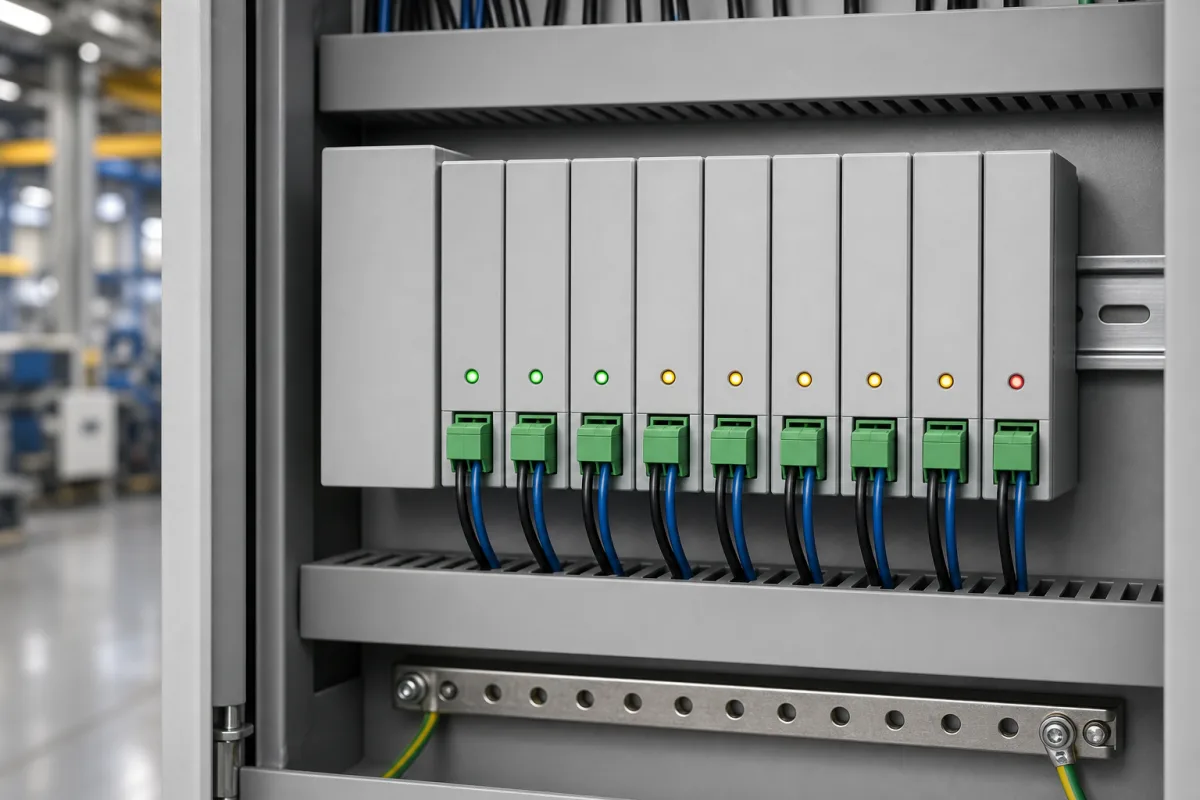
I/O surge protection module: DIN-rail signal-line SPD for PLC inputs and 4–20 mA loops
Surge protection modules for PLC I/O and 4–20 mA loops · slim DIN-rail signal-line SPDs, Uc against loop voltage, In and Up per IEC 61643-21 category, series resistance, status display
An I/O surge protection module is a signal-line surge protective device (SPD) wired between the field cable and a controller's input or output: it lets the 24 V signal or 4–20 mA loop pass and, during a lightning or switching surge, diverts the current to earth and clamps the voltage the I/O card sees. Check three things first: that its maximum continuous voltage sits above the loop voltage, how much surge current it diverts and to what voltage it clamps, and how much resistance and leakage it adds to the signal it protects.
DIN-rail surge protection modules for signal and I/O lines of PLC, DCS and safety systems, tested to IEC 61643-21: Uc, nominal and impulse discharge current, voltage protection level, series resistance, status indication and pluggable designs. Relay and SSR coupling modules and system-cable breakout modules are covered on the Interface module for PLC and DCS I/O: relay and system-cable interface modules on DIN rail page; optocoupler isolation boards on the DIN-rail optocoupler isolation board page; analog signal isolators on the Industrial signal conditioner page. Type 1 and Type 2 SPDs for AC mains belong to the Surge protection device page, and single TVS diodes to the TVS diode page.
CNFX editorial research · Sources checked October 12, 2026 · 3 sources
Uc above the loop voltage, then In and Up for the IEC 61643-21 test category
Pepperl+Fuchs' M-LB-4252, a 6 mm surge protection barrier for two non-grounded signal lines, is rated for a nominal voltage of 48 V and a maximum continuous operating voltage Uc of 56 V DC (39.6 V AC). It diverts a nominal discharge current In of 5 kA per line (8/20 µs), a total of 10 kA, and 1.5 kA per line of 10/350 µs impulse current, with a maximum surge current of 20 kA; the voltage protection level Up at In is at most 90 V line-line and 600 V line-earth. [1]
DEHN's BLITZDUCTOR XT module BXT ML2 BE S 24 is rated for 24 V with Uc of 33 V DC (23.3 V AC). It lists 10 kA per line and 20 kA total at test category C2 (8/20 µs), 2.5 kA per line and 9 kA total at D1 (10/350 µs), and voltage protection levels of at most 102 V line-line and 66 V line to earth at D1, and 90 V and 45 V at C3 (1 kV/µs). [2]
The letters come from the test classes of EN 61643-21: ABB's Furse reference describes class D as high energy, C as fast rate of rise and B as slow rate of rise for SPDs on data, signal and telecom lines, and notes that the companion specification 61643-22 covers selection and installation. [3] Editorial note: compare Up only at the same test category; DEHN's 45 V at C3 and Pepperl+Fuchs' 600 V line-earth at In are not the same test.
Editorial calculation: a 24 V loop on the DEHN module leaves 33 − 24 = 9 V between nominal and Uc, while the 48 V-rated Pepperl+Fuchs module leaves 56 − 24 = 32 V on the same loop; the trade-off is the higher clamp level of the higher-voltage part. [2][1]
Give the supplier the signal type (24 V digital, 4–20 mA, RS-485 or other), the loop voltage and maximum current, whether the lines are floating or referenced to earth, the I/O card's withstand voltage, the cable route (between buildings, outdoors, inside one cabinet), any SIL or Ex zone requirement, and the earthing arrangement in the cabinet.
02
1 Ω to 1.8 Ω per line in the 4–20 mA loop, and leakage below 30 µA
Each module puts resistance in series with the signal: 1 Ω per line on the Pepperl+Fuchs M-LB-4252 and 1.8 Ω per line on the DEHN BXT ML2 BE S 24. Both list a rated load current of 0.75 A, at 70 °C for Pepperl+Fuchs and at 45 °C for DEHN. [1][2]
Editorial calculation: a 2-wire loop through the DEHN module passes both lines through 1.8 Ω, so 3.6 Ω at 20 mA drops 0.072 V; a second module at the field end doubles that to 0.144 V. The loop supply must cover this on top of the transmitter's minimum voltage and the input resistance of the I/O card. [2]
Pepperl+Fuchs lists leakage below 30 µA line-line at Uc and below 10 nA line to earth. Editorial calculation: 30 µA is 0.19% of the 16 mA span of a 4–20 mA signal; since the figure is stated at Uc (56 V DC), ask for the leakage at your loop voltage before treating it as an error budget item. [1]
Bandwidth limits apply to faster signals: Pepperl+Fuchs gives a cut-off frequency of 3.6 MHz line-line, DEHN 6.8 MHz line to earth with capacitance of at most 0.5 nF line-line and 1.0 nF line to earth. [1][2]
03
Status display, plug-out protection modules and earthing through the base
Both modules split into a base wired to the field and a plug-in protection part. Pepperl+Fuchs' protection module can be replaced without tools, the device resets itself after an impulse in under 30 ms, and a front display shows operating state in green and fault in red. [1]
DEHN's module plugs into a BXT BAS or BSP BAS 4 base part and earths through it. Its LifeCheck function detects thermal or electrical overload; the status is read contactlessly with a DEHNrecord reader, and an overloaded arrester has to be replaced. [2]
For safety loops and hazardous areas, both datasheets list use up to SIL 3 and Zone 2 markings: Ex ec IIC T4 Gc for Pepperl+Fuchs (TÜV 22 ATEX 8881 X) and Ex nA IIC T4 Gc for DEHN (DEKRA 11ATEX0089 X). [1][2]
Editorial note: these modules divert surge current to earth, so the clamp level reached at the I/O card depends on the connection from the base to the cabinet earth as well as on the module; ask the supplier for the installation instructions and keep that path short.
04
Two signal-line SPD modules for 24–48 V I/O side by side
Send the signal, the cable route and the earthing together
Paste it into your enquiry below or into an email to a maker, then replace every bracket.
Signal: [24 V digital; 4–20 mA; RS-485; other]
Voltage: [loop or supply voltage; maximum current]
Lines: [number per channel; floating or earth-referenced]
Surge level: [test category and current per line required]
Loop budget: [series resistance allowed; leakage allowed]
Safety and Ex: [SIL; zone and marking]
Mounting: [module width; status indication; pluggable]
Earthing: [cabinet earth bar; base-to-earth connection]
Explore company information and manufacturing capabilities, then discuss the scope of your project with a relevant supplier.
Share this page
Compiled and source-reviewed by the CNFX editorial team.
Each manufacturer above links to the page on that company's own website where the product is listed, with the date we checked it. How we source and review
· Page last updated 13 October 2026
Buyer questions
What Uc should a surge protection module for a 24 V loop have?
Above the loop voltage: DEHN's 24 V module lists Uc 33 V DC, Pepperl+Fuchs' 48 V module 56 V DC. [2][1]
Does a signal-line SPD affect a 4–20 mA measurement?
It adds series resistance, 1 Ω per line on the Pepperl+Fuchs module and 1.8 Ω on the DEHN module, and a small leakage, below 30 µA at Uc for Pepperl+Fuchs. [1][2]
What do C2, C3 and D1 mean on a surge protector datasheet?
They are IEC/EN 61643-21 test categories: ABB's Furse reference describes class D as high energy and class C as fast rate of rise. [3]
Sources and what still needs a direct check
Sources checked 2026-10-12. Pepperl+Fuchs and DEHN publish data sheets for their own modules; ABB's Furse technical reference summarises the EN 61643 standard series.