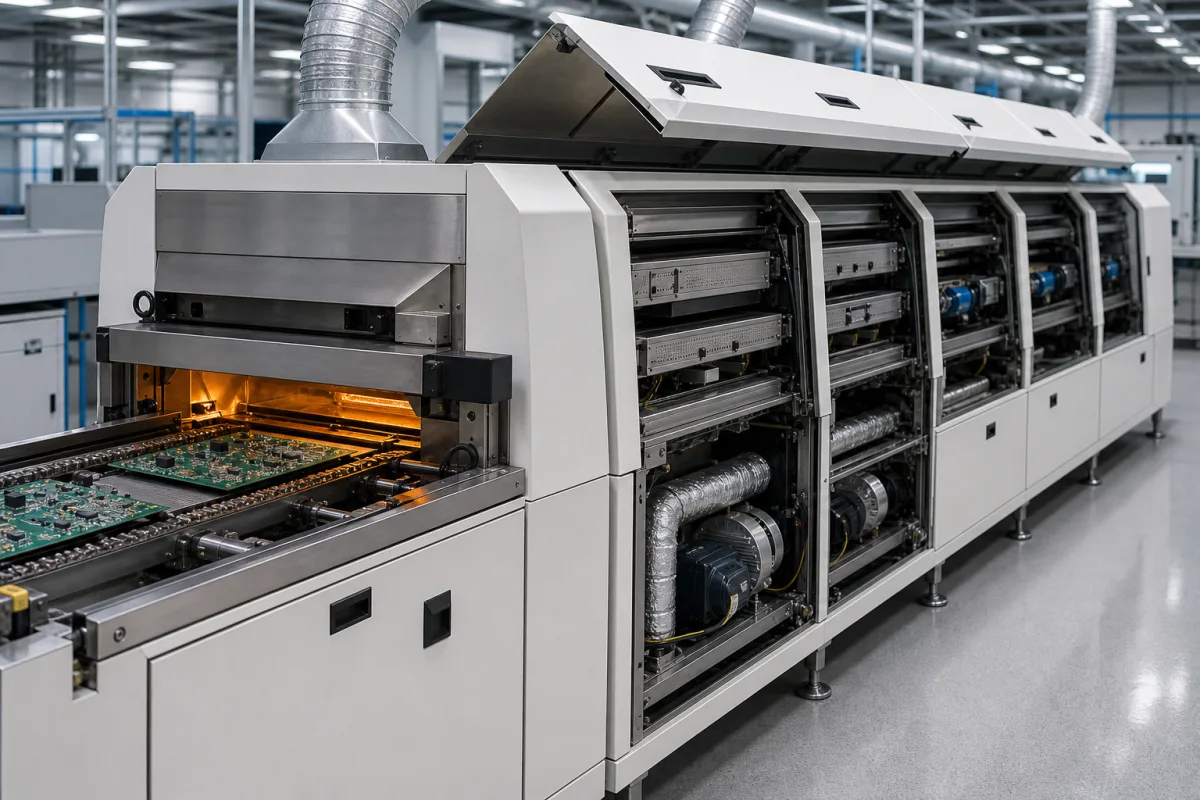
Reflow soldering oven (flux management: getting evaporated flux out of the oven before it condenses)
Keeping a reflow soldering oven clean of flux · how much flux evaporates, where it condenses, condensation heat exchangers and filters, jet-mixing and catalytic cleaning of the process gas, maintenance hours and intervals, and nitrogen reuse
Every board that passes through a reflow oven gives off flux vapour. If that vapour condenses inside the oven it drips onto boards, clogs gas holes and upsets the temperature across the board, and the oven has to stop for cleaning. The flux management system collects the vapour and removes it from the process gas. Specify the paste and volume the oven will see, the collection method, the maintenance it will need and whether it can be done without stopping production.
Flux management and process-gas cleaning in convection reflow soldering ovens: extraction points, condensation heat exchangers and filters, jet-mixing and catalytic or pyrolysis cleaning, maintenance intervals and nitrogen reuse. Reflow oven selection by profile, zones, conveyor and atmosphere is covered on the Reflow oven page; wave soldering pots on the Solder pot page; stencils on the SMT stencil page.
CNFX editorial research · Sources checked October 12, 2026 · 3 sources
Gerjan Diepstraten of Vitronics Soltec writes that "Every PCB assembly loses, on average, 0,25 grams of weight in the oven", that "Solder paste is 10% flux, of which approximately 50% remains on the board after soldering", and that "A high-volume SMT line operating 24/7 will be contaminated with approximately 2 kg per week." Different zones collect different residues, and "in the cool zones more than 10% of the evaporation takes place" for some pastes. [2]
His IPC paper names the risks of excessive contamination as dripping residues, decreased performance and "ΔT due to contaminated holes", notes that flux condenses on cold spots with the cooling zone a critical area, and says exhaust pipes need to be insulated or heated. [1] Soltec's patent puts it the same way: "If the vapors migrate to the cooling region they will condense on the circuit boards", and "The vapors will also condense on cooler surfaces within the oven, clogging gas orifices." [3]
02
Collection methods: condensation, jet mixing and catalysts
The traditional method, Diepstraten explains, is condensation: "The gasses are collected from multiple extraction points in the oven and guided through one or multiple heat exchangers", followed by a filter. It worked well with tin-lead paste, but lead-free chemistries needed different filters. [1]
In Diepstraten's catalyst trial, 2 kg of flux (about 20 kg of paste) was run through the oven; without the catalyst the gas filtration unit was contaminated, and with the catalyst between oven exhaust and filtration unit "all parts of the filtration unit were clean after the same 2" kg. [2]
Hot gas from the high-temperature region is mixed with cooled gas jets so flux condenses in suspension and is caught in a filter; "The flux laden gas does not contact any solid surface below the flux condensation temperature"
On a high-volume nitrogen line with a condensation system, Diepstraten reports that the unit "requires cleaning after soldering 50.000 – 90.000 boards", with 2 hours of downtime for 2 people and a 4-week interval; his table logs 3.0 to 4.0 hours of maintenance after 52,000 to 83,000 boards, corresponding to 208 to 332 kg of paste and 22.88 to 36.52 kg of flux. The 2 hours in the text and the 3.0 to 4.0 hours in the table differ; confirm which applies before using either as a planning figure. [1]
Editorial calculation from the first row of that table: 52,000 boards × 4 g of paste = 208 kg, and 22.88 kg of flux is 11% of that paste. [1]
With the catalyst in production, he reports that "Maintenance was reduced from 48 hours to only 10 hours per quarter, corresponding to a maintenance interval from two weeks (6-8 hours) to eight weeks (two hours)", and that "Nitrogen consumption was found to decrease by more than 20% due to nitrogen cleaning and reuse after the catalyst." [2] His paper adds that a flux collection system that allows filters or collection jars to be replaced during production is preferred. [1]
Give the oven supplier the paste types, boards per day and paste per board, atmosphere, and the maintenance window available, and ask for the expected cleaning interval and downtime with those figures.
04
Reflow flux management details
Paste it into your enquiry below or into an email to a maker, then replace every bracket.
Paste: [type; flux class; g per board]
Volume: [boards per day; shifts]
Atmosphere: [air; nitrogen]
Collection: [condensation; filter; catalyst]
Maintenance: [interval; hours; during production]
Exhaust: [insulated or heated pipes]
Nitrogen: [consumption; reuse]
4 companies list this product among what they make. Company figures are quoted from each
company's own website; every card states where the relationship came from.
Explore company information and manufacturing capabilities, then discuss the scope of your project with a relevant supplier.
Share this page
Compiled and source-reviewed by the CNFX editorial team.
Each manufacturer above links to the page on that company's own website where the product is listed, with the date we checked it. How we source and review
· Page last updated 13 October 2026
Buyer questions
How much flux contaminates a reflow oven?
Diepstraten estimates about 2 kg per week on a high-volume SMT line running 24/7. [2]
How often does a condensation system need cleaning?
In his example, after 50,000 to 90,000 boards, about every 4 weeks, with 2 to 4 hours of work. [1]
What did catalysts change?
Maintenance fell from 48 to 10 hours per quarter and nitrogen use by more than 20% in his trial. [2]
Why insulate exhaust pipes?
Flux condenses on cold spots; Diepstraten says exhaust pipes need to be insulated or heated. [1]
Sources and what still needs a direct check
Sources checked 2026-10-12. IPC published Gerjan Diepstraten's paper on volatile compounds in reflow; Dataweek's EMP Handbook carried his catalyst experiment; Soltec's US patent 6,146,448 describes a jet-mixing flux management system.