Industry-Verified Manufacturing Data (2026)

Microprocessor

Based on aggregated insights from multiple verified factory profiles within the CNFX directory, the standard Microprocessor used in the Computer, Electronic and Optical Product Manufacturing sector typically supports operational capacities ranging from standard industrial configurations to heavy-duty production requirements.

Technical Definition & Core Assembly

A canonical Microprocessor is characterized by the integration of Arithmetic Logic Unit (ALU) and Control Unit. In industrial production environments, manufacturers listed on CNFX commonly emphasize Silicon construction to support stable, high-cycle operation across diverse manufacturing scenarios.

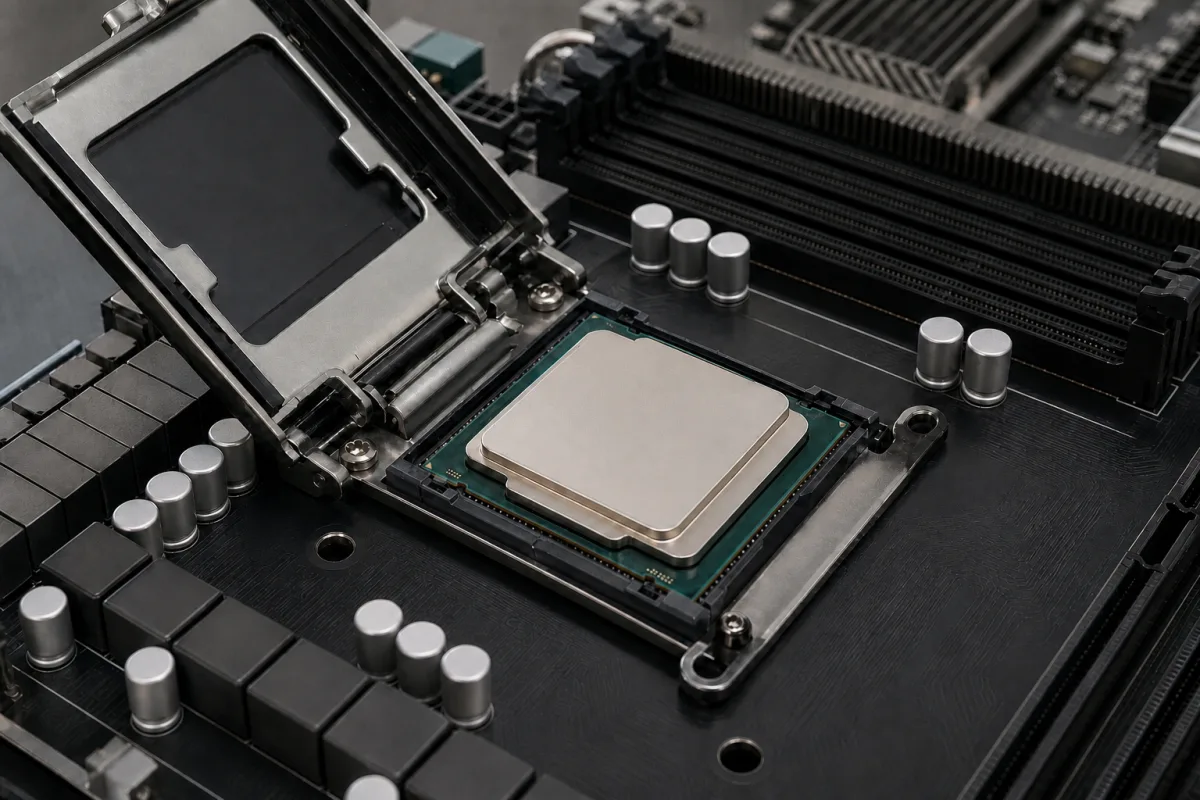
The primary integrated circuit that executes instructions and processes data in a computer system.
Product Specifications

Technical details and manufacturing context for Microprocessor

Definition
A microprocessor is the central component of a Central Processing Unit (CPU), responsible for performing arithmetic, logic, control, and input/output operations specified by computer program instructions. It acts as the brain of the computer system, fetching, decoding, and executing instructions from memory.
Working Principle
The microprocessor operates by fetching instructions from memory via the control unit, decoding them to understand the operation, executing the operation using the arithmetic logic unit (ALU) and registers, and then storing the results back in memory or registers. This fetch-decode-execute cycle is synchronized by a clock signal.
Common Materials
Silicon
Technical Parameters
  • Manufacturing process node indicating transistor size and density (nm) Customizable
Components / BOM
  • Arithmetic Logic Unit (ALU)
    Performs arithmetic and logical operations on data
    Material: silicon
  • Control Unit
    Directs operation of the processor by controlling data flow between components
    Material: silicon
  • Registers
    Small, fast storage locations for temporary data during processing
    Material: silicon
Engineering Reasoning
0.8-1.4 V core voltage, -40°C to 125°C junction temperature
1.6 V core voltage (electromigration threshold), 150°C junction temperature (silicon thermal runaway)
Design Rationale: Electromigration at >1.6V (electron wind force > 2.5×10⁵ N/m² dislodges copper atoms), thermal runaway at >150°C (exponential increase in leakage current > 10 mA/cm²)
Risk Mitigation (FMEA)
Trigger Electrostatic discharge > 2 kV (HBM model)
Mode: Gate oxide breakdown (dielectric rupture at >10 MV/cm)
Strategy: On-die ESD protection diodes with 0.5 ns response time
Trigger Clock signal jitter > 50 ps RMS
Mode: Setup/hold time violation (timing error propagation)
Strategy: Phase-locked loop with < 5 ps RMS jitter and clock tree balancing

Industry Taxonomies & Aliases

Commonly used trade names and technical identifiers for Microprocessor.

Applied To / Applications

This component is essential for the following industrial systems and equipment:

Industrial Ecosystem & Supply Chain DNA

Complementary Systems
Downstream Applications
Specialized Tooling

Application Fit & Sizing Matrix

Operational Limits
pressure: Atmospheric (not pressure-sensitive)
other spec: Power consumption: 15W to 150W typical, Clock frequency: 1GHz to 5GHz, Voltage: 0.8V to 1.2V core
temperature: 0°C to 85°C (commercial), -40°C to 125°C (industrial/automotive)
Media Compatibility
✓ Clean room assembly environments ✓ Standard PCB substrates (FR-4) ✓ Controlled data center cooling systems
Unsuitable: High-vibration industrial machinery without shock mounting
Sizing Data Required
  • Required processing performance (MIPS/GHz)
  • Thermal design power (TDP) budget
  • Memory bandwidth requirements (GB/s)

Reliability & Engineering Risk Analysis

Failure Mode & Root Cause
Electromigration
Cause: High current density causing metal atom migration in interconnects, leading to open/short circuits due to prolonged operation at elevated temperatures or overclocking.
Thermal runaway
Cause: Excessive heat generation from poor cooling, inadequate thermal interface material, or high ambient temperatures, resulting in permanent damage to semiconductor junctions.
Maintenance Indicators
  • System instability: frequent crashes, blue screens, or unexpected reboots under normal operating conditions.
  • Abnormal thermal behavior: unusually high CPU temperatures reported by monitoring software or audible fan speed fluctuations without load changes.
Engineering Tips
  • Implement robust thermal management: use high-quality thermal paste, ensure proper heatsink contact, maintain clean airflow paths, and monitor temperatures with predictive analytics.
  • Apply voltage regulation best practices: use stable power supplies with proper filtering, avoid overclocking beyond manufacturer specifications, and implement surge protection to prevent electrical stress.

Compliance & Manufacturing Standards

Reference Standards
ISO 9001:2015 (Quality Management Systems) IEC 60747-2 (Semiconductor devices - Discrete devices and integrated circuits) RoHS Directive (Restriction of Hazardous Substances)
Manufacturing Precision
  • Clock Frequency Stability: +/- 0.01%
  • Power Consumption Variation: +/- 5%
Quality Inspection
  • Automated Optical Inspection (AOI)
  • Electrical Parametric Testing (EPT)

Factories Producing Microprocessor

Verified manufacturers with capability to produce this product in China

✓ 98% Supplier Capability Match Found

T Technical Director from Singapore Feb 11, 2026
★★★★★
"The Microprocessor we sourced perfectly fits our Computer, Electronic and Optical Product Manufacturing production line requirements."
Technical Specifications Verified
P Project Engineer from Germany Feb 08, 2026
★★★★☆
"Found 38+ suppliers for Microprocessor on CNFX, but this spec remains the most cost-effective. (Delivery took slightly longer than expected, but technical support was excellent.)"
Technical Specifications Verified
S Sourcing Manager from Brazil Feb 05, 2026
★★★★★
"The technical documentation for this Microprocessor is very thorough, especially regarding technical reliability."
Technical Specifications Verified
Verification Protocol

“Feedback is collected from verified sourcing managers during RFQ (Request for Quote) and factory evaluation processes on CNFX. These reports represent historical performance data and technical audit summaries from our B2B manufacturing network.”

14 sourcing managers are analyzing this specification now. Last inquiry for Microprocessor from Mexico (1h ago).

Supply Chain Compatible Machinery & Devices

Industrial IoT Gateway

Edge computing device connecting industrial equipment to cloud platforms.

Explore Specs →
Modular Industrial Edge Computing Device

Rugged computing platform for industrial data processing at the network edge

Explore Specs →
Industrial Smart Camera Module

Embedded vision system for industrial automation and quality inspection.

Explore Specs →
Industrial Wireless Power Transfer Module

Wireless power transfer module for industrial equipment applications

Explore Specs →

Frequently Asked Questions

What are the main components of a microprocessor?

The main components include the Arithmetic Logic Unit (ALU) for calculations, Control Unit for instruction management, and Registers for temporary data storage.

Why is silicon used in microprocessor manufacturing?

Silicon is used because it's a semiconductor that can be precisely doped to create transistors, has excellent thermal properties, and allows for miniaturization in integrated circuits.

How does a microprocessor execute instructions in a computer system?

The microprocessor fetches instructions from memory, decodes them in the Control Unit, executes operations using the ALU, and stores results in registers or memory through a coordinated processing cycle.

Can I contact factories directly on CNFX?

CNFX is an open directory, not a transaction platform. Each factory profile provides direct contact information and production details to help you initiate direct inquiries with Chinese suppliers.

Get Quote for Microprocessor

Request technical pricing, lead times, or customized specifications for Microprocessor directly from verified manufacturing units.

Your business information is encrypted and only shared with verified Microprocessor suppliers.

Thank you! Your message has been sent. We'll respond within 1–3 business days.

Need to Manufacture Microprocessor?

Connect with verified factories specializing in this product category

Add Your Factory Contact Us
Previous Product
Microcontroller/Protocol Processor
Next Product
Microprocessor (CPU)