Industry-Verified Manufacturing Data (2026)

Central Processing Unit (CPU)

Based on aggregated insights from multiple verified factory profiles within the CNFX directory, the standard Central Processing Unit (CPU) used in the Machinery and Equipment Manufacturing sector typically supports operational capacities ranging from standard industrial configurations to heavy-duty production requirements.

Technical Definition & Core Assembly

A canonical Central Processing Unit (CPU) is characterized by the integration of Microprocessor and Memory Unit (RAM). In industrial production environments, manufacturers listed on CNFX commonly emphasize Semiconductor Silicon construction to support stable, high-cycle operation across diverse manufacturing scenarios.

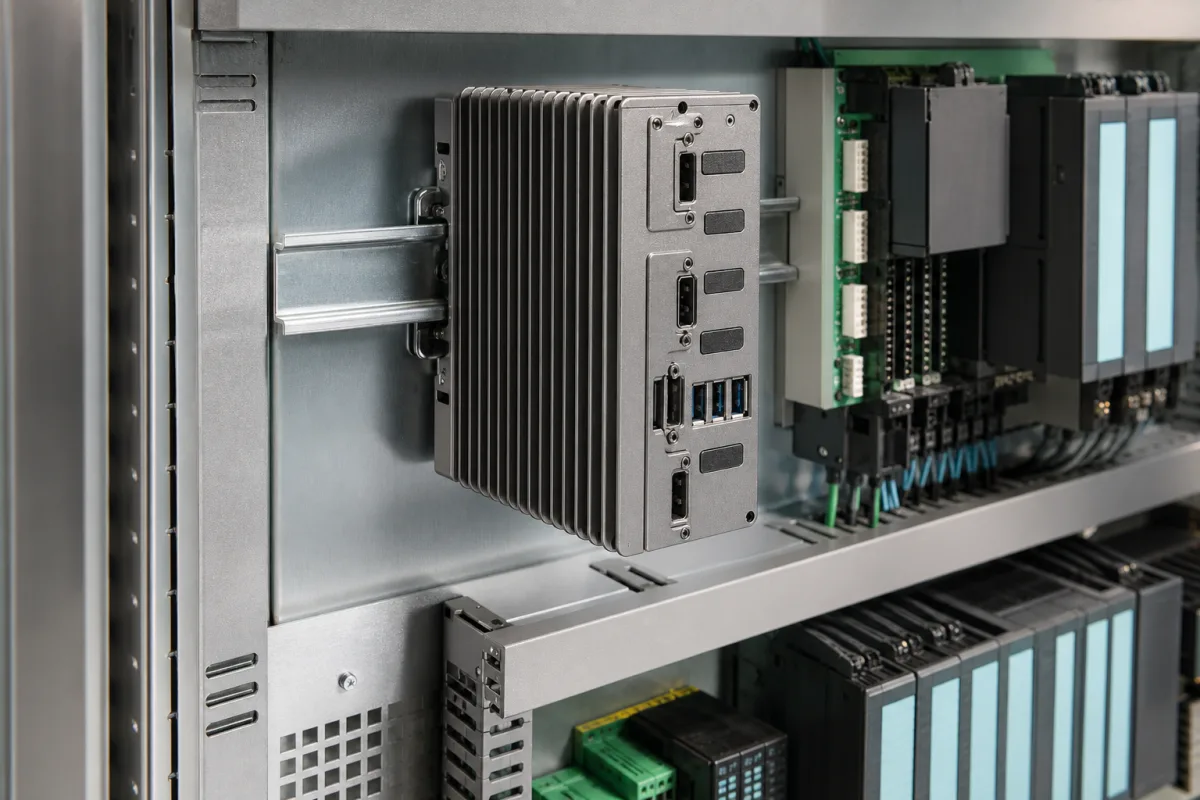
The primary computational and control unit within a PLC system that executes program instructions and manages system operations.
Product Specifications

Technical details and manufacturing context for Central Processing Unit (CPU)

Definition
In a PLC Control System, the Central Processing Unit (CPU) serves as the brain of the programmable logic controller. It is responsible for reading input signals from connected sensors and devices, executing the user-programmed control logic stored in memory, performing arithmetic and logical operations, and generating output signals to control actuators, motors, valves, and other industrial equipment. The CPU manages the entire scan cycle, handles communication with other devices (like HMIs, other PLCs, or SCADA systems), and performs diagnostic functions to ensure reliable automation process control.
Working Principle
The CPU operates on a cyclic scan principle: 1) Reads the status of all input modules. 2) Executes the user program (ladder logic, function block, structured text, etc.) stored in memory, one instruction at a time. 3) Updates the status of all output modules based on the program results. 4) Performs internal diagnostics and communication tasks. This scan cycle repeats continuously, typically in milliseconds, to provide real-time control of the industrial process.
Common Materials
Semiconductor Silicon, Copper, Plastic, Ceramic
Technical Parameters
  • Processor clock speed determining instruction execution rate (MHz) Standard Spec
Components / BOM
  • Microprocessor
    Executes arithmetic, logic, control, and input/output operations specified by program instructions
    Material: Semiconductor Silicon
  • Memory Unit (RAM)
    Stores the user program and data temporarily during operation for fast access by the microprocessor
    Material: Semiconductor Silicon
  • Memory Unit (ROM/Flash)
    Stores the operating system and firmware permanently, and may store the user program non-volatilely
    Material: Semiconductor Silicon
  • System Bus
    Pathway for transferring data, addresses, and control signals between the microprocessor, memory, and I/O interfaces
    Material: Copper
  • I/O Interface Controller
    Manages communication and data exchange between the CPU and the input/output modules
    Material: Semiconductor Silicon
  • Communication Interface
    Handles data exchange with external devices like programming terminals, HMIs, networks, and other controllers
    Material: Semiconductor Silicon, Copper, Plastic
  • Real-Time Clock (RTC)
    Provides accurate timekeeping for time-stamping events and scheduling time-based operations
    Material: Semiconductor Silicon
Engineering Reasoning
0-85°C ambient temperature, 0.95-1.05 Vcore voltage, 0-100% duty cycle
Junction temperature exceeding 125°C (TJmax), voltage deviation beyond ±5% of nominal, clock frequency instability >±0.01%
Design Rationale: Electromigration at current densities >1×10⁶ A/cm², dielectric breakdown at electric fields >10 MV/cm, thermal runaway due to power density >100 W/cm²
Risk Mitigation (FMEA)
Trigger Electrostatic discharge (ESD) exceeding 2000 V HBM
Mode: Gate oxide rupture in CMOS transistors
Strategy: Integrated ESD protection diodes with clamping voltage <5 V
Trigger Thermal cycling between -40°C and 125°C at 10 cycles/hour
Mode: Solder joint fatigue failure due to CTE mismatch (17 ppm/°C silicon vs 24 ppm/°C PCB)
Strategy: Underfill encapsulation with Young's modulus 5 GPa and CTE 25 ppm/°C

Industry Taxonomies & Aliases

Commonly used trade names and technical identifiers for Central Processing Unit (CPU).

Applied To / Applications

This component is essential for the following industrial systems and equipment:

Industrial Ecosystem & Supply Chain DNA

Complementary Systems
Downstream Applications
Specialized Tooling

Application Fit & Sizing Matrix

Operational Limits
pressure: N/A (electronic component)
other spec: Humidity: 5% to 95% non-condensing, Vibration: 5-500 Hz at 2G, Shock: 30G for 11ms
temperature: 0°C to 60°C (operating), -40°C to 85°C (storage)
Media Compatibility
✓ Industrial control cabinets ✓ Clean manufacturing environments ✓ Temperature-controlled enclosures
Unsuitable: Outdoor environments with direct exposure to moisture, dust, or corrosive chemicals
Sizing Data Required
  • Required I/O count and types
  • Program memory size needed
  • Communication protocol requirements (Ethernet/IP, Profinet, etc.)

Reliability & Engineering Risk Analysis

Failure Mode & Root Cause
Thermal throttling and degradation
Cause: Inadequate cooling leading to sustained high temperatures, causing silicon degradation, electromigration, and eventual failure of transistors and interconnects.
Electrostatic discharge (ESD) damage
Cause: Improper handling during installation or maintenance, resulting in sudden voltage spikes that destroy sensitive semiconductor components.
Maintenance Indicators
  • Frequent system crashes or blue screens under normal load conditions
  • Audible fan speed fluctuations or constant high-speed operation indicating thermal management issues
Engineering Tips
  • Implement proactive thermal management with regular cleaning of heatsinks/fans and monitoring of temperature sensors using predictive maintenance software
  • Establish strict ESD protocols during handling and maintenance, including use of grounded workstations and wrist straps, along with proper storage in anti-static packaging

Compliance & Manufacturing Standards

Reference Standards
ISO/IEC 15408: Common Criteria for Information Technology Security Evaluation CE Marking: EMC Directive 2014/30/EU for Electromagnetic Compatibility ANSI/ESD S20.20: Standard for the Development of an Electrostatic Discharge Control Program
Manufacturing Precision
  • Die Thickness: +/-0.01mm
  • Package Coplanarity: 0.05mm
Quality Inspection
  • Thermal Cycling Test (JESD22-A104)
  • Scanning Electron Microscopy (SEM) for Die Inspection

Factories Producing Central Processing Unit (CPU)

Verified manufacturers with capability to produce this product in China

✓ 93% Supplier Capability Match Found

P Project Engineer from Germany Feb 10, 2026
★★★★★
"Great transparency on the Central Processing Unit (CPU) components. Essential for our Machinery and Equipment Manufacturing supply chain."
Technical Specifications Verified
S Sourcing Manager from Brazil Feb 07, 2026
★★★★★
"The Central Processing Unit (CPU) we sourced perfectly fits our Machinery and Equipment Manufacturing production line requirements."
Technical Specifications Verified
P Procurement Specialist from Canada Feb 04, 2026
★★★★★
"Found 29+ suppliers for Central Processing Unit (CPU) on CNFX, but this spec remains the most cost-effective."
Technical Specifications Verified
Verification Protocol

“Feedback is collected from verified sourcing managers during RFQ (Request for Quote) and factory evaluation processes on CNFX. These reports represent historical performance data and technical audit summaries from our B2B manufacturing network.”

12 sourcing managers are analyzing this specification now. Last inquiry for Central Processing Unit (CPU) from Thailand (35m ago).

Supply Chain Compatible Machinery & Devices

Heavy-Duty CNC Plasma Cutting Machine

Industrial machine for precision metal cutting using plasma arc technology

Explore Specs →
Automated Assembly Line System

Integrated production system for sequential component assembly operations

Explore Specs →
Automated Powder Coating System

Integrated industrial system for applying dry powder coatings to metal substrates.

Explore Specs →
Centrifugal Pump Impeller

Rotating component that transfers energy to fluid in centrifugal pumps.

Explore Specs →

Frequently Asked Questions

What is the role of the CPU in a PLC system for machinery manufacturing?

The CPU serves as the central control unit that executes program instructions, processes input/output signals, and manages all system operations in industrial automation equipment.

What materials ensure reliability in industrial CPU construction?

Semiconductor silicon for processing, copper for conductivity, ceramic for heat dissipation, and durable plastic housing ensure long-term reliability in harsh manufacturing environments.

How does the CPU interface with machinery components?

Through dedicated I/O interface controllers and communication interfaces that connect to sensors, actuators, and other industrial equipment for real-time control and monitoring.

Can I contact factories directly on CNFX?

CNFX is an open directory, not a transaction platform. Each factory profile provides direct contact information and production details to help you initiate direct inquiries with Chinese suppliers.

Get Quote for Central Processing Unit (CPU)

Request technical pricing, lead times, or customized specifications for Central Processing Unit (CPU) directly from verified manufacturing units.

Your business information is encrypted and only shared with verified Central Processing Unit (CPU) suppliers.

Thank you! Your message has been sent. We'll respond within 1–3 business days.

Need to Manufacture Central Processing Unit (CPU)?

Connect with verified factories specializing in this product category

Add Your Factory Contact Us
Previous Product
Central Processing Unit
Next Product
Centralized Control System