Editorial Technical Reference

Power Supply Module

This page explains how Power Supply Module is classified within Electrical Equipment Manufacturing. Technical values and manufacturer relationships are research references; confirm the current specification and supplier evidence for each order.

Technical Definition & Core Assembly

A modular unit that converts and regulates electrical power for distribution to other components within an industrial system.

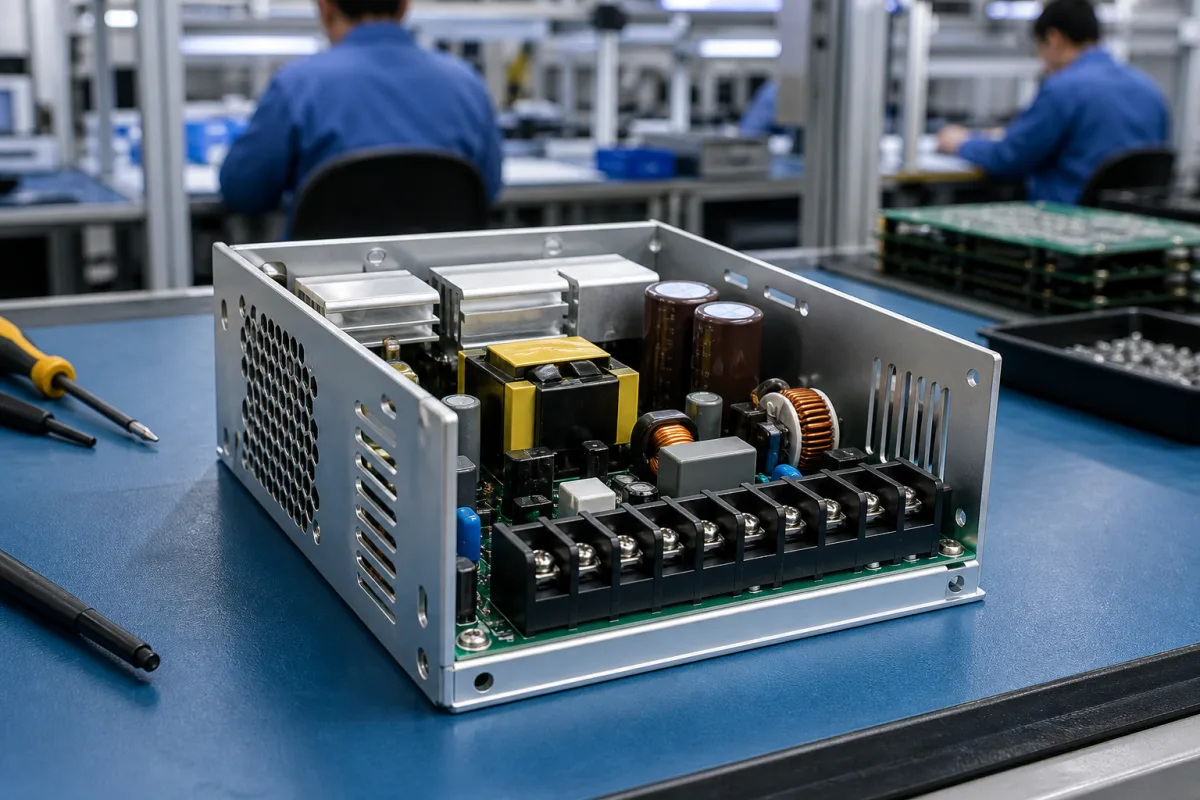
Representative product image. Confirm appearance and specifications with the manufacturer.

Product Specifications

Technical details and manufacturing context for Power Supply Module

Definition
The Power Supply Module is a critical component within industrial systems. It receives incoming electrical power, converts it to appropriate voltage and current levels, regulates output stability, and distributes clean, reliable power to various subsystems, controllers, sensors, and actuators throughout the industrial environment. This module is designed for a wide range of input voltages (85–264 V AC) to accommodate global compatibility, and it provides a typical output voltage of 24 V DC, which is common for industrial control systems. Output power ranges from 50 to 1000 W, allowing scalability based on system load requirements. Efficiency is rated between 85% and 95%, contributing to reduced heat generation. The module maintains line regulation within ±0.5% and load regulation within ±1.0%, ensuring stable output under varying input and load conditions. Ripple and noise are kept at or below 50 mV peak-to-peak, which is critical for sensitive electronics. The operating temperature range is -40°C to 85°C, with derating above 60°C, and storage temperature ranges from -40°C to 105°C. Relative humidity tolerance is 5% to 95% non-condensing. Ingress protection ratings vary from IP20 to IP65, with IP65 suitable for washdown environments. Isolation voltage between input and output is 3000 V AC for 1 minute, and the mean time between failures (MTBF) is 500,000 hours at 25°C full load. Typical dimensions for a 100W module are 50 x 100 x 150 mm (W x H x D). The module is constructed with an aluminum heat sink, printed circuit board, electronic components (capacitors, resistors, ICs), and a plastic or steel enclosure. It operates by receiving AC or DC input, passing through transformers, rectifiers, and filtering circuits, then using linear or switching regulation to maintain stable output. Protection circuits guard against overloads, short circuits, and overheating. For specific model applications, verify all parameters and standards with the legal manufacturer or supplier.
Working Principle
The Power Supply Module physically functions by receiving AC or DC input power through input terminals, passing it through transformers, rectifiers, and filtering circuits to convert and condition the electrical signal. It then uses voltage regulation circuits (linear or switching) to maintain stable output parameters despite input fluctuations or load variations. Heat sinks and cooling mechanisms dissipate generated thermal energy, while protection circuits guard against overloads, short circuits, and overheating.
Common Materials
Aluminum Heat Sink, Printed Circuit Board (PCB), Electronic Components (capacitors, resistors, ICs), Plastic/Steel Enclosure
Technical Parameters
ParameterTypical rangeNotes & selection driver
Input Voltage Range85–264 V ACWide range for global compatibilityIEC 61000-4-11
Output Voltage24 V DCTypical industrial control voltage
Output Power50–1000 WScalable for system load
Efficiency85–95 %Higher efficiency reduces heatIEC 62301
Line Regulation±0.5 %Output stability under input variation
Load Regulation±1.0 %Output stability under load change
Ripple & Noise≤50 mV p-pCritical for sensitive electronics
Operating Temperature-40–85 °CFull load derating above 60°CIEC 60068-2-1/2
Storage Temperature-40–105 °CNon-operating survivalIEC 60068-2-1/2
Relative Humidity5–95 %Non-condensingIEC 60068-2-78
Ingress ProtectionIP20–IP65IP65 for washdown environmentsIEC 60529
Isolation Voltage3000 V ACInput to output, 1 minuteIEC 62368-1
MTBF500000 hAt 25°C, full loadIEC 61709
Dimensions (W x H x D)50 x 100 x 150 mmTypical for 100W module

Ranges are indicative industry figures for RFQ preparation, not a supplier commitment. Confirm every value and standard with the legal manufacturer before ordering.

Components / BOM
  • Input Filter Part
    Reduces electromagnetic interference and noise from input power
    Material: Ferrite cores, capacitors, inductors
  • Rectifier Circuit
    Converts AC input to DC for further processing
    Material: Diodes, bridge rectifiers
  • Voltage Regulator
    Maintains stable output voltage despite input or load variations
    Material: Voltage regulator ICs, transistors, feedback circuits
  • Output Protection
    Prevents damage from overloads, short circuits, and overvoltage
    Material: Fuses, circuit breakers, protection ICs
  • Cooling System Optional
    Dissipates heat generated during power conversion
    Material: Aluminum heat sink, fan (if active cooling)
  • Transformer
    Steps the input voltage to the level the rectifier stage needs, and gives isolation.

Industry Taxonomies & Aliases

Commonly used trade names and technical identifiers for Power Supply Module.

Applied To / Applications

This component is essential for the following industrial systems and equipment:

Industrial Ecosystem & Supply Chain Structure

Complementary Systems
Downstream Applications
Specialized Tooling

Application Fit & Sizing Matrix

Operational Limits
pressure: N/A (electrical component, not fluid handling)
other spec: Input Voltage Range: 85-264V AC, 120-370V DC
temperature: -40°C to +85°C
Media Compatibility
✓ Industrial Control Systems ✓ Motor Drives ✓ PLC Cabinets
Unsuitable: High-vibration environments without proper mounting
Sizing Data Required
  • Required Output Power (W)
  • Input Voltage Type (AC/DC)
  • Output Voltage/Current Requirements

Reliability & Engineering Risk Analysis

Failure Mode & Root Cause
Capacitor degradation
Cause: Electrolyte drying due to thermal stress from high ambient temperatures or poor ventilation
MOSFET/transistor failure
Cause: Overcurrent or voltage spikes from load fluctuations, poor power quality, or inadequate surge protection
Maintenance Indicators
  • Audible high-pitched whine or buzzing from the module indicating capacitor or transformer issues
  • Visible bulging or leaking capacitors, or discoloration/burning on PCB components
Engineering Tips
  • Implement regular thermal monitoring and ensure adequate cooling with clean airflow to maintain operating temperatures within manufacturer specifications
  • Install proper line conditioning (surge protectors, voltage regulators) and ensure stable, balanced loads to prevent electrical stress on components

Indicative industry ranges for design and RFQ preparation. Confirm the exact figures and applicable standard with the manufacturer before specifying.

Compliance & Manufacturing Standards

Applicable Standards
CE Marking (EU Directive 2014/35/EU - Low Voltage Directive) IEC 61010-1 (Safety Requirements for Electrical Equipment for Measurement, Control, and Laboratory Use)

Quoted from the published standard.

Manufacturing Precision
  • Output Voltage Regulation: +/- 5% of nominal voltage
  • Temperature Coefficient: +/- 0.03%/°C over operating range
Quality Inspection
  • Hi-Pot (Dielectric Withstand) Test
  • Load Regulation and Efficiency Test

Manufacturers of Power Supply Module

1 company lists this product among what they make. Company figures are quoted from each company's own website; every card states where the relationship came from.

HONGFA
Xiamen, Fujian, CN
Listed on the company's own website · profile compiled by CNFX from public sources

Manufacturer listings support early research and capability understanding. They are not certification, ranking, or transaction guarantees.

Technical documentation
Request current drawings, revision history, and a signed specification sheet.
Manufacturing capability
Verify equipment lists, process limits, capacity, and representative production evidence.
Inspection readiness
Confirm test methods, calibrated equipment, sampling plans, and traceable reports.
Supplier transparency
Check the legal entity, factory address, ownership, certifications, and direct contacts.

CNFX does not score or rank suppliers. Buyers must verify all claims and documents with the legal manufacturer before ordering.

Supply Chain Commonly Integrated Components

Flange Assembly

A structural component that provides mechanical connection and sealing interface in high-voltage insulating bushings.

Explore Specs →
Slurry Supply System

A system that precisely meters and delivers electrode slurry to the coating head in lithium-ion battery electrode production.

Explore Specs →
Voltage Control Unit

A precision electronic component that regulates and adjusts the output voltage in an Industrial Dielectric Strength Tester.

Explore Specs →
Main Circuit Breaker

Primary protective device in a smart home electrical panel that controls and safeguards the entire electrical circuit.

Explore Specs →

Frequently Asked Questions

What input voltage ranges are supported?

The module accepts a wide input voltage range of 85–264 V AC, designed for global compatibility. Always verify the exact input range for the specific model with the manufacturer.

What is the typical output voltage and power?

The typical output voltage is 24 V DC, and output power ranges from 50 to 1000 W, scalable to system load. Confirm the exact output specifications for your application.

What are the key performance specifications?

Efficiency is 85–95%, line regulation ±0.5%, load regulation ±1.0%, ripple and noise ≤50 mV p-p, and MTBF 500,000 hours at 25°C full load. These are reference values; verify with the manufacturer.

What environmental conditions can it withstand?

Operating temperature is -40°C to 85°C (derate above 60°C), storage -40°C to 105°C, humidity 5–95% non-condensing, and ingress protection IP20–IP65. Check the specific model's ratings.

Data Basis

Editorial classification, named public sources where available, and source-reviewed manufacturer records.

Preliminary Technical Classification
This page supports structured research, RFQ preparation, and supplier evaluation. It does not replace buyer-led supplier qualification, standards review, or technical approval.
Buyer enquiry

Request manufacturing insight for Power Supply Module

Ask for use case, specification boundaries, supplier type, and RFQ preparation information for this product.

Where it goes
Straight to the CNFX editorial desk, and to the manufacturer if this product is linked to a claimed profile. Nothing is broadcast to a supplier list.
Your details stay here
We do not sell or rent enquiry data, and we do not add you to a mailing list. Used only to answer this request.
No commission, no middleman
CNFX is a directory. We take no cut of any order and never negotiate on a supplier's behalf.
What we don't claim
A listing is not an endorsement. Qualify every supplier and verify every figure yourself before ordering.

Your business information is used only to process this request.

Thank you! Your message has been sent. We'll respond within 1–3 business days.
Sorry, we couldn't send your message. Please try again, or email us at contact@cnfx.com.

Need to Manufacture Power Supply Module?

Compare manufacturer profiles with relevant product and process capability.

Previous Product
Wire Tensioning System
Last Product
Get QuotesChat