Industry-Verified Manufacturing Data (2026)

Modulator/Demodulator (Modem)

Based on aggregated insights from multiple verified factory profiles within the CNFX directory, the standard Modulator/Demodulator (Modem) used in the Computer, Electronic and Optical Product Manufacturing sector typically supports operational capacities ranging from standard industrial configurations to heavy-duty production requirements.

Technical Definition & Core Assembly

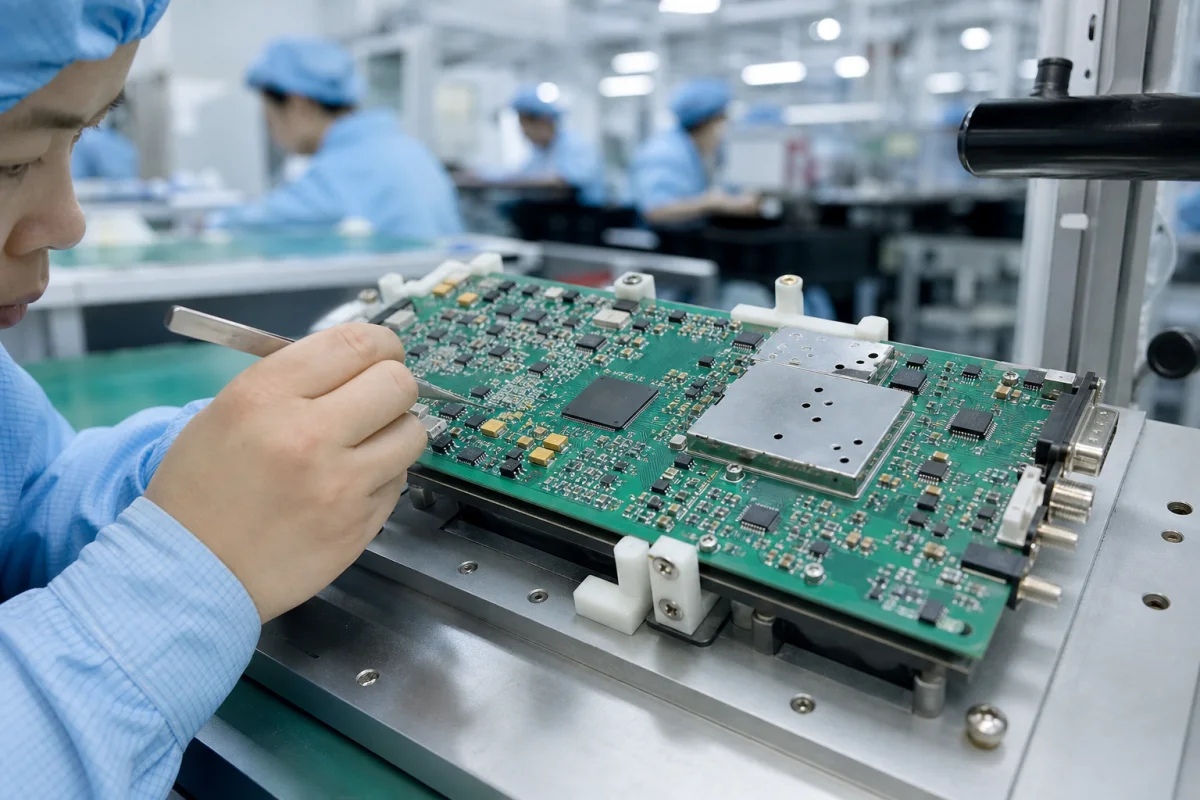
A canonical Modulator/Demodulator (Modem) is characterized by the integration of Digital Signal Processor (DSP) Core and Digital-to-Analog Converter (DAC). In industrial production environments, manufacturers listed on CNFX commonly emphasize Semiconductor (Silicon/GaAs) construction to support stable, high-cycle operation across diverse manufacturing scenarios.

A component within an RF transceiver that modulates digital data onto a carrier signal for transmission and demodulates received signals to recover the original data.
Product Specifications

Technical details and manufacturing context for Modulator/Demodulator (Modem)

Definition
The Modulator/Demodulator (Modem) is a critical functional block within an RF transceiver system. It serves as the interface between the digital baseband processing unit and the analog RF front-end. Its primary role is to convert outgoing digital data streams into modulated RF signals suitable for transmission over a wireless channel and to convert incoming modulated RF signals back into digital data streams for processing.
Working Principle
The modem operates by applying a modulation scheme (e.g., QPSK, QAM, OFDM) to a carrier wave based on the input digital data. The modulator maps bits to specific changes in the carrier's amplitude, frequency, or phase. The demodulator performs the inverse process, analyzing the received signal to detect these changes and map them back to the original digital bits, often involving synchronization, equalization, and error correction.
Common Materials
Semiconductor (Silicon/GaAs), Ceramic Substrate, Copper Traces
Technical Parameters
  • Operating frequency band of the RF transceiver. (MHz) Standard Spec
Components / BOM
  • Digital Signal Processor (DSP) Core
    Executes algorithms for modulation, demodulation, coding, and filtering.
    Material: Semiconductor (Silicon)
  • Digital-to-Analog Converter (DAC)
    Converts modulated digital signals to analog waveforms for the transmitter path.
    Material: Semiconductor (Silicon)
  • Analog-to-Digital Converter (ADC)
    Converts received analog signals to digital samples for the receiver demodulation path.
    Material: Semiconductor (Silicon)
  • Local Oscillator Interface
    Provides the carrier frequency reference signal from the transceiver's synthesizer.
    Material: Copper/Gold
Engineering Reasoning
0-85°C ambient temperature, 3.3-5.0V DC supply voltage, -40 to +85 dBm input power
Ambient temperature > 125°C, supply voltage > 5.5V or < 2.7V, input power > +10 dBm
Design Rationale: Semiconductor junction thermal runaway at > 150°C junction temperature, dielectric breakdown at > 5.5V, mixer stage saturation at > +10 dBm input
Risk Mitigation (FMEA)
Trigger Local oscillator phase noise exceeding -110 dBc/Hz at 1 kHz offset
Mode: Bit error rate degradation beyond 10^-6 at 256-QAM modulation
Strategy: Crystal oscillator with 0.5 ppm stability and temperature-compensated varactor tuning
Trigger I/Q modulator amplitude imbalance > 0.5 dB or phase error > 2 degrees
Mode: Constellation diagram distortion causing EVM > 3.5% at 64-QAM
Strategy: Calibrated Gilbert cell mixer with automatic gain control loop maintaining 0.1 dB precision

Industry Taxonomies & Aliases

Commonly used trade names and technical identifiers for Modulator/Demodulator (Modem).

Applied To / Applications

This component is essential for the following industrial systems and equipment:

Industrial Ecosystem & Supply Chain DNA

Complementary Systems
Downstream Applications
Specialized Tooling

Application Fit & Sizing Matrix

Operational Limits
pressure: Not applicable (solid-state electronic component)
other spec: Frequency range: 400 MHz to 6 GHz, Data rate: up to 100 Mbps, Power supply: 3.3V ±10%
temperature: -40°C to +85°C (operational), -55°C to +125°C (storage)
Media Compatibility
✓ RF coaxial connectors (SMA, N-type) ✓ Printed circuit boards (FR-4, Rogers) ✓ Enclosures (aluminum, shielded plastic)
Unsuitable: High-voltage electrical discharge environments (e.g., near arc welding equipment)
Sizing Data Required
  • Required data rate (bps)
  • Operating frequency range (MHz/GHz)
  • Modulation scheme (e.g., QPSK, 16-QAM, 64-QAM)

Reliability & Engineering Risk Analysis

Failure Mode & Root Cause
Overheating due to thermal stress
Cause: Inadequate cooling, dust accumulation on heat sinks, or prolonged high-load operation causing component degradation
Signal degradation or loss
Cause: Corrosion or oxidation of connectors, electromagnetic interference (EMI) from nearby equipment, or aging of internal capacitors and semiconductors
Maintenance Indicators
  • Intermittent or complete loss of signal connectivity despite proper network settings
  • Unusual audible buzzing or humming from the unit, or visible signs of overheating such as discoloration or a burning smell
Engineering Tips
  • Implement regular cleaning of vents and heat sinks to prevent dust buildup, and ensure adequate ventilation in the installation environment
  • Use shielded cables and proper grounding to minimize EMI, and periodically inspect and clean connector contacts to prevent corrosion

Compliance & Manufacturing Standards

Reference Standards
ISO/IEC 11801: Information technology - Generic cabling for customer premises ANSI/TIA-568.2-D: Balanced Twisted-Pair Telecommunications Cabling and Components Standards EN 55032: Electromagnetic compatibility of multimedia equipment - Emission requirements
Manufacturing Precision
  • Signal-to-Noise Ratio (SNR): +/- 3 dB
  • Frequency Stability: +/- 0.1 ppm
Quality Inspection
  • Bit Error Rate (BER) Test
  • Electromagnetic Compatibility (EMC) Emission Test

Factories Producing Modulator/Demodulator (Modem)

Verified manufacturers with capability to produce this product in China

✓ 94% Supplier Capability Match Found

S Sourcing Manager from United Arab Emirates Jan 08, 2026
★★★★★
"Impressive build quality. Especially the technical reliability is very stable during long-term operation."
Technical Specifications Verified
P Procurement Specialist from Australia Jan 05, 2026
★★★★☆
"As a professional in the Computer, Electronic and Optical Product Manufacturing sector, I confirm this Modulator/Demodulator (Modem) meets all ISO standards. (Delivery took slightly longer than expected, but technical support was excellent.)"
Technical Specifications Verified
T Technical Director from Singapore Jan 02, 2026
★★★★★
"Standard OEM quality for Computer, Electronic and Optical Product Manufacturing applications. The Modulator/Demodulator (Modem) arrived with full certification."
Technical Specifications Verified
Verification Protocol

“Feedback is collected from verified sourcing managers during RFQ (Request for Quote) and factory evaluation processes on CNFX. These reports represent historical performance data and technical audit summaries from our B2B manufacturing network.”

18 sourcing managers are analyzing this specification now. Last inquiry for Modulator/Demodulator (Modem) from Germany (1h ago).

Supply Chain Compatible Machinery & Devices

Modular Industrial Edge Computing Device

Rugged computing platform for industrial data processing at the network edge

Explore Specs →
Industrial Smart Camera Module

Embedded vision system for industrial automation and quality inspection.

Explore Specs →
Industrial Wireless Power Transfer Module

Wireless power transfer module for industrial equipment applications

Explore Specs →
Industrial Smart Sensor Module

Modular industrial sensor with embedded processing and wireless connectivity

Explore Specs →

Frequently Asked Questions

What is the primary function of this modem in RF transceivers?

This modem modulates digital data onto a carrier signal for transmission and demodulates received signals to recover the original data, serving as a critical component in RF communication systems.

What materials are used in this modem's construction?

The modem utilizes semiconductor materials like Silicon and GaAs for active components, ceramic substrates for thermal management, and copper traces for electrical connectivity.

What key components are included in the modem's Bill of Materials (BOM)?

The BOM includes a Digital Signal Processor (DSP) core for signal processing, Digital-to-Analog Converter (DAC) and Analog-to-Digital Converter (ADC) for signal conversion, and a Local Oscillator Interface for frequency control.

Can I contact factories directly on CNFX?

CNFX is an open directory, not a transaction platform. Each factory profile provides direct contact information and production details to help you initiate direct inquiries with Chinese suppliers.

Get Quote for Modulator/Demodulator (Modem)

Request technical pricing, lead times, or customized specifications for Modulator/Demodulator (Modem) directly from verified manufacturing units.

Your business information is encrypted and only shared with verified Modulator/Demodulator (Modem) suppliers.

Thank you! Your message has been sent. We'll respond within 1–3 business days.

Need to Manufacture Modulator/Demodulator (Modem)?

Connect with verified factories specializing in this product category

Add Your Factory Contact Us
Previous Product
Modulator/Demodulator
Next Product
Module Housing Assembly Station