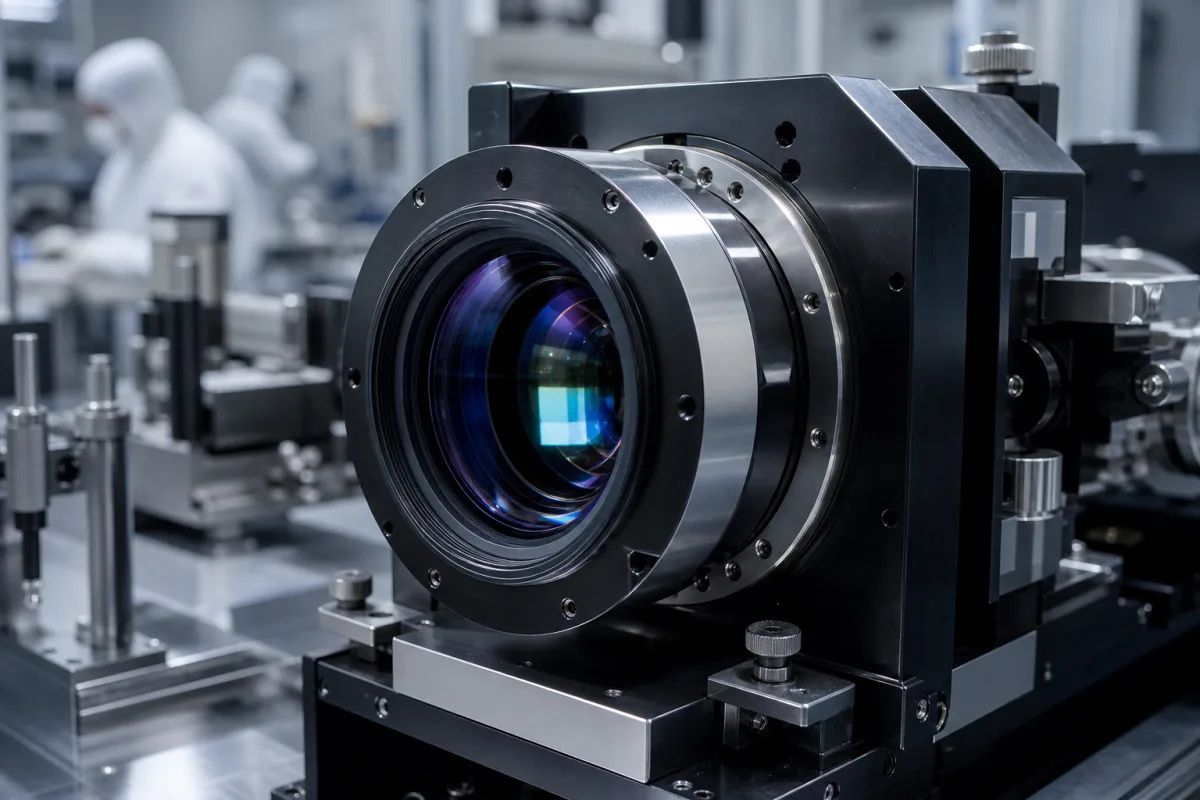
Objective lens for microscopes, inspection and interferometric heads
Microscope and inspection optics · Numerical aperture and resolution, infinity tube lens and thread, interferometry objectives, working distance
An objective lens is the optical assembly nearest the specimen in a microscope, inspection camera or interferometric optical head: it collects light from the object and, with a tube lens or eyepiece, forms the magnified image. Ask three things first: what numerical aperture and working distance the task needs, which optical system the objective must match (infinity or finite, tube lens focal length, thread, cover glass), and whether the head uses an interferometry objective with a built-in reference path.
Microscope-type objective lenses, including infinity-corrected objectives and Mirau-type interferometry objectives, for laboratory, industrial inspection and optical metrology heads. Camera lenses, miniature board lenses, telescope objectives and complete microscopes are outside this page.
CNFX editorial research · Sources checked October 12, 2026 · 6 sources
Set numerical aperture for resolution and working distance
Nikon's MicroscopyU defines numerical aperture as NA = n × sin(α), where n is the refractive index of the medium between the front lens and the specimen and α is half the angular aperture. NA measures the objective's ability to gather light and resolve fine detail at a fixed object distance; MicroscopyU states that NA above 0.95 is difficult to reach with dry objectives, and that water (n = 1.33), glycerin (1.47) and immersion oil (1.51) allow higher values. [1]
MicroscopyU gives resolution, the shortest distance between two points that can still be distinguished, as r = 0.61λ/NA among its formulas, and notes that shorter wavelengths resolve finer detail and that the condenser NA also affects total resolution in transmitted light. [2] For 10x plan objectives it gives NA 0.25 for a plan achromat, 0.30 for a plan fluorite and 0.45 for a plan apochromat, showing that higher correction comes with higher NA at the same magnification. [1]
Editorial calculation: at an assumed 550 nm wavelength, r = 0.61 × 0.55 µm / 0.30 ≈ 1.1 µm for an NA 0.30 objective and ≈ 0.67 µm for NA 0.50. [2] Leica's 10x/0.30 Mirau objective has 4.27 mm free working distance and its 50x/0.50 Mirau objective 2.52 mm, so the higher-NA objective in this pair leaves less room above the part. [5][6]
Give the supplier the task (imaging, inspection, interferometric surface measurement), the smallest feature to resolve, wavelength band and light source, required magnification and field of view, minimum working distance, immersion or dry, cover glass or none, the microscope or head the objective must fit (tube lens focal length, thread, parfocal distance), environment, and test data required.
02
Match the objective to the optical system
MicroscopyU explains that in infinity-corrected systems the objective sends parallel light to a tube lens that forms the intermediate image, allowing prisms, polarizers and illuminators in the parallel path with minimal effect on focus. It lists tube lens focal lengths of 200 mm (Leica, Nikon), 180 mm (Olympus) and 165 mm (Zeiss), parfocal distances of 45 mm or 60 mm (Nikon), and M25 or RMS threads. [3]
MicroscopyU warns that infinity-corrected objectives “are usually not interchangeable” with those for finite 160 mm or 170 mm tube length microscopes, that infinity objectives suffer spherical aberration on a finite system, and that infinity objectives from different makers may not interchange because of tube length and thread differences. [3][4] Editorial calculation: in an infinity system, magnification is the tube lens focal length divided by the objective focal length, so the same objective focused by a 180 mm tube lens instead of a 200 mm one gives 10% lower magnification.
Barrel engravings carry the key data. MicroscopyU's table of designations includes Plan (flat field), Apo (apochromatic), LWD/ELWD (long working distances), Corr (correction collar), NC/NCG (no coverslip), M25/M32 metric threads, and DI, MI, TI for interferometry objectives. [4]
03
Choose an interferometry objective for surface measurement
Leica lists Mirau objectives for reflected-light interferometry: the HC PL FLUOTAR 10x/0.30 Mirau with 4.27 mm free working distance, field number 22, M25 thread and no cover glass, and the N PLAN L 50x/0.50 Mirau with 2.52 mm free working distance, field number 25 and M25 thread, also without cover glass. [5][6]
Leica's 50x Mirau page lists the immersion as dry in its specification table while its summary text mentions oil immersion; editorial note: confirm the immersion medium and working distance with the supplier for the exact part number. [6] For any interferometric head, ask whether the reference mirror is built into the objective, how it is adjusted, and which wavelength and light source the objective is corrected for.
04
OEM microscope objectives and custom instrument objectives from Hitronics and VY Optoelectronics
Listings include custom objectives for microscopes and instruments and OEM microscope objectives for biomedical and metrology modules; ask each for NA, working distance, focal length, wavelength range and thread.
05
Lens elements, front lens and medium, housing and thread, coating, Mirau reference path and correction collar
The housing-and-thread row decides whether an objective fits at all: MicroscopyU lists M25 and RMS threads and parfocal distances of 45 mm or 60 mm. [3]
Focal length, NA, working distance, wavelength band, transmittance and thread for an objective order
Working distance is the only row with part-number values, from Leica's two Mirau objectives; focal length matters because, with the tube lens, it sets magnification. [5][6][3]
2 companies list this product among what they make. Company figures are quoted from each
company's own website; every card states where the relationship came from.
Hitronics
Manufacturing site to be confirmed for the order
Lists OEM microscope objective lenses, including high-NA fluorescence collection and OCT objectives.
Explore company information and manufacturing capabilities, then discuss the scope of your project with a relevant supplier.
Share this page
Compiled and source-reviewed by the CNFX editorial team.
Each manufacturer above links to the page on that company's own website where the product is listed, with the date we checked it. How we source and review
· Page last updated 13 October 2026
Buyer questions
What is the numerical aperture of an objective?
Per Nikon's MicroscopyU, NA = n × sin α, where n is the refractive index of the medium and α is half the angular aperture; it sets light gathering and resolution. [1]
How does NA relate to resolution?
MicroscopyU gives r = 0.61λ/NA; at 550 nm an NA 0.30 objective resolves about 1.1 µm (editorial calculation). [2]
Can I use any infinity objective on any microscope?
Not necessarily: MicroscopyU lists tube lens focal lengths from 165 to 200 mm and different threads by maker, and says finite and infinity objectives “are usually not interchangeable”. [3]
What is a Mirau objective?
An interferometry objective; Leica lists 10x/0.30 and 50x/0.50 Mirau objectives with 4.27 mm and 2.52 mm free working distance. [5][6]
Sources and what still needs a direct check
Sources checked 2026-10-12. Nikon's MicroscopyU is a maker's educational reference; Leica's pages are maker specifications for specific objectives. Objective data should be confirmed for the exact part number.