Industry-Verified Manufacturing Data (2026)

Interferometric Optical Head

Based on aggregated insights from multiple verified factory profiles within the CNFX directory, the standard Interferometric Optical Head used in the Computer, Electronic and Optical Product Manufacturing sector typically supports operational capacities ranging from standard industrial configurations to heavy-duty production requirements.

Technical Definition & Core Assembly

A canonical Interferometric Optical Head is characterized by the integration of Laser Source and Beam Splitter. In industrial production environments, manufacturers listed on CNFX commonly emphasize Fused Silica construction to support stable, high-cycle operation across diverse manufacturing scenarios.

A precision optical component that generates and analyzes interference patterns for non-contact surface measurement.

Product Specifications

Technical details and manufacturing context for Interferometric Optical Head

Definition
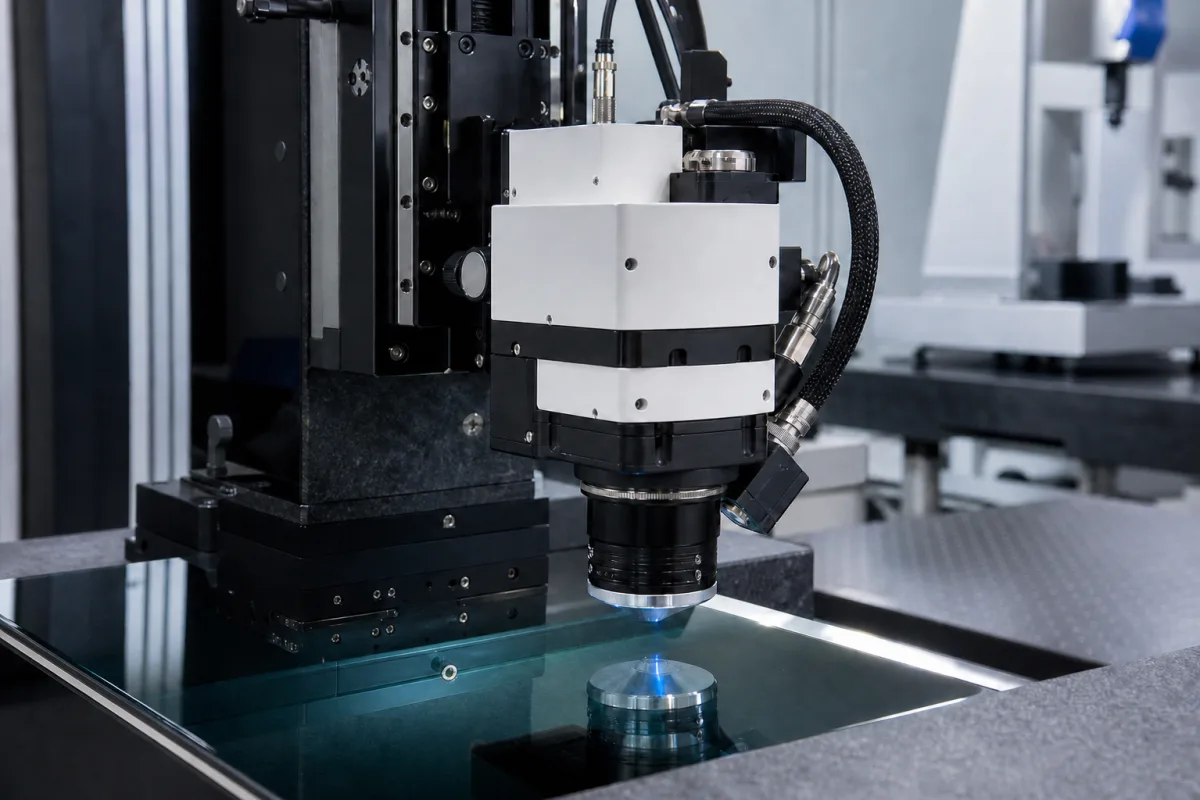
The interferometric optical head is a critical component within the Precision Optical Lens Inspection and Measurement System. It functions as the primary sensing unit, projecting coherent light onto the lens surface and capturing the resulting interference fringes. These fringes are used to calculate surface topography, curvature, and defects with nanometer-level accuracy, enabling high-precision quality control in optical manufacturing.
Working Principle
The head emits a coherent light beam (typically from a laser) that splits into a reference beam and a measurement beam. The measurement beam reflects off the optical lens surface, while the reference beam travels a known path. The two beams recombine, creating an interference pattern whose phase and intensity variations correspond directly to the surface profile of the lens under test. This pattern is captured by a detector array and processed to generate 3D surface maps.
Common Materials
Fused Silica, Stainless Steel, Precision Bearings
Technical Parameters
  • Measurement resolution (typically < 1 nm) (nm) Customizable
Components / BOM
  • Laser Source
    Generates coherent monochromatic light for interference
    Material: Semiconductor/Gas Laser Components
  • Beam Splitter
    Divides the incoming light into reference and measurement beams
    Material: Coated Fused Silica
  • Reference Mirror
    Provides a stable reference path for the interferometer
    Material: Ultra-flat Coated Glass
  • Objective Lens
    Focuses light onto the test surface and collects reflected light
    Material: Precision Optical Glass
  • Detector Array
    Captures the interference pattern for digital processing
    Material: CCD/CMOS Sensor Silicon
Engineering Reasoning
0.1-100 μm displacement measurement range, 0.1-10 m/s scanning velocity, 632.8 nm HeNe laser wavelength
Coherence length degradation below 10 m, fringe contrast reduction below 0.3, beam divergence exceeding 0.5 mrad
Design Rationale: Thermal expansion mismatch between optical mounts (Δα=7.2×10⁻⁶ K⁻¹) causing misalignment, photodetector saturation at 5 mW incident power, piezoelectric actuator hysteresis exceeding 2% at 100 Hz
Risk Mitigation (FMEA)
Trigger Thermal gradient of 15 K across optical bench
Mode: Fringe pattern distortion with 0.25λ wavefront error
Strategy: Invar alloy structural members with α=1.2×10⁻⁶ K⁻¹, active thermal control with ±0.1 K stability
Trigger Vibration at 120 Hz with 0.5 g amplitude
Mode: Phase measurement noise exceeding 2π/100 rad
Strategy: Kinematic mounting with 25 Hz natural frequency, eddy current damping with 0.7 critical damping ratio

Industry Taxonomies & Aliases

Commonly used trade names and technical identifiers for Interferometric Optical Head.

Industrial Ecosystem & Supply Chain DNA

Complementary Systems
Downstream Applications
Specialized Tooling

Application Fit & Sizing Matrix

Operational Limits
pressure: Atmospheric pressure only (non-pressurized)
other spec: Vibration tolerance: <0.5g RMS, Humidity: 10-80% non-condensing, Cleanliness: ISO Class 5 or better recommended
temperature: 0°C to 50°C (operating), -20°C to 70°C (storage)
Media Compatibility
✓ Metallic surfaces (steel, aluminum, titanium) ✓ Semiconductor wafers (silicon, GaAs) ✓ Optical components (lenses, mirrors, prisms)
Unsuitable: High particulate environments (sandblasting, powder coating areas)
Sizing Data Required
  • Measurement range (e.g., 0-100μm, 0-1mm)
  • Required resolution/accuracy (e.g., ±10nm, ±0.1%)
  • Target surface reflectivity/roughness (e.g., Ra <0.1μm, >20% reflectivity)

Reliability & Engineering Risk Analysis

Failure Mode & Root Cause
Optical Misalignment
Cause: Thermal expansion/contraction of mounting components, mechanical shock/vibration, or improper installation causing beam path deviation
Laser Diode Degradation
Cause: Thermal stress from inadequate heat dissipation, current spikes in power supply, or exceeding operational duty cycles leading to reduced output power
Maintenance Indicators
  • Inconsistent or fluctuating measurement readings during calibration checks
  • Visible condensation or contamination on optical surfaces or audible cooling fan irregularities
Engineering Tips
  • Implement active temperature stabilization with PID-controlled thermal management to minimize thermal drift effects
  • Establish regular optical path verification using certified reference standards and maintain clean-room level particulate control in the operating environment

Compliance & Manufacturing Standards

Reference Standards
ISO 10110-7:2017 (Optics and photonics - Preparation of drawings for optical elements and systems - Surface imperfection tolerances) ANSI/ASME B46.1-2019 (Surface Texture, Surface Roughness, Waviness, and Lay) DIN 3140-7:2016 (Optics and optical instruments - Preparation of drawings for optical elements and systems - Part 7: Surface imperfection tolerances)
Manufacturing Precision
  • Flatness of reference surface: λ/10 (typically 63.3 nm at 632.8 nm wavelength)
  • Parallelism between mounting surfaces: ≤ 2 arcseconds
Quality Inspection
  • Interferometric surface flatness test (using reference flat and monochromatic light source)
  • Laser alignment and optical axis verification test

Factories Producing Interferometric Optical Head

Verified manufacturers with capability to produce this product in China

✓ 92% Supplier Capability Match Found

P Project Engineer from United States Jan 09, 2026
★★★★★
"The Interferometric Optical Head we sourced perfectly fits our Computer, Electronic and Optical Product Manufacturing production line requirements."
Technical Specifications Verified
S Sourcing Manager from United Arab Emirates Jan 06, 2026
★★★★★
"Found 51+ suppliers for Interferometric Optical Head on CNFX, but this spec remains the most cost-effective."
Technical Specifications Verified
P Procurement Specialist from Australia Jan 03, 2026
★★★★★
"The technical documentation for this Interferometric Optical Head is very thorough, especially regarding technical reliability."
Technical Specifications Verified
Verification Protocol

“Feedback is collected from verified sourcing managers during RFQ (Request for Quote) and factory evaluation processes on CNFX. These reports represent historical performance data and technical audit summaries from our B2B manufacturing network.”

14 sourcing managers are analyzing this specification now. Last inquiry for Interferometric Optical Head from USA (1h ago).

Supply Chain Compatible Machinery & Devices

Industrial IoT Gateway

Edge computing device connecting industrial equipment to cloud platforms.

Explore Specs →
Modular Industrial Edge Computing Device

Rugged computing platform for industrial data processing at the network edge

Explore Specs →
Industrial Smart Camera Module

Embedded vision system for industrial automation and quality inspection.

Explore Specs →
Industrial Wireless Power Transfer Module

Wireless power transfer module for industrial equipment applications

Explore Specs →

Frequently Asked Questions

What applications is this interferometric optical head designed for?

This optical head is designed for non-contact surface measurement applications in computer, electronic, and optical product manufacturing, including quality control, surface profiling, and precision metrology of components like semiconductor wafers, optical lenses, and precision mechanical parts.

What are the key advantages of using fused silica in this optical head?

Fused silica provides exceptional thermal stability, low thermal expansion, high transmission in visible and near-infrared spectra, and excellent surface quality, ensuring consistent interference patterns and measurement accuracy in varying environmental conditions.

How does the interferometric optical head achieve non-contact measurement?

The head generates laser interference patterns that reflect off the measured surface and a reference mirror. By analyzing the interference fringes with the detector array, it calculates surface topography without physical contact, preventing damage to delicate components.

Can I contact factories directly on CNFX?

CNFX is an open directory, not a transaction platform. Each factory profile provides direct contact information and production details to help you initiate direct inquiries with Chinese suppliers.

Get Quote for Interferometric Optical Head

Request technical pricing, lead times, or customized specifications for Interferometric Optical Head directly from verified manufacturing units.

Your business information is encrypted and only shared with verified Interferometric Optical Head suppliers.

Thank you! Your message has been sent. We'll respond within 1–3 business days.

Need to Manufacture Interferometric Optical Head?

Connect with verified factories specializing in this product category

Add Your Factory Contact Us
Previous Product
Interferometric Measurement Head
Next Product
Intermediate Frequency (IF) Filter