Industry-Verified Manufacturing Data (2026)

Optical Access Port

Based on aggregated insights from multiple verified factory profiles within the CNFX directory, the standard Optical Access Port used in the Computer, Electronic and Optical Product Manufacturing sector typically supports operational capacities ranging from standard industrial configurations to heavy-duty production requirements.

Technical Definition & Core Assembly

A canonical Optical Access Port is characterized by the integration of Optical Window and Sealing Flange. In industrial production environments, manufacturers listed on CNFX commonly emphasize Optical-grade fused silica construction to support stable, high-cycle operation across diverse manufacturing scenarios.

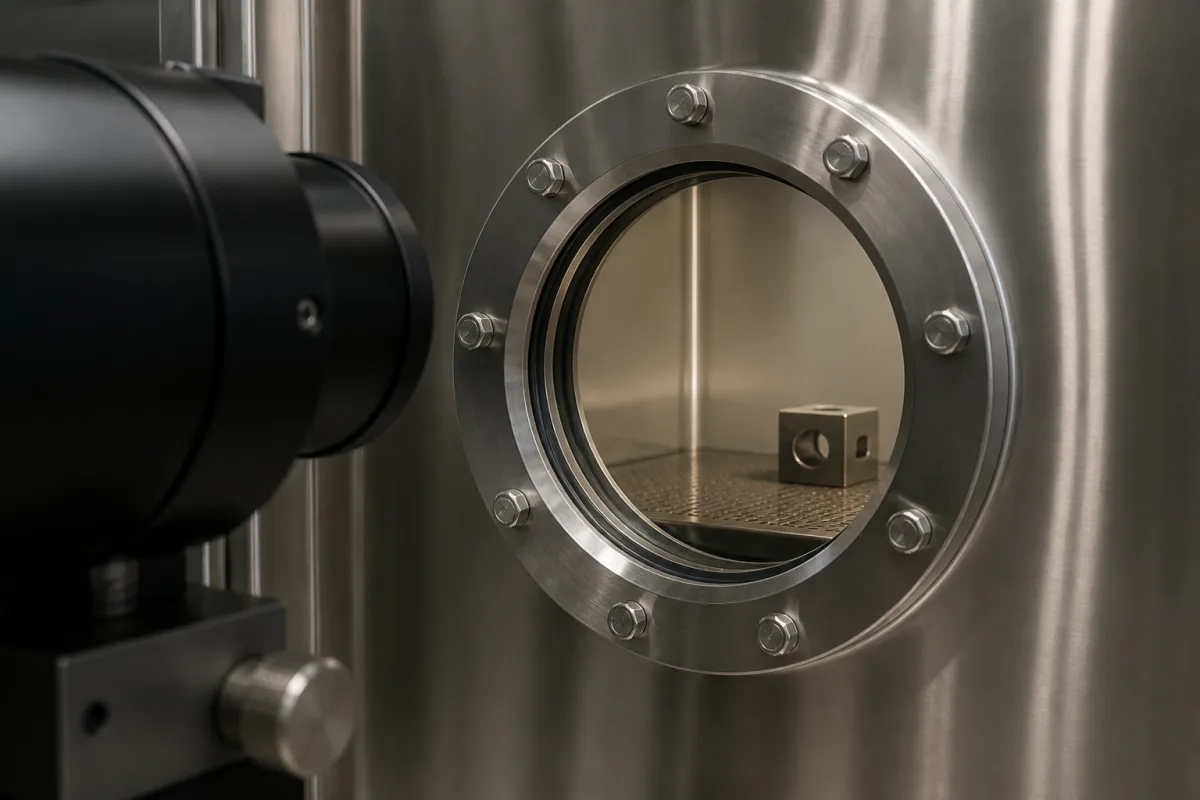
A transparent interface on a calibration chamber that allows optical instruments to measure or monitor internal conditions without physical intrusion.
Product Specifications

Technical details and manufacturing context for Optical Access Port

Definition
An optical access port is a specialized component integrated into calibration chambers that provides a sealed, transparent window or opening. It enables non-contact optical measurement techniques such as spectroscopy, imaging, or laser-based analysis to be performed on samples or processes inside the chamber while maintaining environmental control and integrity.
Working Principle
The port consists of a transparent material (typically optical glass or quartz) mounted in a sealed flange. It allows light to pass through while maintaining the chamber's pressure, temperature, or atmospheric conditions. Optical instruments outside the chamber can transmit light through the port and collect reflected/transmitted light from inside for analysis.
Common Materials
Optical-grade fused silica, Stainless steel flange
Technical Parameters
  • Clear aperture diameter of the optical window (mm) Per Request
Components / BOM
  • Optical Window
    Provides transparent interface for light transmission
    Material: Fused silica
  • Sealing Flange
    Secures window and maintains chamber seal
    Material: Stainless steel
  • Vacuum Seal
    Prevents gas leakage around window edges
    Material: Viton or Kalrez O-ring
Engineering Reasoning
0-1500 kPa internal pressure, -40°C to +85°C temperature, 400-700 nm optical wavelength
Fracture at 1800 kPa internal pressure, optical transmission loss >5% at 100°C, seal failure at -50°C
Design Rationale: Brittle fracture of fused silica at 1800 kPa due to tensile stress concentration at port edges; thermal expansion mismatch between fused silica (α=0.55×10⁻⁶/K) and stainless steel housing (α=17.3×10⁻⁶/K) causing seal failure at -50°C
Risk Mitigation (FMEA)
Trigger Cyclic pressure fluctuation between 0-1200 kPa at 10 Hz frequency
Mode: Microcrack propagation in fused silica leading to catastrophic fracture
Strategy: Design with pressure-relief grooves and controlled compressive preload of 200 N on sealing surface
Trigger Condensation formation on internal surface at 85% relative humidity with 20°C temperature differential
Mode: Optical scattering loss exceeding 3 dB, measurement error >2%
Strategy: Integrated Peltier cooling element maintaining port surface at 5°C above dew point with PID control

Industry Taxonomies & Aliases

Commonly used trade names and technical identifiers for Optical Access Port.

Applied To / Applications

This component is essential for the following industrial systems and equipment:

Industrial Ecosystem & Supply Chain DNA

Complementary Systems
Downstream Applications
Specialized Tooling

Application Fit & Sizing Matrix

Operational Limits
pressure: 0 to 10 bar (gauge)
other spec: Optical clarity >90% transmission, Max slurry concentration: 15% solids by weight
temperature: -40°C to +150°C
Media Compatibility
✓ Calibration gases (N2, Ar, air) ✓ Process liquids (water, oils, solvents) ✓ Non-abrasive slurries (polymer solutions, catalyst suspensions)
Unsuitable: Hydrofluoric acid or highly corrosive halogenated compounds
Sizing Data Required
  • Port flange diameter (mm/in)
  • Required optical window diameter (mm)
  • Interface pressure rating (bar/psi)

Reliability & Engineering Risk Analysis

Failure Mode & Root Cause
Seal Degradation
Cause: Chemical attack from process fluids or cleaning agents compromising elastomeric seals, leading to leaks and optical path contamination.
Optical Surface Fouling
Cause: Accumulation of particulate matter, biofilm, or crystallization on the optical window, reducing light transmission and measurement accuracy.
Maintenance Indicators
  • Visible fluid leakage around the port housing or seal interface
  • Persistent measurement drift or signal attenuation despite calibration
Engineering Tips
  • Implement regular optical window inspections using borescopes or visual aids, with cleaning protocols using compatible, non-abrasive solvents
  • Establish preventive seal replacement intervals based on fluid compatibility charts and operating temperature cycles

Compliance & Manufacturing Standards

Reference Standards
ISO 10110-7:2017 (Optics and photonics - Preparation of drawings for optical elements and systems - Surface imperfection tolerances) ANSI/TIA-568.3-D (Optical Fiber Cabling Components Standard) DIN 58141-2 (Fiber optic connectors - Part 2: Detail specification for type LC-PC duplex connectors)
Manufacturing Precision
  • Bore diameter: +/-0.01mm
  • End-face radius of curvature: +/-10% of nominal value
Quality Inspection
  • Interferometric surface flatness test
  • Insertion loss and return loss measurement

Factories Producing Optical Access Port

Verified manufacturers with capability to produce this product in China

✓ 97% Supplier Capability Match Found

P Project Engineer from Canada Feb 18, 2026
★★★★★
"Standard OEM quality for Computer, Electronic and Optical Product Manufacturing applications. The Optical Access Port arrived with full certification."
Technical Specifications Verified
S Sourcing Manager from United States Feb 15, 2026
★★★★★
"Great transparency on the Optical Access Port components. Essential for our Computer, Electronic and Optical Product Manufacturing supply chain."
Technical Specifications Verified
P Procurement Specialist from United Arab Emirates Feb 12, 2026
★★★★★
"The Optical Access Port we sourced perfectly fits our Computer, Electronic and Optical Product Manufacturing production line requirements."
Technical Specifications Verified
Verification Protocol

“Feedback is collected from verified sourcing managers during RFQ (Request for Quote) and factory evaluation processes on CNFX. These reports represent historical performance data and technical audit summaries from our B2B manufacturing network.”

5 sourcing managers are analyzing this specification now. Last inquiry for Optical Access Port from USA (1h ago).

Supply Chain Compatible Machinery & Devices

Industrial Smart Camera Module

Embedded vision system for industrial automation and quality inspection.

Explore Specs →
Industrial Wireless Power Transfer Module

Wireless power transfer module for industrial equipment applications

Explore Specs →
Industrial Smart Sensor Module

Modular industrial sensor with embedded processing and wireless connectivity

Explore Specs →
Surface Mount Resistor

Passive electronic component for current limiting and voltage division in circuits

Explore Specs →

Frequently Asked Questions

What are the main applications for optical access ports in manufacturing?

Optical access ports are used in calibration chambers for non-intrusive monitoring and measurement of internal conditions, temperature, pressure, or process parameters using optical instruments like spectrometers, cameras, or lasers without breaking vacuum or contaminating the environment.

Why is fused silica used for the optical window?

Fused silica offers high optical clarity, thermal stability, and chemical resistance, making it ideal for maintaining precise optical transmission while withstanding the harsh conditions inside calibration chambers during manufacturing processes.

How does the vacuum seal maintain chamber integrity?

The vacuum seal, combined with the stainless steel flange, ensures an airtight and leak-proof interface that preserves the chamber's internal environment, preventing contamination or pressure loss while allowing optical instruments to monitor conditions externally.

Can I contact factories directly on CNFX?

CNFX is an open directory, not a transaction platform. Each factory profile provides direct contact information and production details to help you initiate direct inquiries with Chinese suppliers.

Get Quote for Optical Access Port

Request technical pricing, lead times, or customized specifications for Optical Access Port directly from verified manufacturing units.

Your business information is encrypted and only shared with verified Optical Access Port suppliers.

Thank you! Your message has been sent. We'll respond within 1–3 business days.

Need to Manufacture Optical Access Port?

Connect with verified factories specializing in this product category

Add Your Factory Contact Us
Previous Product
Operational Amplifier IC
Next Product
Optical Chamber