Industry-Verified Manufacturing Data (2026)

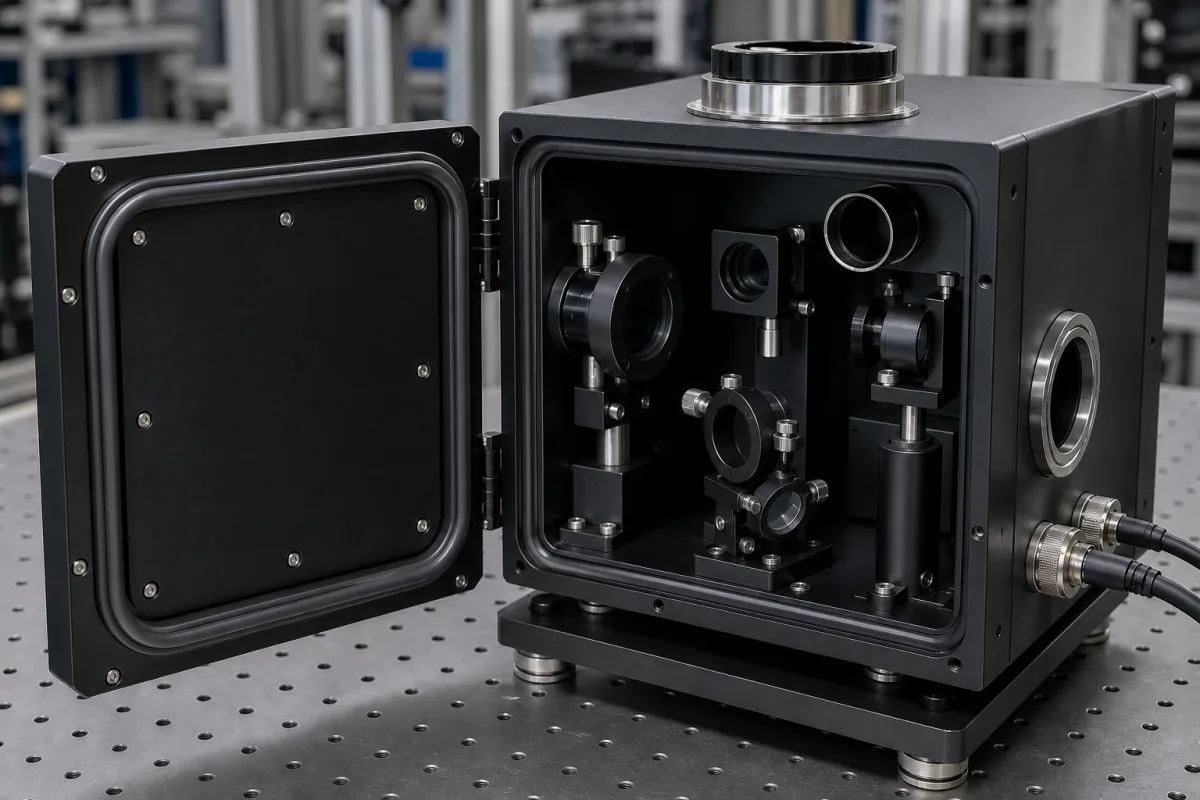
Optical Chamber

Based on aggregated insights from multiple verified factory profiles within the CNFX directory, the standard Optical Chamber used in the Computer, Electronic and Optical Product Manufacturing sector typically supports operational capacities ranging from standard industrial configurations to heavy-duty production requirements.

Technical Definition & Core Assembly

A canonical Optical Chamber is characterized by the integration of Optical window and Mounting plate. In industrial production environments, manufacturers listed on CNFX commonly emphasize Aluminum alloy construction to support stable, high-cycle operation across diverse manufacturing scenarios.

A sealed enclosure designed to house optical components and create a controlled environment for light-based measurements within a sensor system.

Product Specifications

Technical details and manufacturing context for Optical Chamber

Definition
The optical chamber is a critical component of the Sensor Module that provides a protected, stable environment for optical elements such as lenses, mirrors, detectors, and light sources. It isolates sensitive optical components from external contaminants, vibrations, and stray light while maintaining specific atmospheric conditions (e.g., temperature, humidity, gas composition) required for accurate optical measurements and signal processing.
Working Principle
The optical chamber functions by creating a controlled internal environment where light can be directed, focused, reflected, or detected without interference. It typically incorporates optical windows or ports for light entry/exit, internal mounting structures for precise optical alignment, and may include features for environmental control (temperature stabilization, vacuum/pressure control, inert gas purging) to ensure consistent optical performance and measurement accuracy.
Common Materials
Aluminum alloy, Stainless steel, Optical-grade glass
Technical Parameters
  • Internal dimensions (length × width × height) defining the available space for optical components (mm) Customizable
Components / BOM
  • Optical window
    Provides transparent interface for light transmission while maintaining chamber seal
    Material: Optical glass or quartz
  • Mounting plate
    Precisely positions and secures internal optical components
    Material: Aluminum or stainless steel
  • Sealing gasket
    Creates airtight/light-tight seal between chamber sections
    Material: Silicone or fluoropolymer
  • Temperature control element
    Maintains stable internal temperature for optical stability
    Material: Peltier device or heating element
Engineering Reasoning
0.1-1.0 bar absolute pressure, 20-40°C temperature, <100 ppm particulate concentration
Pressure differential >0.5 bar across chamber walls, temperature gradient >15°C across optical path, particulate contamination >1000 ppm
Design Rationale: Birefringence from thermal stress exceeding 10 nm/cm at 632.8 nm wavelength, Rayleigh scattering from particulate contamination exceeding 1% transmission loss, pressure-induced refractive index variation >0.001 RIU
Risk Mitigation (FMEA)
Trigger Thermal cycling at >5°C/min rate
Mode: Optical misalignment from differential expansion between Invar mounts and fused silica windows
Strategy: Active temperature stabilization with PID control to ±0.1°C using Peltier elements
Trigger Helium permeation through Viton O-rings at >1×10⁻⁹ mbar·L/s leak rate
Mode: Refractive index drift exceeding 1×10⁻⁶ RIU/hour
Strategy: Double O-ring seal with intermediate vacuum monitoring and helium mass spectrometer leak detection

Industry Taxonomies & Aliases

Commonly used trade names and technical identifiers for Optical Chamber.

Applied To / Applications

This component is essential for the following industrial systems and equipment:

Industrial Ecosystem & Supply Chain DNA

Complementary Systems
Downstream Applications
Specialized Tooling

Application Fit & Sizing Matrix

Operational Limits
pressure: 0 to 2 bar absolute
other spec: Flow Rate: 0-5 L/min, Slurry Concentration: <1% solids by volume
temperature: -20°C to +80°C
Media Compatibility
✓ Clean dry air ✓ Nitrogen gas ✓ Optically clear liquids (e.g., deionized water)
Unsuitable: Abrasive slurries with high particulate concentration
Sizing Data Required
  • Optical path length required
  • Internal volume needed for components
  • Connection port diameter specifications

Reliability & Engineering Risk Analysis

Failure Mode & Root Cause
Optical window contamination/degradation
Cause: Accumulation of particulates, chemical residues, or moisture on optical surfaces due to inadequate sealing, improper cleaning procedures, or exposure to process contaminants, leading to reduced light transmission, scattering, or signal attenuation.
Seal/gasket failure leading to pressure or vacuum loss
Cause: Degradation of elastomeric or polymer seals from thermal cycling, chemical exposure, mechanical wear, or improper installation, compromising chamber integrity and causing leaks that affect optical alignment, introduce contaminants, or disrupt controlled environments.
Maintenance Indicators
  • Gradual or sudden decrease in signal intensity or increased noise in optical measurements, indicating contamination, misalignment, or component degradation.
  • Audible hissing or whistling from chamber seals, or visible condensation/fogging on optical windows, suggesting pressure/vacuum leaks or moisture ingress.
Engineering Tips
  • Implement strict contamination control protocols: use high-purity purge gases (e.g., dry nitrogen), install particulate filters on inlet lines, and establish regular, non-abrasive cleaning schedules for optical surfaces with approved solvents and lint-free wipes.
  • Conduct preventive seal inspections and replacements based on thermal/chemical exposure history, use alignment fixtures during reassembly to maintain optical precision, and monitor chamber pressure/vacuum levels with real-time sensors to detect early leak development.

Compliance & Manufacturing Standards

Reference Standards
ISO 10110-7:2017 - Optical components and systems - Preparation of drawings for optical elements and systems: Surface imperfection tolerances ANSI/ASME B46.1-2019 - Surface Texture (Surface Roughness, Waviness, and Lay) DIN 3140-7:2018 - Optical systems and components - Tolerances for optical components - Part 7: Surface form tolerances
Manufacturing Precision
  • Bore diameter: +/-0.01mm
  • Surface flatness: λ/4 (approximately 0.158 μm at 632.8 nm)
Quality Inspection
  • Interferometric surface flatness test
  • Cleanliness inspection per ISO 14644-1 cleanroom standards

Factories Producing Optical Chamber

Verified manufacturers with capability to produce this product in China

✓ 92% Supplier Capability Match Found

P Procurement Specialist from United States Jan 03, 2026
★★★★★
"The Optical Chamber we sourced perfectly fits our Computer, Electronic and Optical Product Manufacturing production line requirements."
Technical Specifications Verified
T Technical Director from United Arab Emirates Dec 31, 2025
★★★★★
"Found 37+ suppliers for Optical Chamber on CNFX, but this spec remains the most cost-effective."
Technical Specifications Verified
P Project Engineer from Australia Dec 28, 2025
★★★★★
"The technical documentation for this Optical Chamber is very thorough, especially regarding technical reliability."
Technical Specifications Verified
Verification Protocol

“Feedback is collected from verified sourcing managers during RFQ (Request for Quote) and factory evaluation processes on CNFX. These reports represent historical performance data and technical audit summaries from our B2B manufacturing network.”

6 sourcing managers are analyzing this specification now. Last inquiry for Optical Chamber from Turkey (1h ago).

Supply Chain Compatible Machinery & Devices

Industrial IoT Gateway

Edge computing device connecting industrial equipment to cloud platforms.

Explore Specs →
Modular Industrial Edge Computing Device

Rugged computing platform for industrial data processing at the network edge

Explore Specs →
Industrial Smart Camera Module

Embedded vision system for industrial automation and quality inspection.

Explore Specs →
Industrial Wireless Power Transfer Module

Wireless power transfer module for industrial equipment applications

Explore Specs →

Frequently Asked Questions

What are the main applications for this optical chamber?

This optical chamber is designed for sensor calibration, photometric testing, spectral analysis, and optical component evaluation in industrial and research settings requiring controlled light environments.

How does the temperature control element improve measurement accuracy?

The integrated temperature control maintains stable thermal conditions, minimizing refractive index variations and thermal expansion that can affect optical path length and measurement precision in light-based systems.

What sealing standards does this optical chamber meet?

The chamber features precision-machined sealing surfaces with optical-grade gaskets to achieve IP65 or higher protection levels, preventing dust ingress and moisture contamination that could compromise optical measurements.

Can I contact factories directly on CNFX?

CNFX is an open directory, not a transaction platform. Each factory profile provides direct contact information and production details to help you initiate direct inquiries with Chinese suppliers.

Get Quote for Optical Chamber

Request technical pricing, lead times, or customized specifications for Optical Chamber directly from verified manufacturing units.

Your business information is encrypted and only shared with verified Optical Chamber suppliers.

Thank you! Your message has been sent. We'll respond within 1–3 business days.

Need to Manufacture Optical Chamber?

Connect with verified factories specializing in this product category

Add Your Factory Contact Us
Previous Product
Optical Access Port
Next Product
Optical Channel