Industry-Verified Manufacturing Data (2026)

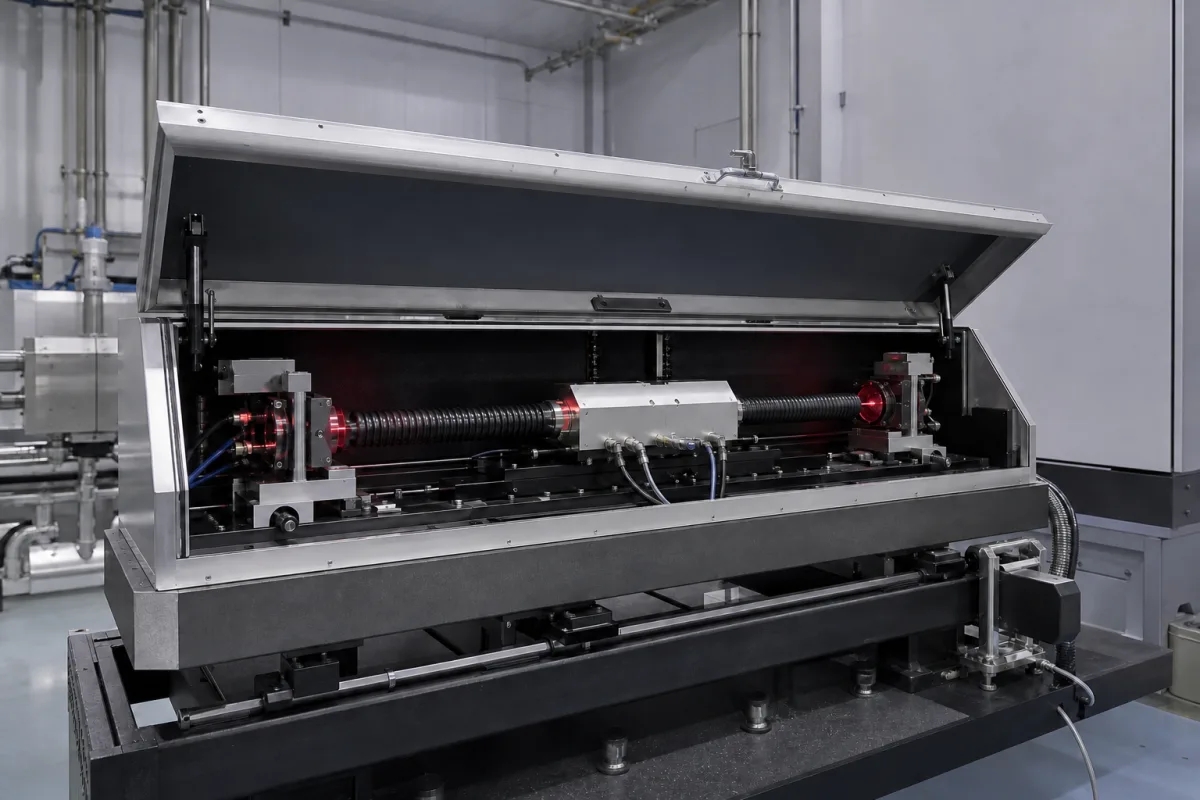
Optical Resonator

Based on aggregated insights from multiple verified factory profiles within the CNFX directory, the standard Optical Resonator used in the Computer, Electronic and Optical Product Manufacturing sector typically supports operational capacities ranging from standard industrial configurations to heavy-duty production requirements.

Technical Definition & Core Assembly

A canonical Optical Resonator is characterized by the integration of High Reflector Mirror and Output Coupler Mirror. In industrial production environments, manufacturers listed on CNFX commonly emphasize Dielectric-coated glass construction to support stable, high-cycle operation across diverse manufacturing scenarios.

A cavity structure that confines and amplifies light through multiple reflections to sustain laser oscillation.
Product Specifications

Technical details and manufacturing context for Optical Resonator

Definition
An optical resonator is a critical component within a laser source that provides optical feedback by reflecting light back and forth between mirrors or reflective surfaces. It confines photons within a specific spatial mode, allowing them to interact repeatedly with the gain medium, thereby achieving population inversion and stimulated emission necessary for coherent laser output. The resonator determines the laser's spatial mode quality, beam divergence, wavelength stability, and output power characteristics.
Working Principle
Light generated in the gain medium enters the resonator cavity and reflects between two or more mirrors (one highly reflective, one partially transmissive). With each pass through the gain medium, photons stimulate additional emission, amplifying the light. Only specific wavelengths (resonant modes) that satisfy the cavity's boundary conditions constructively interfere and are sustained, while others are suppressed. The partially transmissive mirror allows a portion of the amplified light to exit as the laser beam.
Common Materials
Dielectric-coated glass, Crystalline materials (e.g., Nd:YAG, Ti:Sapphire), Metallic mirrors (for certain wavelengths)
Technical Parameters
  • Cavity length, typically ranging from millimeters to meters depending on laser type and application (mm) Customizable
Components / BOM
  • High Reflector Mirror
    Reflects nearly all incident light back into the cavity to maintain oscillation
    Material: Dielectric-coated substrate
  • Output Coupler Mirror
    Partially transmits amplified light to form the output laser beam while reflecting the remainder
    Material: Dielectric-coated substrate
  • Cavity Structure/Spacer
    Maintains precise alignment and distance between resonator mirrors
    Material: Invar, ceramic, or temperature-stable metal
Engineering Reasoning
532-1064 nm wavelength, 1-100 mW output power, 20-40°C temperature
Mirror reflectivity <99.5%, cavity misalignment >0.1 mrad, temperature >45°C
Design Rationale: Thermal lensing from quantum defect heating (Stokes shift energy loss), mirror coating degradation from UV exposure, cavity mode mismatch from thermal expansion coefficient mismatch (Δα=7.2×10⁻⁶/K)
Risk Mitigation (FMEA)
Trigger Diode pump current exceeding 2.5A (150% rated)
Mode: Thermal runaway causing Nd:YAG crystal fracture at 210°C
Strategy: PID-controlled TEC cooling with 0.1°C stability, current-limiting circuit with 2.0A hard cutoff
Trigger Acoustic vibration at 120 Hz resonance frequency
Mode: Cavity length modulation exceeding λ/4 (132.5 nm at 1064 nm)
Strategy: Active piezoelectric mirror stabilization with 10 nm resolution, vibration isolation mounts with 40 dB attenuation at 100-200 Hz

Industry Taxonomies & Aliases

Commonly used trade names and technical identifiers for Optical Resonator.

Applied To / Applications

This component is essential for the following industrial systems and equipment:

Industrial Ecosystem & Supply Chain DNA

Complementary Systems
Downstream Applications
Specialized Tooling

Application Fit & Sizing Matrix

Operational Limits
pressure: Atmospheric to 1.5 bar
other spec: Wavelength range: 400-1600 nm, Power handling: up to 500 mW
temperature: -40°C to 85°C
Media Compatibility
✓ Clean dry air ✓ Nitrogen gas ✓ Vacuum
Unsuitable: High particulate environments (e.g., industrial dust, abrasive slurries)
Sizing Data Required
  • Desired wavelength (nm)
  • Required finesse (Q-factor)
  • Cavity length (mm)

Reliability & Engineering Risk Analysis

Failure Mode & Root Cause
Mirror coating degradation
Cause: Thermal cycling and UV exposure causing delamination or oxidation of reflective coatings, reducing reflectivity and increasing optical losses.
Cavity misalignment
Cause: Mechanical stress from thermal expansion mismatches or vibration leading to optical axis deviation, causing mode hopping or lasing instability.
Maintenance Indicators
  • Gradual increase in lasing threshold current or power required for same output
  • Unstable or fluctuating output beam profile or power readings
Engineering Tips
  • Implement active temperature stabilization with PID controllers to minimize thermal cycling stress on optical components
  • Use vibration isolation mounts and regular alignment verification protocols with autocollimators or interferometers

Compliance & Manufacturing Standards

Reference Standards
ISO 10110-7:2017 (Optics and photonics - Preparation of drawings for optical elements and systems - Part 7: Surface imperfection tolerances) ANSI Z136.1 (Safe Use of Lasers) DIN 3140-7 (Dimensions and tolerances for optical components - Part 7: Resonators)
Manufacturing Precision
  • Mirror surface flatness: λ/20 at 632.8 nm
  • Cavity length stability: ±0.1 μm over operating temperature range
Quality Inspection
  • Interferometric surface flatness test
  • Spectral linewidth measurement (using optical spectrum analyzer)

Factories Producing Optical Resonator

Verified manufacturers with capability to produce this product in China

✓ 94% Supplier Capability Match Found

P Project Engineer from United Arab Emirates Jan 09, 2026
★★★★★
"The Optical Resonator we sourced perfectly fits our Computer, Electronic and Optical Product Manufacturing production line requirements."
Technical Specifications Verified
S Sourcing Manager from Australia Jan 06, 2026
★★★★★
"Found 31+ suppliers for Optical Resonator on CNFX, but this spec remains the most cost-effective."
Technical Specifications Verified
P Procurement Specialist from Singapore Jan 03, 2026
★★★★★
"The technical documentation for this Optical Resonator is very thorough, especially regarding technical reliability."
Technical Specifications Verified
Verification Protocol

“Feedback is collected from verified sourcing managers during RFQ (Request for Quote) and factory evaluation processes on CNFX. These reports represent historical performance data and technical audit summaries from our B2B manufacturing network.”

14 sourcing managers are analyzing this specification now. Last inquiry for Optical Resonator from USA (1h ago).

Supply Chain Compatible Machinery & Devices

Industrial IoT Gateway

Edge computing device connecting industrial equipment to cloud platforms.

Explore Specs →
Modular Industrial Edge Computing Device

Rugged computing platform for industrial data processing at the network edge

Explore Specs →
Industrial Smart Camera Module

Embedded vision system for industrial automation and quality inspection.

Explore Specs →
Industrial Wireless Power Transfer Module

Wireless power transfer module for industrial equipment applications

Explore Specs →

Frequently Asked Questions

What materials are best for optical resonators in industrial laser systems?

Optical resonators typically use dielectric-coated glass for broadband applications, crystalline materials like Nd:YAG for solid-state lasers, and metallic mirrors for specific wavelength ranges in industrial settings.

How does the cavity structure affect laser performance in manufacturing?

The cavity structure determines resonance stability, beam quality, and output power. Proper spacing and alignment of mirrors (high reflector and output coupler) are critical for sustained oscillation and efficiency in optical product manufacturing.

What are the key specifications to consider when selecting an optical resonator?

Key specs include wavelength compatibility, mirror reflectivity (typically >99% for high reflectors), damage threshold, thermal stability, and dimensional precision of the cavity spacer for reliable integration into laser systems.

Can I contact factories directly on CNFX?

CNFX is an open directory, not a transaction platform. Each factory profile provides direct contact information and production details to help you initiate direct inquiries with Chinese suppliers.

Get Quote for Optical Resonator

Request technical pricing, lead times, or customized specifications for Optical Resonator directly from verified manufacturing units.

Your business information is encrypted and only shared with verified Optical Resonator suppliers.

Thank you! Your message has been sent. We'll respond within 1–3 business days.

Need to Manufacture Optical Resonator?

Connect with verified factories specializing in this product category

Add Your Factory Contact Us
Previous Product
Optical Mount/Housing
Next Product
Optical Scanner