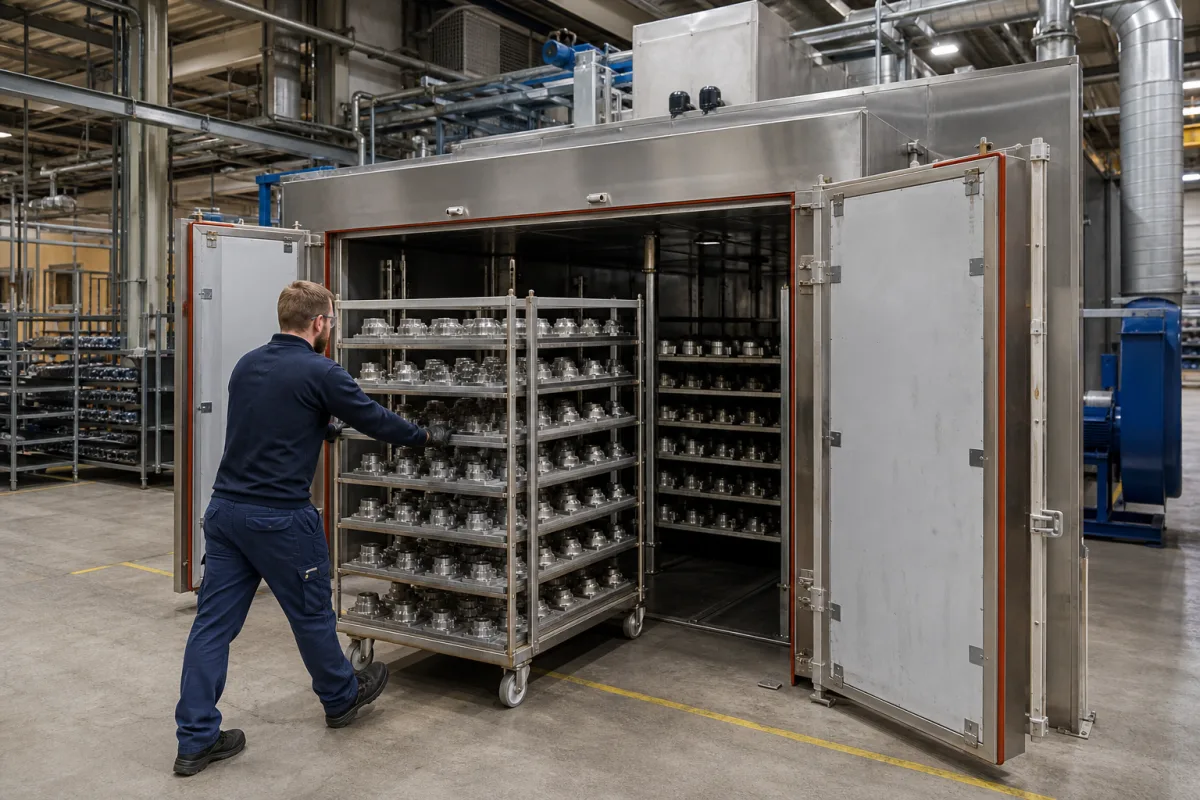
Walk-in and truck-in batch drying ovens · Chamber size and recirculation, heat input and uniformity, exhaust and make-up air losses
A walk-in or truck-in drying oven, as used on this page, is a batch oven large enough to roll wheeled racks or trucks of parts straight in through full-height doors, used to dry parts after washing, rinsing or coating and to bake or cure them. It differs from a cabinet oven in that the load arrives on racks and the chamber, air system and burner are sized around them. Ask three things first: the rack size, load mass and moisture to be removed, the temperature and uniformity required, and how much heat the oven exhausts.
Walk-in and truck-in (trolley) batch drying ovens with hot-air recirculation, electric or gas heating, for drying washed, rinsed, anodised or coated parts and for baking and curing. Cabinet and benchtop hot air ovens and their DIN 12880 uniformity testing are covered on the Industrial hot air oven page. Laboratory drying ovens, vacuum drying ovens, fluid bed and spray dryers, and conveyor tunnel ovens are outside this page.
CNFX editorial research · Sources checked October 12, 2026 · 3 sources
Size the chamber, recirculation and heat input to the racks
Wisconsin Oven describes six heavy-duty walk-in batch ovens for an energy-industry manufacturer with work chambers of 7 ft wide × 12 ft long × 8 ft high, a maximum operating temperature of 500°F and guaranteed uniformity of ±5°F at 285°F, verified by nine-point profile tests in each empty chamber under static conditions. Each has air heat burners rated at 1,000,000 BTU per hour and 14,000 CFM recirculation blowers driven by 15 hp motors, with a combination airflow configuration. [1]
The ovens have bi-parting doors with a window, floors with chamfered front edges for smooth loading, panel seams Wisconsin Oven credits with 25% better insulating efficiency than traditional designs, and alarms for blower failure, burner failure and over-temperature on PLC controls. [1]
Editorial calculation: 7 × 12 × 8 = 672 ft³ (about 19 m³), so 14,000 CFM recirculates the chamber volume about 14,000 ÷ 672 ≈ 21 times a minute; 1,000,000 BTU/h is about 293 kW. [1] Editorial note: uniformity tested in an empty chamber does not show what happens with racks loaded; ask for a loaded survey with your racks and parts.
Give the supplier the rack or truck dimensions and number per load, load mass and material, how wet the parts arrive and what they were washed or rinsed in, required temperature, uniformity and cycle time, any solvent or coating released, the heating source (electric, gas or steam), door and floor details, available floor space and utilities.
02
Control exhaust, make-up air and recirculation
An Oak Ridge National Laboratory process heating training deck gives gas-fired dry-off ovens as an example of waste heat: they can exhaust up to 50% of the total oven heat load and operate at 200–650°F. Its savings table lists 5% to 20% for controlling and minimising make-up air in ovens and dryers, 2% to 10% for reducing excess combustion air, and 1% to 5% each for reducing openings and for pressure control against infiltration. [2]
An Oregon State University energy assessment of three natural-gas curing ovens, two of them fired at 0.880 MMBtu per hour and running at 100°F for one hour then 265°F for two to three hours with 700 lb steel fixtures each hour, recommended annual tuning to 4.0% excess oxygen plus a stack recirculation system. Modelled with DOE's PHAST tool, it estimated a 75.9% cut in oven energy, 795 MMBtu and $5,065 a year, for $5,807 and a 1.1-year payback, and noted a filter may be needed in the recirculation duct to keep excess moisture out of the oven. [3]
Editorial note: in a drying oven the exhaust removes the evaporated water, so recirculation is limited by the humidity the process allows; ask the supplier how exhaust rate is set and whether it is reduced once the parts are dry. [3][2]
03
Compare drying oven layouts
Layout
Load
Check
Walk-in batch oven
Racks or trucks rolled in through full-height doors. [1]
12 companies list this product among what they make. Company figures are quoted from each
company's own website; every card states where the relationship came from.
Climatest Symor
Manufacturing site to be confirmed for the order
Lists ovens with charging trolley and hot air circulation ovens alongside benchtop drying ovens.
Explore company information and manufacturing capabilities, then discuss the scope of your project with a relevant supplier.
Share this page
Compiled and source-reviewed by the CNFX editorial team.
Each manufacturer above links to the page on that company's own website where the product is listed, with the date we checked it. How we source and review
· Page last updated 13 October 2026
Buyer questions
How large is a walk-in drying oven?
Wisconsin Oven's six walk-in units have 7 × 12 × 8 ft chambers with 1,000,000 BTU/h burners and 14,000 CFM recirculation. [1]
How much heat does a dry-off oven lose in exhaust?
ORNL's training deck says gas-fired dry-off ovens can exhaust up to 50% of total oven heat load. [2]
What can tuning and recirculation save?
An Oregon State assessment estimated a 75.9% energy cut for three curing ovens from tuning to 4.0% excess oxygen and stack recirculation. [3]
Sources and what still needs a direct check
Sources checked 2026-10-12. Wisconsin Oven is an industrial oven maker describing a shipped installation; the ORNL deck is US DOE process heating training material; the Oregon State document is an industrial energy assessment report.