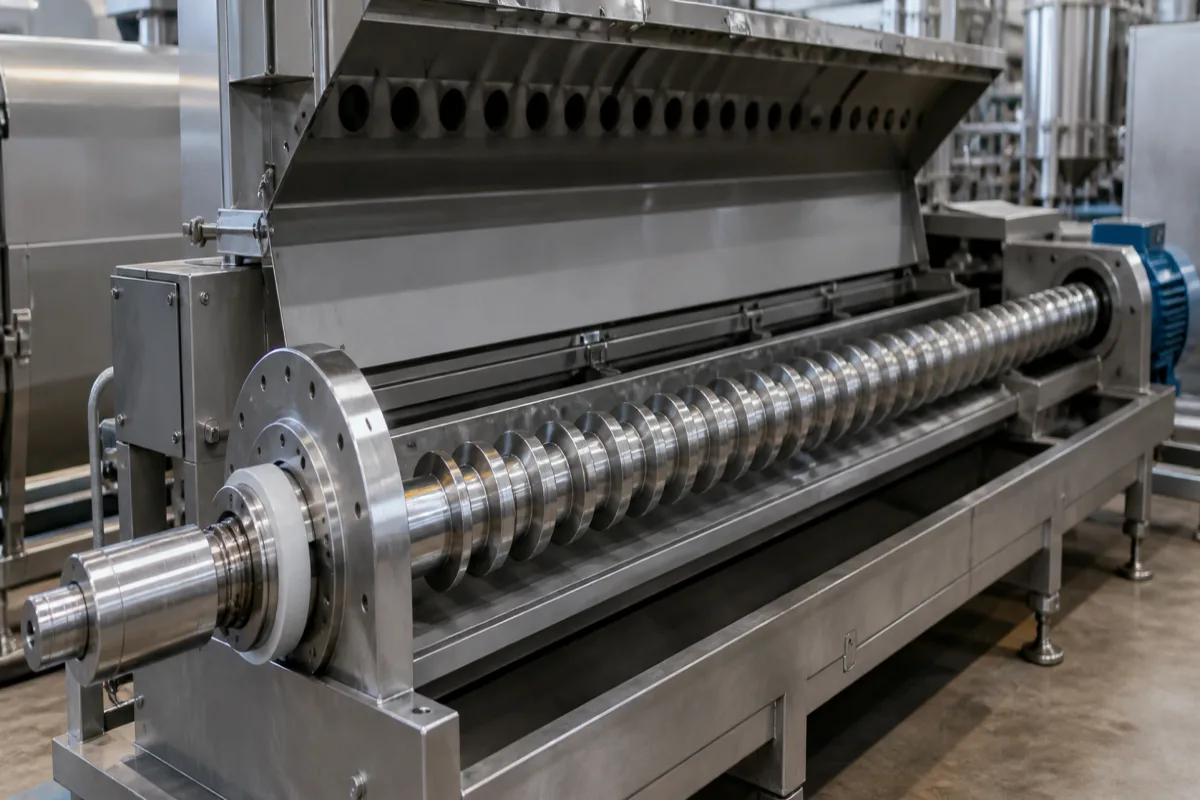
Extrusion screw for food and feed extruders (segmented twin-screw element sets)
Screws for food and feed cooking extruders · segmented conveying, kneading and reverse elements, torque and specific mechanical energy, and corrosion-resistant screw steels for wet food mixes
In a segmented food or feed extruder the screw is a set of elements threaded on shafts: conveying flights that carry flour, protein or feed mash forward, kneading blocks that shear and mix it with water and heat, and reverse elements that hold material back to build pressure before the die. Ask three things first: which element sequence the screw uses for your product, how much torque the shafts and elements are rated for at your screw speed, and which steel the elements are made of for wet, salty or acidic food mixes.
Screws and screw-element sets for food and feed extruders: segmented co-rotating twin-screw conveying, kneading and reverse elements and their shafts, for snacks, cereals, textured plant protein, pet food and aquafeed. Screws for single-screw plastics extruders, including metering, barrier and mixing designs, are covered on the Polymer extrusion screw page. Complete extruders, dies and cutters, and screw conveyors are outside this page.
CNFX editorial research · Sources checked October 12, 2026 · 3 sources
Lay out conveying, kneading and reverse elements along the screw
Researchers at Yangzhou University, testing dies for expanded feed pellets on an MY-120X2 twin-screw extruder, describe its screw from feed inlet to die as a conveying section, a combination of kneading blocks, a reverse-thread pressure-building section and a final conveying section; the machine's screw speed range was 250–450 rpm. [2]
A University of Murcia study texturising hydrolysed rice and pea protein isolates used a TSA EF 21-20 twin-screw extruder with a barrel L/D of 20:1, three heating zones at 65, 110 and 120 °C, and a screw configuration combining conveying and kneading elements for mixing, compression and shear; it ran at 150 rpm with 30% feed moisture and compared 1 mm and 3 mm die nozzles. [3]
Thermo Fisher describes the screw of its Process 16 extruder, offered for polymer and food work, as segmented so that conveying, mixing and extrusion elements can be configured to the process, on a 40 L/D length that can be shortened with an adaption kit. [1]
Editorial note: send the supplier the element sequence (type, pitch, kneading-disc angle and length of each element) or ask for theirs for your product, since the Yangzhou and Murcia screws show that different products use different sequences.
Give the supplier the extruder make and model, screw diameter and centre distance, shaft spline or key profile, barrel length (L/D), product (snack, cereal, textured protein, pet food, aquafeed), feed moisture, screw speed, torque, the element sequence required, wear or corrosion seen on the present elements, and the material and hardness required.
02
Rate the shafts for torque and estimate specific mechanical energy
The Murcia study defines specific mechanical energy (SME) as the energy needed to produce 1 g of extrudate and calculates it as SME = C × V ÷ Q, with torque C in N·m, screw speed V in rad/s and mass flow Q in g/s. [3]
Thermo Fisher's Process 16 data show what a screw set is rated for: a 16 mm screw diameter, an outer-to-inner diameter ratio (Do/Di) of 1.73 for a high free volume, screw speeds of 10–1,000 rpm, maximum torque of 36 N·m, maximum pressure of 100 bar and temperature up to 350 °C. [1]
Editorial calculation: at the Process 16's 36 N·m maximum torque and 1,000 rpm (1,000 × 2π ÷ 60 = 104.7 rad/s), the shafts transmit about 36 × 104.7 ≈ 3.8 kW. If that extruder made 10 kg/h (2.78 g/s, an assumed rate), the SME formula would give 3,770 W ÷ 2.78 g/s ≈ 1,357 J/g, or about 0.38 kWh/kg; use your own torque, speed and flow. [1][3]
Editorial note: torque limits belong to the shafts and the element splines as much as to the gearbox, so ask the supplier for the permitted torque per shaft for the elements you are buying.
03
Choose screw steel for wet, acidic or abrasive food mixes
Thermo Fisher builds the barrel and screw of its standard Process 16 in 440C steel, with a CPM option, and makes every product-contact part of the Process 16 Hygienic version in X15TN steel, which it chose for corrosion resistance and cleanability; the 450 °C temperature option is not available on the hygienic version. [1]
Thermo Fisher also notes a liquid cooling option for food work such as high-moisture meat analogues and a horizontally split barrel whose top can be removed for cleaning and inspection. [1] Editorial note: ask for the steel grade, hardness and any coating of each element type, and whether kneading blocks and reverse elements are offered in a harder grade than conveying elements.
04
Screw dimensions, speed and material data for an element order
Values from the reviewed extruders are shown for comparison; give your own extruder's data.
Ningbo Jinyi lists food processing screw barrels; Nanjing Zhitian lists twin-screw extruder elements and names food among the industries its guide covers.
Ningbo Jinyi Precision Machinery Co., Ltd.
Manufacturing site to be confirmed for the order
Lists food processing screw barrels for extruders, mixers and grinders, used for pasta, snacks, pet food and confectionery, alongside single and twin screw barrels.
Nanjing Zhitian Mechanical And Electrical Co.,ltd.
Manufacturing site to be confirmed for the order
Lists twin-screw extruder screw elements, barrels and gearboxes; its element selection guide names plastics, rubber, food and pharmaceuticals among the industries served.
Explore company information and manufacturing capabilities, then discuss the scope of your project with a relevant supplier.
Share this page
Compiled and source-reviewed by the CNFX editorial team.
Each manufacturer above links to the page on that company's own website where the product is listed, with the date we checked it. How we source and review
· Page last updated 13 October 2026
Buyer questions
What elements make up a food extruder screw?
Yangzhou University's feed extruder screw runs conveying, kneading-block, reverse-thread and final conveying sections from inlet to die. [2]
How is specific mechanical energy calculated?
As torque × screw speed ÷ mass flow (SME = C × V ÷ Q), the energy needed per gram of extrudate, as defined in the University of Murcia study. [3]
Which steel suits food-contact screw elements?
Thermo Fisher uses X15TN steel for all product-contact parts of its hygienic Process 16 extruder, against 440C in the standard version. [1]
Sources and what still needs a direct check
Sources checked 2026-10-12. Thermo Fisher describes its own extruder; the Yangzhou University and University of Murcia groups report extrusion trials in peer-reviewed papers in Foods.