Industry-Verified Manufacturing Data (2026)

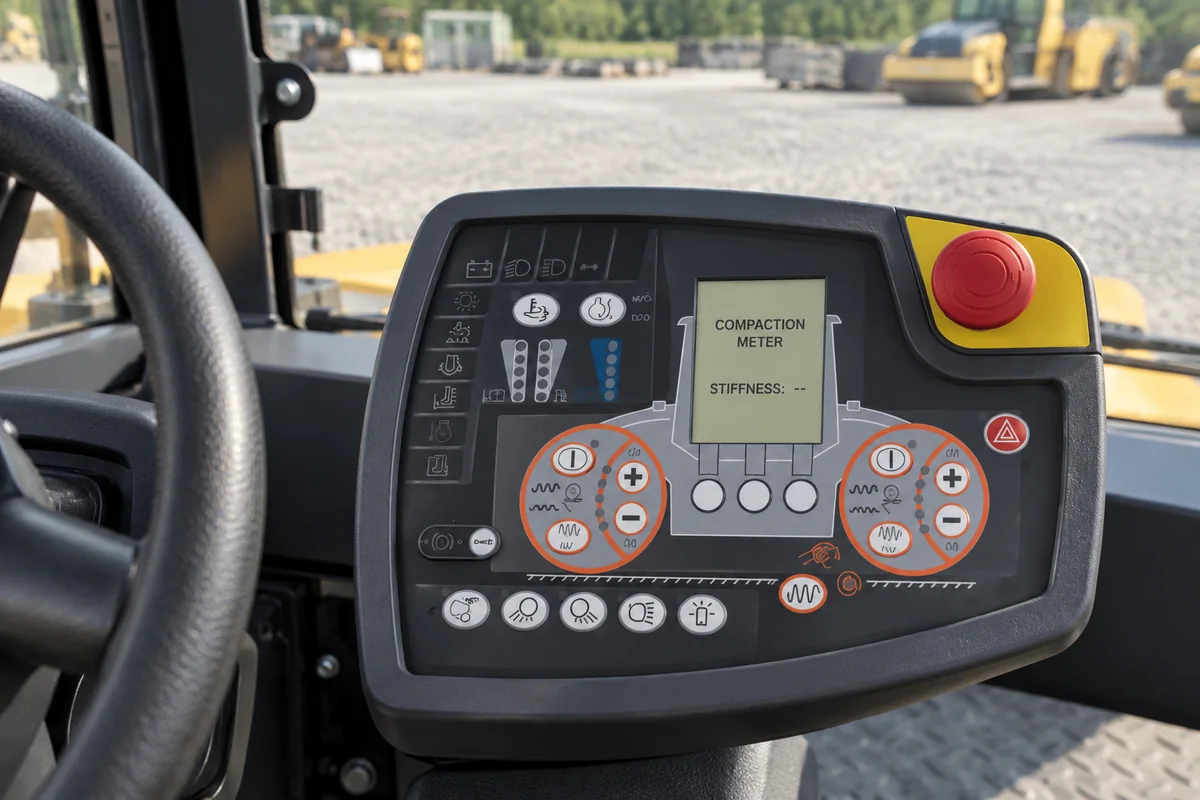
Compaction Meter

Based on aggregated insights from multiple verified factory profiles within the CNFX directory, the standard Compaction Meter used in the Machinery and Equipment Manufacturing sector typically supports operational capacities ranging from standard industrial configurations to heavy-duty production requirements.

Technical Definition & Core Assembly

A canonical Compaction Meter is characterized by the integration of Accelerometer Sensor and Signal Processor. In industrial production environments, manufacturers listed on CNFX commonly emphasize Stainless Steel construction to support stable, high-cycle operation across diverse manufacturing scenarios.

A measurement device that monitors and displays the compaction level achieved by a vibratory roller during soil or asphalt compaction operations.
Product Specifications

Technical details and manufacturing context for Compaction Meter

Definition
The compaction meter is an integrated measurement component of a vibratory roller that continuously monitors the compaction process by analyzing vibration frequency, amplitude, and ground response. It provides real-time feedback to the operator about the density and stiffness of the material being compacted, ensuring quality control and preventing over-compaction or under-compaction.
Working Principle
The compaction meter typically uses accelerometers and sensors to measure the vibratory roller's drum vibration characteristics and the ground's response. By analyzing the harmonic response and frequency changes during compaction, it calculates the material's stiffness and density, displaying the results as a compaction value or percentage on an operator interface.
Common Materials
Stainless Steel, Aluminum Alloy, Electronic Components
Technical Parameters
  • Measurement frequency range for accurate compaction monitoring (MHz) Standard Spec
Components / BOM
  • Accelerometer Sensor
    Measures vibration frequency and amplitude of the roller drum
    Material: Piezoelectric Ceramic
  • Signal Processor
    Processes sensor data to calculate compaction values
    Material: Electronic Components
  • Display Unit
    Shows real-time compaction measurements to the operator
    Material: Polycarbonate
Engineering Reasoning
0-100% compaction ratio, calibrated to 0.1% resolution
Sensor membrane rupture at 2.5 MPa overpressure or -40°C to +85°C temperature excursion
Design Rationale: Piezoresistive diaphragm fatigue failure due to cyclic loading exceeding 10⁶ cycles at 10 Hz vibration frequency
Risk Mitigation (FMEA)
Trigger Moisture ingress through IP67-rated seal degradation
Mode: Capacitance sensor drift exceeding ±0.5% full-scale accuracy
Strategy: Hermetic laser welding with helium leak testing at 5×10⁻⁸ mbar·L/s
Trigger Electromagnetic interference from 400V AC vibratory motor harmonics
Mode: ADC sampling corruption producing ±3% measurement error
Strategy: Triple-shielded twisted-pair cabling with ferrite cores at 100 MHz cutoff

Industry Taxonomies & Aliases

Commonly used trade names and technical identifiers for Compaction Meter.

Applied To / Applications

This component is essential for the following industrial systems and equipment:

Industrial Ecosystem & Supply Chain DNA

Complementary Systems
Downstream Applications
Specialized Tooling

Application Fit & Sizing Matrix

Operational Limits
pressure: 0 to 5 bar
other spec: Vibration frequency range: 20-60 Hz, Roller speed: 0-10 km/h
temperature: -20°C to +60°C
Media Compatibility
✓ Soil compaction (clay, sand, gravel) ✓ Asphalt compaction (hot mix asphalt) ✓ Granular base materials
Unsuitable: Underwater or submerged compaction operations
Sizing Data Required
  • Roller drum width (mm)
  • Target compaction density (kN/m³)
  • Material type and layer thickness (mm)

Reliability & Engineering Risk Analysis

Failure Mode & Root Cause
Sensor Drift/Calibration Loss
Cause: Environmental exposure (moisture, temperature fluctuations, vibration) degrading internal electronics or reference standards, leading to inaccurate compaction readings over time.
Mechanical Damage to Probe/Tip
Cause: Impact with hard objects (rocks, debris) during insertion or extraction, or excessive lateral force during use, causing bending, cracking, or wear of the contact surface.
Maintenance Indicators
  • Erratic or inconsistent readings despite proper soil conditions and operator technique
  • Visible physical damage (cracks, dents, bent probe) or audible grinding/clicking during operation
Engineering Tips
  • Implement regular calibration checks against known standards (e.g., lab compaction tests) and store the meter in a controlled environment when not in use.
  • Use protective sleeves or caps for the probe during transport and storage, and train operators on proper insertion/withdrawal techniques to avoid side-loading.

Compliance & Manufacturing Standards

Reference Standards
ISO 22476-2: Geotechnical investigation and testing - Field testing - Part 2: Dynamic probing ASTM D1557: Standard Test Methods for Laboratory Compaction Characteristics of Soil Using Modified Effort CE marking for machinery under Directive 2006/42/EC
Manufacturing Precision
  • Impact energy: +/- 2% of specified value
  • Hammer drop height: +/- 5mm
Quality Inspection
  • Calibration verification with certified reference mass
  • Dimensional accuracy check of hammer assembly components

Factories Producing Compaction Meter

Verified manufacturers with capability to produce this product in China

✓ 98% Supplier Capability Match Found

T Technical Director from Singapore Jan 14, 2026
★★★★★
"Great transparency on the Compaction Meter components. Essential for our Machinery and Equipment Manufacturing supply chain."
Technical Specifications Verified
P Project Engineer from Germany Jan 11, 2026
★★★★☆
"The Compaction Meter we sourced perfectly fits our Machinery and Equipment Manufacturing production line requirements. (Delivery took slightly longer than expected, but technical support was excellent.)"
Technical Specifications Verified
S Sourcing Manager from Brazil Jan 08, 2026
★★★★★
"Found 56+ suppliers for Compaction Meter on CNFX, but this spec remains the most cost-effective."
Technical Specifications Verified
Verification Protocol

“Feedback is collected from verified sourcing managers during RFQ (Request for Quote) and factory evaluation processes on CNFX. These reports represent historical performance data and technical audit summaries from our B2B manufacturing network.”

9 sourcing managers are analyzing this specification now. Last inquiry for Compaction Meter from Vietnam (54m ago).

Supply Chain Compatible Machinery & Devices

Heavy-Duty CNC Plasma Cutting Machine

Industrial machine for precision metal cutting using plasma arc technology

Explore Specs →
Automated Assembly Line System

Integrated production system for sequential component assembly operations

Explore Specs →
Automated Powder Coating System

Integrated industrial system for applying dry powder coatings to metal substrates.

Explore Specs →
Centrifugal Pump Impeller

Rotating component that transfers energy to fluid in centrifugal pumps.

Explore Specs →

Frequently Asked Questions

What materials is the Compaction Meter constructed from?

The Compaction Meter is built with a durable stainless steel housing, aluminum alloy components, and high-quality electronic parts for reliable performance in harsh construction environments.

How does the Compaction Meter measure compaction levels?

Using an accelerometer sensor, the device detects vibrations from the vibratory roller, processes the data through its signal processor, and displays real-time compaction levels on the display unit.

What industries commonly use this Compaction Meter?

This equipment is essential for machinery and equipment manufacturing, road construction, civil engineering projects, and any operation requiring precise soil or asphalt compaction monitoring.

Can I contact factories directly on CNFX?

CNFX is an open directory, not a transaction platform. Each factory profile provides direct contact information and production details to help you initiate direct inquiries with Chinese suppliers.

Get Quote for Compaction Meter

Request technical pricing, lead times, or customized specifications for Compaction Meter directly from verified manufacturing units.

Your business information is encrypted and only shared with verified Compaction Meter suppliers.

Thank you! Your message has been sent. We'll respond within 1–3 business days.

Need to Manufacture Compaction Meter?

Connect with verified factories specializing in this product category

Add Your Factory Contact Us
Previous Product
Compaction Mechanism
Next Product
Compaction System