Thermal Paste Dispenser
View system integration details
This page explains how Pneumatic/Servo Actuator is classified within Computer, Electronic and Optical Product Manufacturing. Technical values and manufacturer relationships are research references; confirm the current specification and supplier evidence for each order.
A precision motion control component that provides controlled linear or rotary movement for thermal paste dispensing applications.
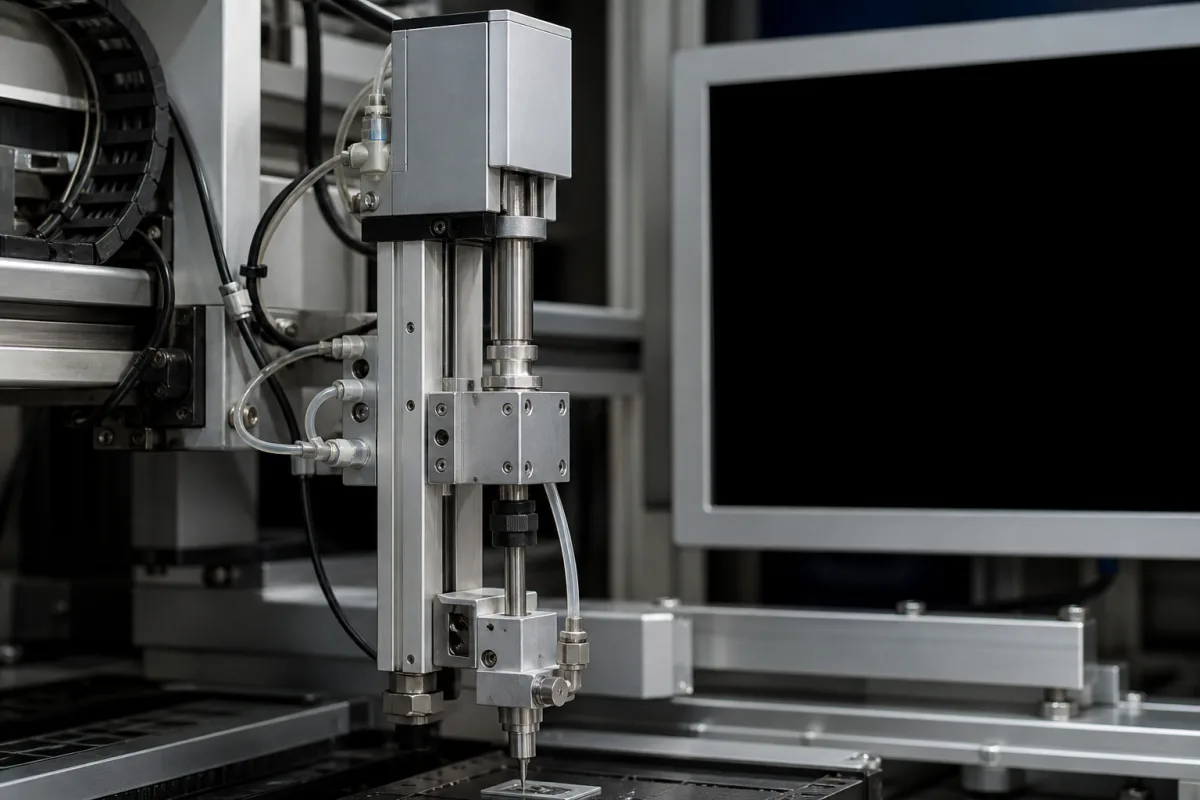
Technical details and manufacturing context for Pneumatic/Servo Actuator
| Parameter | Typical range | Notes & selection driver |
|---|---|---|
| Stroke Length | 10–100 mm | 10–100 — Linear travel for pneumatic or servo actuators; longer strokes for larger dispensers. Linear travel for pneumatic or servo actuators; longer strokes for larger dispensers. |
| Maximum Force | 50–500 N | 50–500 — Force at rated supply pressure (pneumatic) or motor torque (servo). Force at rated supply pressure (pneumatic) or motor torque (servo). |
| Positioning Repeatability | ±0.01–±0.05 mm | ±0.01–±0.05 — For servo actuators; pneumatic typically ±0.1–±0.5 mm. For servo actuators; pneumatic typically ±0.1–±0.5 mm.ISO 9283 |
| Motor Power (Servo) | 0.1–1.0 kW | 0.1–1.0 — Continuous rating; peak torque for short durations. Continuous rating; peak torque for short durations.IEC 60034 |
| Operating Temperature | 5–50 °C | 5–50 — Ambient; outside this range, seals and lubricants degrade. Ambient; outside this range, seals and lubricants degrade. Outside this range: Below 5°C: seals become brittle, lubricants thicken; above 50°C: seal degradation, thermal expansion affects accuracy. |
| Ingress Protection | IP54–IP65 | IP54–IP65 — IP65 for washdown areas, IP54 for dry cleanroom-like environments. IP65 for washdown areas, IP54 for dry cleanroom-like environments.IEC 60529 |
| Material - Housing | Aluminum alloy 6061-T6 or 316L stainless steel | Aluminum alloy 6061-T6 or 316L stainless steel — Aluminum for weight savings, stainless for corrosion resistance. Aluminum for weight savings, stainless for corrosion resistance.ASTM B221 (Al), ASTM A276 (SS) |
| Material - Seals | NBR or FKM (Viton) | NBR or FKM (Viton) — FKM for higher temperature and chemical resistance. FKM for higher temperature and chemical resistance.ASTM D2000 |
| Material - Piston Rod | Hard chrome plated 1045/42CrMo4 steel | Hard chrome plated 1045/42CrMo4 steel — Surface hardness 50–60 HRC for wear resistance. Surface hardness 50–60 HRC for wear resistance.ISO 683-1 |
| Duty Cycle | 100% continuous (servo), 50–100% (pneumatic) % | 100% continuous (servo), 50–100% (pneumatic) — Pneumatic duty cycle limited by heat generation; servo can run continuously. Pneumatic duty cycle limited by heat generation; servo can run continuously. |
| Service Life | 10,000,000–50,000,000 cycles | 10,000,000–50,000,000 — Depends on load, speed, and maintenance. Depends on load, speed, and maintenance.ISO 19973 |
| Electrical Interface (Servo) | 24 VDC, 0–10 V or 4–20 mA command signal | 24 VDC, 0–10 V or 4–20 mA command signal — Digital or analog; encoder feedback for closed-loop control. Digital or analog; encoder feedback for closed-loop control.IEC 61131-2 |
| Supply pressure (pneumatic) | 4–8 bar | 4–8 bar — Outside this window: Below 4 bar: insufficient force, erratic motion; above 8 bar: seal damage, excessive force, safety risk. Clean, dry air; class 5.4.4 or better. Outside this range: Below 4 bar: insufficient force, erratic motion; above 8 bar: seal damage, excessive force, safety risk.ISO 8573-1 |
| Relative humidity | 0–85% non-condensing | 0–85% non-condensing — Outside this window: Condensation causes corrosion and electrical short circuits in servo versions. Outside this window: Condensation causes corrosion and electrical short circuits in servo versions. |
| Air quality (pneumatic) | ISO 8573-1 Class 5.4.4 (particle, water, oil) | ISO 8573-1 Class 5.4.4 or better — Outside this window: Particulates cause seal wear; water causes corrosion; oil degrades seals. Poor air quality causes seal wear and sticking.ISO 8573-1 |
| Voltage stability (servo) | 24 VDC ±10% | 24 VDC ±10% — Outside this window: Voltage fluctuations cause erratic positioning and potential motor damage. Outside this window: Voltage fluctuations cause erratic positioning and potential motor damage. |
Ranges are indicative industry figures for RFQ preparation, not a supplier commitment. Confirm every value and standard with the legal manufacturer before ordering.
Indicative industry ranges for design and RFQ preparation. Confirm the exact figures and applicable standard with the manufacturer before specifying.
Quoted from the published standard.
A practical evidence checklist for RFQ preparation and supplier evaluation.
Compare the published product scope and source details, then include your specifications and quantity in an enquiry.
Manufacturer profiles associated with Pneumatic/Servo Actuator.
Explore company information and manufacturing capabilities, then discuss the scope of your project with a relevant supplier.
Ask for use case, specification boundaries, supplier type, and RFQ preparation information for this product.
Pneumatic actuators use compressed air to drive a piston, offering simpler construction and lower cost but limited positioning accuracy. Servo actuators use an electric motor with encoder feedback, providing higher precision and repeatability, suitable for applications requiring tight control.
Typical operating temperature is 5–50 °C, relative humidity 0–85% non-condensing. Pneumatic versions require clean, dry air per ISO 8573-1 Class 5.4.4, with supply pressure 4–8 bar. Servo versions require 24 VDC ±10% power supply.
Relevant standards include ISO 9283 for positioning repeatability, ISO 8573-1 for air quality, IEC 60034 for motor power, IEC 60529 for ingress protection, IEC 61131-2 for electrical interface, and ISO 19973 for service life. Always verify compliance with the manufacturer.
Consider required stroke length, force, positioning repeatability, and duty cycle. Evaluate environmental factors like temperature, humidity, and air quality. Confirm that the actuator's specifications meet your application needs, and consult the manufacturer for model-specific data.
This component is essential for the following industrial systems and equipment:
Editorial classification, named public sources where available, and source-reviewed manufacturer records.
Compare manufacturer profiles with relevant product and process capability.