Industry-Verified Manufacturing Data (2026)

Primary Hub Speaker

Based on aggregated insights from multiple verified factory profiles within the CNFX directory, the standard Primary Hub Speaker used in the Computer, Electronic and Optical Product Manufacturing sector typically supports operational capacities ranging from standard industrial configurations to heavy-duty production requirements.

Technical Definition & Core Assembly

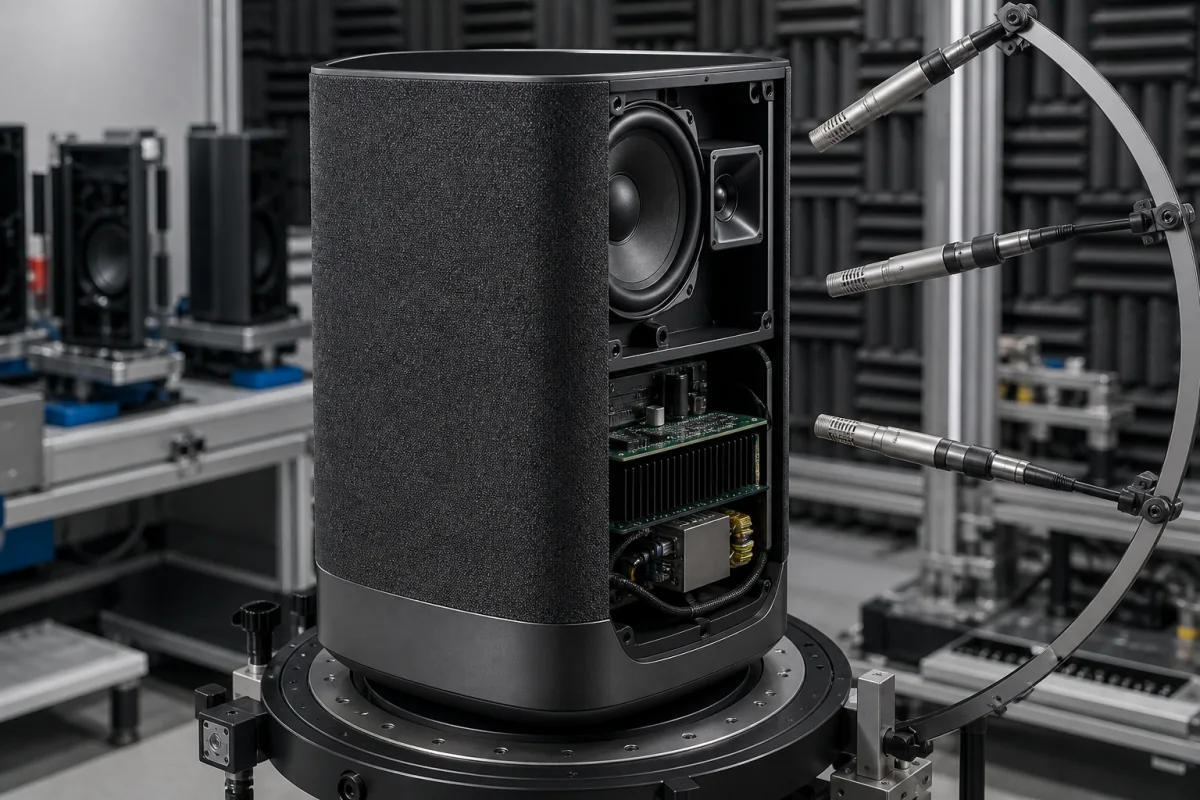
A canonical Primary Hub Speaker is characterized by the integration of Amplifier Module and Wireless Transceiver. In industrial production environments, manufacturers listed on CNFX commonly emphasize ABS plastic construction to support stable, high-cycle operation across diverse manufacturing scenarios.

The central control and audio distribution unit in a wireless multi-room audio system

Product Specifications

Technical details and manufacturing context for Primary Hub Speaker

Definition
The Primary Hub Speaker serves as the central component in a Wireless Multi-Room Audio Speaker System, functioning as both an audio source and distribution controller. It connects to audio sources (via Bluetooth, Wi-Fi, or wired connections), processes audio signals, and wirelessly transmits synchronized audio to secondary speakers throughout different rooms or zones while managing system settings and connectivity.
Working Principle
Receives digital audio signals from various sources, processes them through digital signal processing (DSP) chips, converts to analog signals via digital-to-analog converters (DAC), amplifies the signals, and wirelessly transmits synchronized audio streams to secondary speakers using proprietary wireless protocols (like Wi-Fi, Bluetooth mesh, or dedicated RF) while maintaining network coordination and audio synchronization.
Common Materials
ABS plastic, aluminum alloy, PCB with electronic components, speaker driver materials (paper, polypropylene, or composite cones), rubber surrounds
Technical Parameters
  • Output power rating of the built-in amplifier (W) Per Request
Components / BOM
  • Amplifier Module
    Amplifies audio signals to drive the speaker drivers
    Material: PCB with electronic components (transistors, capacitors, resistors)
  • Wireless Transceiver
    Transmits and receives wireless audio signals to/from secondary speakers
    Material: PCB with RF components and antennas
  • Digital Signal Processor
    Processes audio signals for synchronization, equalization, and multi-room distribution
    Material: Integrated circuit chip on PCB
  • Speaker Driver
    Converts electrical signals into sound waves
    Material: Paper/polypropylene cone, voice coil, magnet assembly
  • Power Supply Unit
    Provides regulated power to all electronic components
    Material: Transformer, rectifier circuits, voltage regulators
Engineering Reasoning
2.4-5.0 GHz (ISM band), 20-100 dBm transmit power, -40°C to +85°C ambient temperature
RF output power drops below 10 dBm, signal-to-noise ratio falls below 15 dB, processor temperature exceeds 105°C, DC supply voltage deviates beyond ±10% of 12V nominal
Design Rationale: Thermal runaway in Class-D amplifier ICs due to inadequate heat dissipation, dielectric breakdown in RF power transistors at high VSWR mismatches (>3:1), phase-locked loop instability from quartz crystal aging (>±50 ppm frequency drift)
Risk Mitigation (FMEA)
Trigger Simultaneous streaming to >8 zones exceeding 100 Mbps aggregate bandwidth
Mode: Network processor buffer overflow causing audio dropout >200 ms
Strategy: Implement hierarchical QoS with strict per-zone bandwidth caps at 15 Mbps using token bucket algorithm
Trigger Conducted EMI from switching power supply injecting >100 mVpp noise on 3.3V rail
Mode: ADC clipping distortion producing >1% THD+N at 1 kHz reference
Strategy: Install π-filter with 10 μH ferrite bead and 100 μF tantalum capacitors on all analog supply rails

Industry Taxonomies & Aliases

Commonly used trade names and technical identifiers for Primary Hub Speaker.

Industrial Ecosystem & Supply Chain DNA

Complementary Systems
Downstream Applications
Specialized Tooling

Application Fit & Sizing Matrix

Operational Limits
pressure: N/A (atmospheric)
other spec: Humidity: 20-80% RH non-condensing
temperature: 0°C to 40°C
Media Compatibility
✓ Indoor air (clean, dry) ✓ Standard AC power (100-240V, 50/60Hz) ✓ WiFi/Bluetooth RF environments
Unsuitable: Outdoor/wet/high-vibration industrial environments
Sizing Data Required
  • Room/zone count and layout
  • Audio source types and input requirements
  • Desired audio power output per zone (watts RMS)

Reliability & Engineering Risk Analysis

Failure Mode & Root Cause
Voice Coil Overheating
Cause: Excessive power input or prolonged high-volume operation leading to thermal degradation of coil insulation and adhesive bonds.
Diaphragm Fatigue and Tearing
Cause: Cyclic mechanical stress from repeated vibration, material aging, or exposure to environmental factors like humidity and temperature extremes.
Maintenance Indicators
  • Audible distortion, crackling, or buzzing sounds during audio playback
  • Reduced sound output or complete loss of audio despite proper input signals
Engineering Tips
  • Implement thermal management: Ensure adequate ventilation around the speaker, avoid placing near heat sources, and use within specified power ratings to prevent voice coil overheating.
  • Regularly inspect and clean the diaphragm and surrounding components to remove dust and debris that can impede movement and accelerate material fatigue.

Compliance & Manufacturing Standards

Reference Standards
ISO 9001:2015 - Quality Management Systems ANSI/ASA S12.60 - Acoustical Performance Criteria for Classroom Acoustics CE Marking - EMC Directive 2014/30/EU
Manufacturing Precision
  • Frequency Response: +/- 3 dB (20 Hz - 20 kHz)
  • Enclosure Flatness: 0.5 mm across mounting surface
Quality Inspection
  • Acoustic Performance Test (ANSI/ASA S12.60 compliance)
  • Electrical Safety Test (IEC 62368-1)

Factories Producing Primary Hub Speaker

Verified manufacturers with capability to produce this product in China

✓ 97% Supplier Capability Match Found

T Technical Director from Canada Feb 16, 2026
★★★★★
"Testing the Primary Hub Speaker now; the technical reliability results are within 1% of the laboratory datasheet."
Technical Specifications Verified
P Project Engineer from United States Feb 13, 2026
★★★★☆
"Impressive build quality. Especially the technical reliability is very stable during long-term operation. (Delivery took slightly longer than expected, but technical support was excellent.)"
Technical Specifications Verified
S Sourcing Manager from United Arab Emirates Feb 10, 2026
★★★★★
"As a professional in the Computer, Electronic and Optical Product Manufacturing sector, I confirm this Primary Hub Speaker meets all ISO standards."
Technical Specifications Verified
Verification Protocol

“Feedback is collected from verified sourcing managers during RFQ (Request for Quote) and factory evaluation processes on CNFX. These reports represent historical performance data and technical audit summaries from our B2B manufacturing network.”

5 sourcing managers are analyzing this specification now. Last inquiry for Primary Hub Speaker from Brazil (1h ago).

Supply Chain Compatible Machinery & Devices

Industrial Smart Camera Module

Embedded vision system for industrial automation and quality inspection.

Explore Specs →
Industrial Wireless Power Transfer Module

Wireless power transfer module for industrial equipment applications

Explore Specs →
Industrial Smart Sensor Module

Modular industrial sensor with embedded processing and wireless connectivity

Explore Specs →
Surface Mount Resistor

Passive electronic component for current limiting and voltage division in circuits

Explore Specs →

Frequently Asked Questions

What is the primary function of the Primary Hub Speaker in a multi-room audio system?

The Primary Hub Speaker serves as the central control and audio distribution unit, managing wireless connectivity, audio processing, and synchronization across all connected speakers in the system.

What materials are used in the construction of the Primary Hub Speaker?

It's constructed with durable ABS plastic housing, aluminum alloy accents, a PCB with electronic components, and high-quality speaker driver materials including paper, polypropylene, or composite cones with rubber surrounds.

What key components are included in the Primary Hub Speaker's Bill of Materials?

The BOM includes an Amplifier Module, Digital Signal Processor (DSP), Power Supply Unit, Speaker Driver, and Wireless Transceiver for seamless multi-room audio connectivity and control.

Can I contact factories directly on CNFX?

CNFX is an open directory, not a transaction platform. Each factory profile provides direct contact information and production details to help you initiate direct inquiries with Chinese suppliers.

Get Quote for Primary Hub Speaker

Request technical pricing, lead times, or customized specifications for Primary Hub Speaker directly from verified manufacturing units.

Your business information is encrypted and only shared with verified Primary Hub Speaker suppliers.

Thank you! Your message has been sent. We'll respond within 1–3 business days.

Need to Manufacture Primary Hub Speaker?

Connect with verified factories specializing in this product category

Add Your Factory Contact Us
Previous Product
Pressure Control Mechanism
Next Product
Primitive Assembler