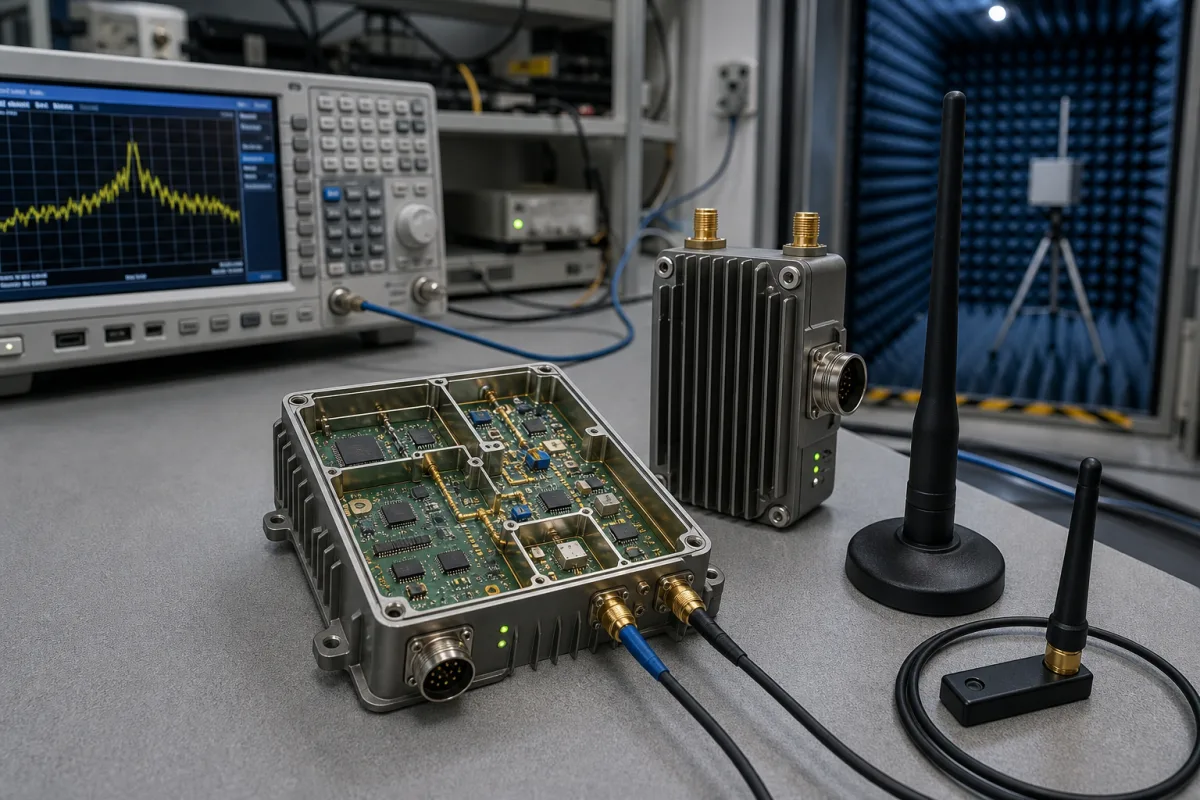
Wireless transceiver: an enclosed data-link radio with antenna ports, Ethernet and serial, sized by throughput, sensitivity and permitted output power
Enclosed wireless data-link transceivers · Metal-housed 2.4 GHz radios with antenna ports, Ethernet and serial for robots, drones and remote equipment, throughput against sensitivity by modulation, and FCC and ETSI output power limits
This page covers enclosed wireless transceivers used as data links: a radio in its own metal housing with antenna connectors, Ethernet and serial ports and a power input, linking robots, drones, vehicles and remote equipment point-to-point, point-to-multipoint or in a mesh. Ask three things first: the throughput you need and the receive sensitivity at that rate, the output power and antenna gain you can legally use in each market, and the housing, connectors and temperature range for the installation.
Enclosed wireless data-link transceivers with their own housing, antenna connectors and Ethernet or serial ports, for point-to-point, point-to-multipoint and mesh links. Pre-certified radio modules for soldering or plugging into a host board are covered on the Wireless module page. Bare radio chips, Wi-Fi routers and gateways, and cellular modems are outside this page.
CNFX editorial research · Sources checked October 12, 2026 · 3 sources
Throughput against receive sensitivity at each modulation and channel width
Microhard's pDDL2450 2.4 GHz digital data link (2.402–2.478 GHz) lists, for each modulation in 8, 4 and 2 MHz channels, the Iperf throughput, the sensitivity at which it is reached and the maximum transmit power: higher-order modulation carries more data but needs a stronger signal and runs at lower power. [1]
Editorial calculation: in the 8 MHz channel, going from BPSK 1/2 to 64QAM 5/6 multiplies throughput by about 9 but needs 20 dB more signal; in free space a 20 dB loss corresponds to ten times the distance, so the highest rate holds over about a tenth of the BPSK range with the same antennas. Halving the channel to 4 MHz at BPSK gains 3 dB of sensitivity for half the throughput. [1]
Give the supplier the throughput needed (video, telemetry, control), the link distance and whether it is line of sight, the network layout (point-to-point, point-to-multipoint, mesh, relay), the markets the radio must be certified for, the antennas and cable runs, the supply voltage and the operating temperature.
02
Conducted output power, antenna gain and e.i.r.p. under FCC 15.247 and ETSI EN 300 328
Under 47 CFR 15.247, digitally modulated systems in 2400–2483.5 MHz may use 1 W maximum conducted output power with antennas of up to 6 dBi directional gain; above 6 dBi the power must be cut by the excess gain in dB, except that fixed point-to-point links in this band reduce power by only 1 dB for every 3 dB of gain above 6 dBi. [2] ETSI EN 300 328 V2.2.2 for 2 400–2 483,5 MHz defines RF output power as mean e.i.r.p. during a transmission burst and limits it to 20 dBm for non-FHSS equipment. [3]
Editorial calculation: 1 W is 30 dBm, so a 6 dBi antenna gives 36 dBm e.i.r.p. under FCC rules; a 9 dBi omnidirectional antenna requires 27 dBm conducted, while a 24 dBi dish on a fixed point-to-point link requires a 6 dB cut to 24 dBm, giving 48 dBm e.i.r.p. Under EN 300 328 the same pDDL2450 at its 30 dBm maximum with a 2 dBi antenna would be 32 dBm e.i.r.p., so it must be set to 18 dBm or less. [2][3][1]
03
OEM board, motherboard or enclosed unit: connectors, size and supply
Microhard sells the same pDDL2450 radio as a 27 × 33 × 4 mm OEM module of about 5 g with two U.FL antenna connectors and an 80-pin SMT data interface, on a motherboard of about 50 g, or as an enclosed modem of about 165 g with three RP-SMA female antenna connectors, two RJ-45 Ethernet ports, a DB9 serial port, USB and a 4-pin interlock connector for power and I/O, taking 7–30 VDC. It is rated −40 to +85 °C and 5–95% RH non-condensing, offers 128-bit AES encryption (optional 256-bit), which requires an export permit, and carries FCC and IC approvals. [1]
Editorial note: an enclosed unit takes a wide DC supply and standard connectors and can be mounted directly, while the OEM module needs a host board; certification of the enclosed unit with your antennas still has to be checked market by market.
04
Send the link budget, markets and installation together
Paste it into your enquiry below or into an email to a maker, then replace every bracket.
1 company lists this product among what they make. Company figures are quoted from each
company's own website; every card states where the relationship came from.
GALOCE (Xi'an) M&C Technology Co., Ltd.
Manufacturing site to be confirmed for the order
Lists a wireless transceiver among its load cell weighing instruments.
Explore company information and manufacturing capabilities, then discuss the scope of your project with a relevant supplier.
Share this page
Compiled and source-reviewed by the CNFX editorial team.
Each manufacturer above links to the page on that company's own website where the product is listed, with the date we checked it. How we source and review
· Page last updated 13 October 2026
Buyer questions
How does throughput affect a radio's range?
Microhard's pDDL2450 reaches 28 Mbps at −76 dBm with 64QAM but needs only −96 dBm for 3 Mbps with BPSK in the same 8 MHz channel; the 20 dB difference corresponds to about ten times the free-space distance (editorial calculation). [1]
What output power can a 2.4 GHz transceiver use?
FCC 15.247 allows 1 W conducted with antennas up to 6 dBi, reduced for higher-gain antennas; ETSI EN 300 328 limits RF output power to 20 dBm e.i.r.p. for non-FHSS equipment. [2][3]
What is the difference between an OEM radio module and an enclosed transceiver?
Microhard's pDDL2450 OEM module weighs about 5 g with U.FL connectors and an SMT interface; the enclosed version weighs about 165 g with RP-SMA, RJ-45, DB9 and USB connectors and a 7–30 VDC input. [1]
Sources and what still needs a direct check
Sources checked 2026-10-12. Microhard states its own radio's ratings; the FCC rule and the ETSI harmonised standard set output power limits.