Editorial Technical Reference

Speaker Driver

This page explains how Speaker Driver is classified within Computer, Electronic and Optical Product Manufacturing. Technical values and manufacturer relationships are research references; confirm the current specification and supplier evidence for each order.

Technical Definition & Core Assembly

The electroacoustic transducer that converts electrical audio signals into sound waves within a speaker system.
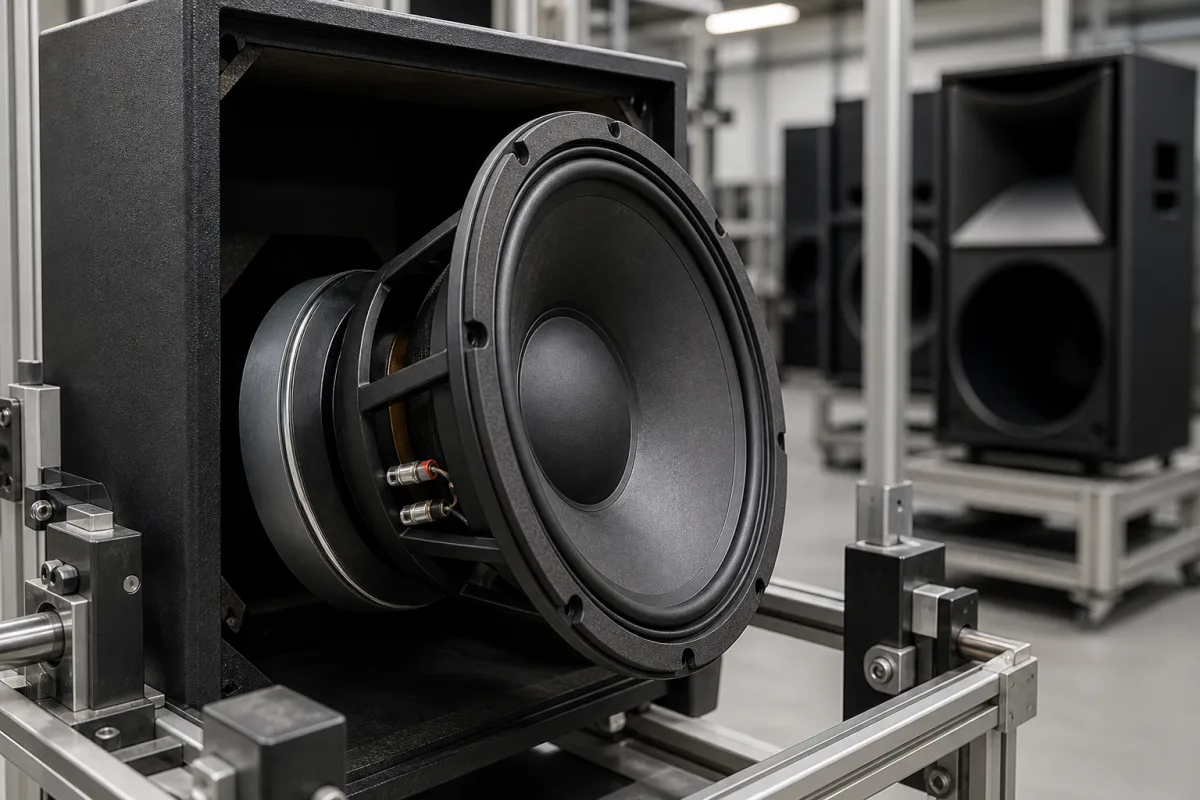
Speaker Driver in a manufacturing environment
Representative product image. Confirm appearance and specifications with the manufacturer.

Product Specifications

Technical details and manufacturing context for Speaker Driver

Definition
The speaker driver is a critical component in a speaker system, responsible for converting electrical audio signals from an amplifier into mechanical vibrations that produce audible sound. It consists of a diaphragm (cone), voice coil, magnet assembly, and suspension system that work together to create precise acoustic output. The diaphragm, typically made of paper, polypropylene, or Kevlar, moves air to generate sound waves. The voice coil, usually copper, is suspended in a magnetic field created by a magnet assembly, which may use ferrite or neodymium (NdFeB) magnets. The suspension system, including the surround and spider, ensures controlled movement and return to rest position. The frame, made of steel, aluminum, or plastic, provides structural support. This component is used in various applications, including consumer speakers and automotive audio systems. Key parameters include nominal impedance (4–8 Ω, with 16 Ω for automotive), frequency response (20–20000 Hz), sensitivity (85–92 dB at 1 W/1 m), power handling (10–100 W RMS), voice coil diameter (20–50 mm), operating temperature (-20–70 °C, extended to -40–85 °C for automotive), weight (0.5–2.5 kg), and other parameters such as DC resistance, resonance frequency, and total Q factor. These values are typical ranges and must be verified for the specific model and application. Standards such as IEC 60268-5 and IEC 60068-2-1/2 are referenced for testing and verification. Always confirm model-specific values and standards with the legal manufacturer or supplier.
Working Principle
When an electrical audio signal passes through the voice coil suspended in a magnetic field, it creates electromagnetic forces that cause the coil and attached diaphragm to move back and forth, displacing air to generate sound waves corresponding to the input signal. The interaction between the current in the coil and the magnetic field produces a force proportional to the current, causing the diaphragm to vibrate at the frequency of the audio signal. The suspension system controls the movement, ensuring linearity and preventing damage. The result is acoustic output that faithfully reproduces the original electrical signal.
Common Materials
Neodymium magnet, Copper voice coil, Paper/polymer diaphragm, Aluminum frame
Technical Parameters
ParameterTypical rangeNotes & selection driver
Nominal Impedance4–8 ΩTypical for consumer speakers; 16 Ω for automotive.IEC 60268-5
Frequency Response20–20000 HzFull-range driver; narrower for tweeters or woofers.IEC 60268-5
Sensitivity85–92 dBMeasured at 1 W/1 m; higher is more efficient.IEC 60268-5
Power Handling (RMS)10–100 WContinuous power; peak power is higher.IEC 60268-5
Voice Coil Diameter20–50 mmLarger coils handle more power.
Magnet MaterialFerrite, NdFeBNdFeB for high sensitivity; ferrite for cost.
Operating Temperature-20–70 °CExtended range for automotive (-40–85 °C).IEC 60068-2-1/2
Weight0.5–2.5 kgDepends on magnet size and frame material.
Frame MaterialSteel, Aluminum, PlasticSteel for strength; aluminum for lightweight.
Cone MaterialPaper, Polypropylene, KevlarPaper for natural sound; Kevlar for rigidity.
Surround MaterialRubber, Foam, ClothRubber for durability; foam for high compliance.
DC Resistance (Re)3.2–6.4 ΩTypically 80–90% of nominal impedance.IEC 60268-5
Resonance Frequency (Fs)50–200 HzLower Fs for better bass response.IEC 60268-5
Total Q Factor (Qts)0.3–0.7Affects enclosure design; lower for sealed boxes.IEC 60268-5

Ranges are indicative industry figures for RFQ preparation, not a supplier commitment. Confirm every value and standard with the legal manufacturer before ordering.

Components / BOM
  • Voice Coil Part
    Converts electrical signals into mechanical motion through electromagnetic interaction
    Material: Copper/aluminum wire
  • Magnet Assembly Part
    Provides a permanent magnetic field for the voice coil to interact with
    Material: Neodymium/ferrite magnet
  • Diaphragm (Cone) Part
    Moves air to create sound waves based on voice coil vibrations
    Material: Paper/polymer composite
  • Suspension (Spider & Surround) Part
    Centers the voice coil and provides restoring force for diaphragm movement
    Material: Polymer foam/rubber

Applied To / Applications

This component is essential for the following industrial systems and equipment:

Industrial Ecosystem & Supply Chain Structure

Complementary Systems
Downstream Applications
Specialized Tooling

Application Fit & Sizing Matrix

Operational Limits
pressure: Atmospheric to 1.5 bar
other spec: Humidity: 20-80% RH, Power Handling: 50-500W RMS
temperature: -20°C to 70°C
Media Compatibility
✓ Indoor Air ✓ Dry Environments ✓ Controlled Atmosphere
Unsuitable: Submerged or High-Moisture Environments
Sizing Data Required
  • Desired Sound Pressure Level (SPL)
  • Frequency Response Range
  • Enclosure Volume/Type

Reliability & Engineering Risk Analysis

Failure Mode & Root Cause
Voice Coil Overheating
Cause: Excessive power input or prolonged operation at high volumes causing thermal degradation of coil insulation and adhesive bonds, leading to short circuits or mechanical failure.
Suspension Fatigue and Tearing
Cause: Cyclic mechanical stress from repeated cone movement, combined with environmental factors like humidity or UV exposure, degrading the flexible surround material over time.
Maintenance Indicators
  • Audible distortion or rattling at specific frequencies, indicating mechanical interference or loose components.
  • Reduced output volume or muffled sound quality, suggesting voice coil misalignment or magnet gap contamination.
Engineering Tips
  • Implement power limiting and thermal monitoring to prevent voice coil overheating, ensuring operation within manufacturer's thermal and power ratings.
  • Regularly inspect and clean the driver assembly, focusing on the suspension and magnet gap, while avoiding mechanical stress during handling to prevent premature wear.

Indicative industry ranges for design and RFQ preparation. Confirm the exact figures and applicable standard with the manufacturer before specifying.

Compliance & Manufacturing Standards

Applicable Standards
CE Marking - Directive 2014/35/EU (Low Voltage) IEC 60268-5:2018 - Loudspeakers

Quoted from the published standard.

Manufacturing Precision
  • Voice Coil Gap: +/-0.05mm
  • Diaphragm Thickness: +/-0.02mm
Quality Inspection
  • Frequency Response Test
  • Impedance and T/S Parameter Verification

Manufacturers of Speaker Driver

3 companies list this product among what they make. Company figures are quoted from each company's own website; every card states where the relationship came from.

BluNet
Ningbo, Zhejiang, CN
CE UL
Also makes: Alarm System, Radar Sensor, Motion Sensor and 3 more
Listed on the company's own website · profile compiled by CNFX from public sources
Listed there as: “Siren Speaker Driver”
View source page ↗ blunet.com.cn · checked 2026-08-22
Pearller (Frank Audio Co.,LTD.)
Hangzhou, Zhejiang, CN
Listed on the company's own website · profile compiled by CNFX from public sources
Listed there as: “Speaker Driver Unit”
View source page ↗ pearller.com · checked 2026-09-05
Surpass
Guangzhou, Guangdong, CN
Listed on the company's own website · profile compiled by CNFX from public sources
Listed there as: “> Speaker Driver”
View source page ↗ surpass-audio.com · checked 2026-09-11

Manufacturer listings support early research and capability understanding. They are not certification, ranking, or transaction guarantees.

Share this page
Technical documentation
Request current drawings, revision history, and a signed specification sheet.
Manufacturing capability
Verify equipment lists, process limits, capacity, and representative production evidence.
Inspection readiness
Confirm test methods, calibrated equipment, sampling plans, and traceable reports.
Supplier transparency
Check the legal entity, factory address, ownership, certifications, and direct contacts.

CNFX does not score or rank suppliers. Buyers must verify all claims and documents with the legal manufacturer before ordering.

Supply Chain Compatible Machinery & Devices

Modular Industrial Edge Computing Device

This modular industrial edge computing device is a ruggedized system designed for deployment in harsh industrial environments to perform real-time data processing, analytics, and control functions at the network edge.

Explore Specs →
Industrial Smart Camera Module

The Industrial Smart Camera Module is a compact, self-contained vision processing unit designed for integration into industrial machinery and production lines.

Explore Specs →
Surface Mount Resistor

Passive electronic component for current limiting and voltage division in circuits

Explore Specs →
Surface Mount Capacitor

A surface mount capacitor is a fundamental electronic component used for energy storage, filtering, coupling, and decoupling in electronic circuits.

Explore Specs →

Frequently Asked Questions

What is the typical impedance range for a speaker driver?

The nominal impedance is typically 4–8 Ω for consumer speakers, with 16 Ω for automotive applications. Always verify the exact impedance for your specific model.

What materials are commonly used for the diaphragm?

Common diaphragm materials include paper, polypropylene, and Kevlar. Each offers different acoustic properties; paper is known for natural sound, while Kevlar provides rigidity.

How is sensitivity measured?

Sensitivity is measured in decibels (dB) at 1 watt of input power measured at 1 meter distance. Typical values range from 85 to 92 dB. Higher sensitivity means more efficient conversion of power to sound.

What standards apply to speaker driver testing?

IEC 60268-5 covers loudspeaker parameters such as impedance, frequency response, and sensitivity. IEC 60068-2-1/2 addresses environmental testing for temperature. These standards are references for verification, not proof of certification.

Data Basis

Editorial classification, named public sources where available, and source-reviewed manufacturer records.

Preliminary Technical Classification
This page supports structured research, RFQ preparation, and supplier evaluation. It does not replace buyer-led supplier qualification, standards review, or technical approval.
Buyer enquiry

Request manufacturing insight for Speaker Driver

Ask for use case, specification boundaries, supplier type, and RFQ preparation information for this product.

Where it goes
Straight to the CNFX editorial desk, and to the manufacturer if this product is linked to a claimed profile. Nothing is broadcast to a supplier list.
Your details stay here
We do not sell or rent enquiry data, and we do not add you to a mailing list. Used only to answer this request.
No commission, no middleman
CNFX is a directory. We take no cut of any order and never negotiate on a supplier's behalf.
What we don't claim
A listing is not an endorsement. Qualify every supplier and verify every figure yourself before ordering.

Your business information is used only to process this request.

Thank you! Your message has been sent. We'll respond within 1–3 business days.
Sorry, we couldn't send your message. Please try again, or email us at [email protected].

Need to Manufacture Speaker Driver?

Compare manufacturer profiles with relevant product and process capability.

Previous Product
XY Positioning Stage
Last Product
Get QuotesChat