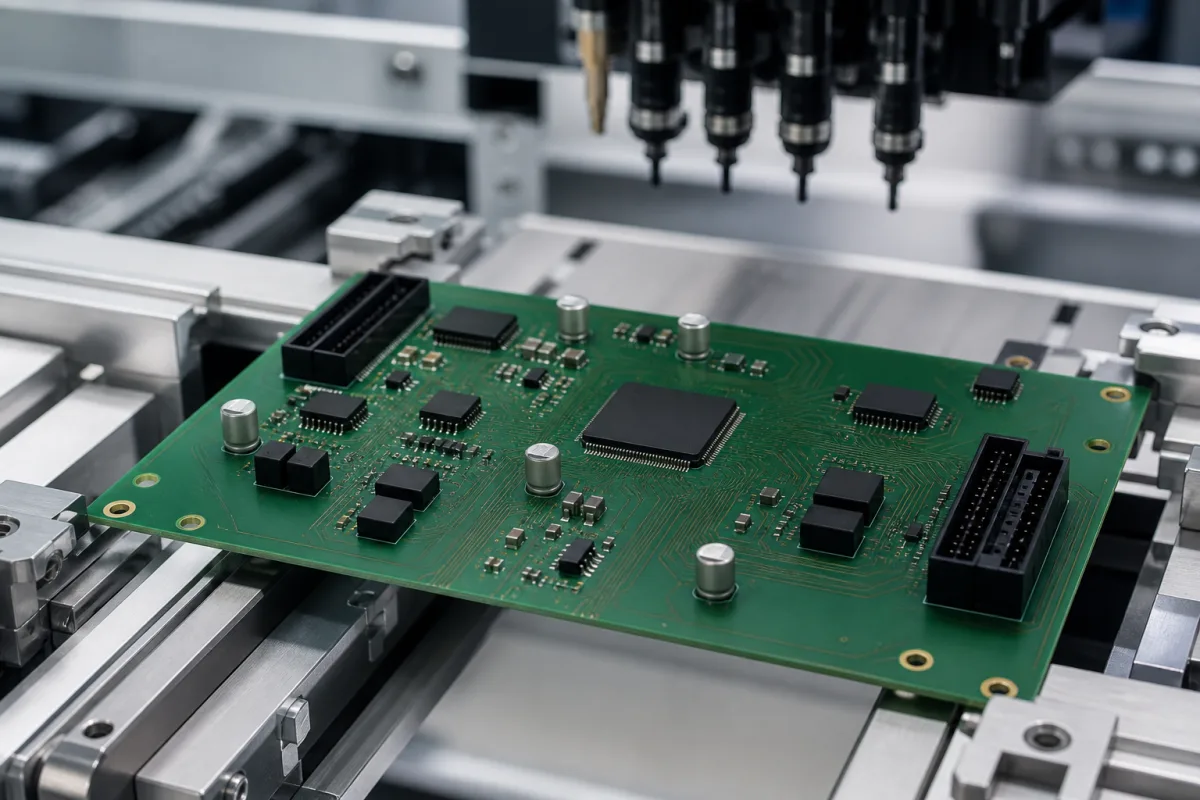
The board under a precision signal-conditioning circuit
The illustrated board sits on the rails of a placement machine with its integrated circuits, connectors and capacitors already in place. When such a board carries a signal-conditioning circuit, such as an amplifier for a sensor of gigaohm source impedance or a front end that resolves microvolts, the board is part of the circuit: its surface leaks current, its copper-to-metal joints generate voltages, and its temperature gradients move them. Texas Instruments and Microchip application material quantifies both effects and sets out the layout fixes.
Covers the layout, cleaning and coating of printed circuit boards that carry precision analog signal-conditioning circuits: surface and bulk leakage, guard rings and guarded inner-layer nets, thermoelectric voltages from component and trace junctions, and thermal layout. Board fabrication by technology is covered on the pages for multilayer (10044), HDI (10037), heavy copper (10038), ceramic (10039), flexible (10040), RF (10042), metal core (10043) and rigid-flex (10169) PCBs; PCB assembly quality on 9306; an LVDT signal-conditioning board on 5579. PCB press-fit pins and valves for the PCB industry share the name and are outside this page.
CNFX editorial research · Sources checked October 13, 2026 · 3 sources
Surface leakage: a teraohm is not an insulator at the picoamp level
Texas Instruments' LMC660/LMC662 datasheet works a layout example for its ultra-low-bias-current CMOS op amps: a trace-to-pad resistance of 10¹² Ω beside an input pad, with a 5 V bus on the trace.
TI's warning is that surface leakage can look acceptably low and still become appreciable under high humidity, dust or contamination. Its multiplexer note (SCDA042) lists the leakage sources on a board as flux residue, other debris, stray capacitance and the board's own resistance between conductors, and notes that the first two can be removed by clean processes or by burying the sensitive trace, while board resistance and dielectric affect any PCB.
In a conditioning circuit, 5 pA flowing through a 1 GΩ sensor source impedance is a 5 mV error at the input (Editorial calculation, V = I × R).
Case (TI LMC660 datasheet)
Leakage into the input
Effect TI states
5 V bus trace, 10¹² Ω to the input pad, no guard
5 pA
100 times degradation from the amplifier's own performance
Guard ring held within 5 mV of the inputs, 10¹¹ Ω to the pad
50 fA
A minor (2:1) degradation
Microchip's AN1258 adds bench experience with its auto-zeroed op amps: contamination caused appreciable voltage shifts even in well-designed circuits; Microchip writes that a standard PCB clean step "is very helpful, but may not eliminate the problem", and that an extra isopropyl alcohol step was needed for residue left by some cleaning solvents.
02
Laying out the guard
A guard is a conductor driven to the same potential as the sensitive net and run around it, so that there is no voltage across the leakage path. The three documents agree on that principle and differ in how far they take it.
Where only a few circuits are involved, TI's datasheet goes one step further: bend the amplifier's input pin up out of the board and wire to it in air, using air as the insulator.
After cleaning, Microchip calls for a conformal coating that is a barrier to moisture and other contaminants, naming epoxy or silicone rubber, to keep the board as clean as it left the cleaning step.
Practice
Source
Ring of foil completely surrounding the op amp inputs and the terminals of every component connected to them
TI LMC660 datasheet
Guard rings on both top and bottom of the board
TI LMC660 datasheet
Guard biased at the sensitive pin's voltage and driven from a low-impedance source; for a non-inverting stage, tied to the non-inverting input
Microchip AN1258
Output traces routed out of the guarded area through vias and back to the surface outside the ring
Microchip AN1258
Bury sensitive nets inside the board, then 'box' them with guard traces on the same layer and guard planes on the layers above and below
TI SCDA042
Generate the guard with a precision buffer so it follows the net voltage
TI SCDA042
Fine-pitch packages: run guard and trace as close to the pin as possible, or choose a wider-pitch SOIC part that allows a full guard
TI SCDA042
03
Thermocouples nobody drew: junctions and gradients
Microchip's AN1258 points out that every PCB contains unintended thermocouple junctions whose Seebeck voltages add to the signal; its worked case follows the junctions from a copper trace through a resistor's end cap and metal film and back to copper.
The rule that follows from the worked case is that a gradient along the current path, not the absolute temperature, makes the error; shifting all junctions by the same temperature leaves it unchanged.
Behind a gain of 100 the −38 µV becomes 3.8 mV at the output (Editorial calculation). AN1258's layout remedies are to cut heat generation near critical parts, use ground and power planes to spread heat, surround critical components with guard traces or thermal heat sinks, and use an FR4 gap to separate heat sources from the sensitive area, as in its thermocouple-amplifier board.
Microchip AN1258 worked case
Figure
Component
1206 SMD resistor, 3.05 mm long, between copper traces
Assumed junction coefficients
+40, −10, +10, −40 µV/°C across the four junctions
Uniform board temperature (125 °C)
Junction voltages cancel; no net voltage across the resistor
Gradient of 10 °C/in along the resistor
1.2 °C from end to end and −38 µV across the resistor
IC socket on an auto-zeroed op amp
±1 µV to ±2 µV measured, removed by soldering the part directly to the board
The junction coefficients in the table are Microchip's assumed values for the illustration, not measured data for a specific part.
04
What to give a board designer or fabricator for a precision front end
Paste it into your enquiry below or into an email to a maker, then replace every bracket.
Give the source impedance and the leakage current the input can tolerate, the smallest signal to be resolved, the supply rails near the input traces, the operating humidity and whether the board will be coated, heat sources on the board and their power, and any sockets or connectors in the signal path. Ask for guard routing on all layers around high-impedance nodes, the cleaning process and residue check after assembly, conformal coating material, and thermal layout around the input stage and reference.
1 company lists this product among what they make. Company figures are quoted from each
company's own website; every card states where the relationship came from.
Explore company information and manufacturing capabilities, then discuss the scope of your project with a relevant supplier.
Share this page
Compiled and source-reviewed by the CNFX editorial team.
Each manufacturer above links to the page on that company's own website where the product is listed, with the date we checked it. How we source and review
· Page last updated 13 October 2026
Buyer questions
How much leakage can a clean-looking PCB cause?
TI's LMC660 datasheet shows a 10¹² Ω trace-to-pad path beside a 5 V bus leaking 5 pA into an op amp input, a 100 times degradation of that amplifier. [1]
What does a guard ring do?
It surrounds a sensitive net with a conductor at the same potential, so no leakage flows across the gap; TI's SCDA042 extends this to boxing the net with guard layers above and below. [2][1]
Can a PCB create offset voltage by itself?
Yes: Microchip's AN1258 shows unintended thermocouple junctions producing −38 µV across one SMD resistor under a 10 °C/in gradient, and ±1–2 µV from an IC socket. [3]
Sources and what still needs a direct check
Sources checked 2026-10-13. A Texas Instruments op amp datasheet layout section and application note on guarding, and Microchip's application note on PCB layout for precision op amp circuits.