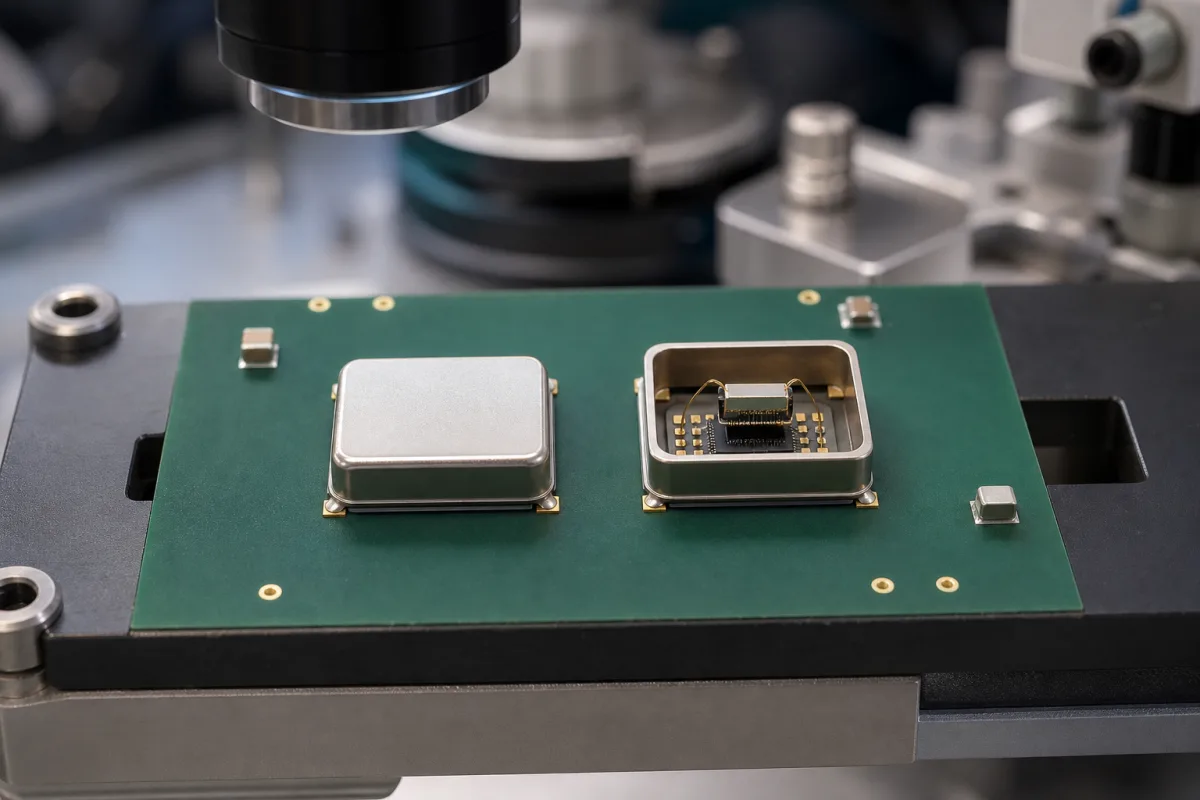
Quartz crystal oscillator: how the crystal cut and the aging of the quartz plate set long-term frequency
The quartz inside the oscillator · AT-cut versus SC-cut plates, frequency constant and plate thickness, aging mechanisms, pre-aging and warm-up
Every quartz crystal oscillator, from a small TCXO to an oven-controlled reference, takes its frequency from a thin plate of quartz vibrating in thickness shear. Two choices about that plate decide how the oscillator behaves after it leaves the factory: the angle at which the plate is cut from the quartz bar, which fixes how frequency moves with temperature and during warm-up, and how the plate, its electrodes and its sealed enclosure were cleaned, mounted and pre-aged, which fixes how far the frequency drifts over months and years.
The quartz resonator plate as it governs a packaged quartz crystal oscillator: crystal cut (AT-cut and SC-cut), plate thickness and frequency constant, frequency-versus-temperature shape, aging mechanisms and aging specifications, pre-aging and warm-up. Choosing between XO, TCXO and OCXO and building a ppm budget are covered on the Crystal oscillator page; bare crystal units sold as components (load capacitance, ESR, drive level) and compensation circuits are outside this page.
CNFX editorial research · Sources checked October 12, 2026 · 3 sources
AT-cut and SC-cut plates: cut angle, thickness and temperature behaviour
John Vig's tutorial for the US Army Communications-Electronics Command shows the AT-cut frequency-temperature curve shifting by minutes of arc: θ = 35° 12.5′ for a fundamental-mode plano-plano AT-cut and θ = 35° 20′ for a fifth-overtone AT-cut, with each minute of change visibly moving the curve. Thickness-shear plates follow f = N/t, with a frequency constant N of 1661 MHz·µm for the AT-cut and 1797 MHz·µm for the SC-cut's c-mode. [1]
Editorial calculation from Vig's frequency constants: a 10 MHz fundamental AT-cut plate is about 1661 / 10 = 166 µm thick and an SC-cut plate about 180 µm; at 30 MHz the AT-cut plate is about 55 µm. Vig adds that for an AT-cut, removing 1.661 µm of quartz (0.83 µm per side) raises frequency by one "f-squared" unit, which is 100 kHz on a 10 MHz plate and 900 kHz on a 30 MHz plate. [1]
Vig lists the SC-cut's advantages as thermal-transient compensation (allowing faster OCXO warm-up), better frequency-temperature repeatability, far fewer activity dips, lower drive-level sensitivity and lower sensitivity to radiation; its stated disadvantage is that it is more difficult to manufacture for OCXOs. Discussing TCXO noise, he notes that the frequency-temperature slope of a TCXO crystal can reach about 1 ppm/°C at the temperature extremes, and that at an AT-cut crystal's activity dip phase noise can degrade by 30 dB. [1]
Vig's comparison of a microcomputer-compensated oscillator (SC-cut, third overtone) with a TCXO (AT-cut, fundamental) puts hysteresis over −55 to +85 °C at 10⁻⁹ to 10⁻⁸ for the SC-cut design against 10⁻⁷ to 10⁻⁶ for the AT-cut TCXO. [1]
listed as ±0.28 min., ±0.5 typ., ±1 ppm max. over −40 to +105 °C; initial tolerance ±0.5 typ., ±1 ppm max. at +25 °C [3]
Ask the supplier which cut and overtone the oscillator uses, the frequency-temperature curve of the production lot, and whether activity dips are screened over the full operating range.
02
Aging of the quartz plate: contamination, stress relief and pre-aging
Vig explains aging through the plate thickness: because f is proportional to 1/t, a 5 MHz plate is about 10⁶ molecular layers thick, so one quartz-equivalent monolayer of mass added or removed shifts frequency by about 1 ppm. He lists mass transfer due to contamination, stress relief in the mounting and bonding structure, electrodes and quartz, quartz outgassing, leaks and outgassing in the enclosure, and aging of the oscillator circuit and oven control as aging mechanisms. [1]
Vig's illustration of typical aging behaviours adds two logarithmic terms of opposite sign, A(t) = 5 ln(0.5t + 1) and B(t) = −35 ln(0.006t + 1), to show how the net drift can reverse direction over time. In his oscillator comparison table, aging per year is 5 × 10⁻⁷ for a TCXO, 2 × 10⁻⁸ for an MCXO and 5 × 10⁻⁹ for an OCXO. [1]
Published aging limits on the two oscillators above differ by a factor of ten in the first year. XtalTQ lists the BT3225AH at ±1.0 ppm maximum in the first year and notes that the test was conducted after 60 days of pre-aging at 85 °C. [3] Euroquartz lists the SC-cut OC18E5S at ±2.0 ppb maximum per day, ±0.1 ppm in the first year and ±0.5 ppm over 10 years. [2]
Editorial calculation: 2.0 ppb per day held for 365 days would be about 0.73 ppm, seven times the ±0.1 ppm first-year limit, so the daily limit and the yearly limit are separate specifications rather than one derived from the other; ask the supplier when each measurement starts and how long the unit was stabilised first. [2]
Ask for the aging test conditions (pre-aging temperature and duration, start point of the measurement, supply on or off), aging per day and per year, and the long-term figure for the service life you need.
03
Describe the quartz behaviour the oscillator must hold
Paste it into your enquiry below or into an email to a maker, then replace every bracket.
Frequency and output: [MHz; CMOS, sine or other]
Crystal: [AT-cut or SC-cut; fundamental or overtone, if specified]
Temperature: [range; frequency-temperature limit; activity-dip screening]
Aging: [per day; first year; over service life; pre-aging conditions]
Warm-up: [time to reach a stated ppm window, for oven types]
Package: [size; hermetic seal; reflow conditions]
2 companies list this product among what they make. Company figures are quoted from each
company's own website; every card states where the relationship came from.
XtalTQ
Manufacturing site to be confirmed for the order
Lists the BT3225AH 3.2 × 2.5 mm Stratum III TCXO (16–60 MHz, stability vs temperature down to ±0.28 ppm over −40 to +105 °C, ±1.0 ppm first-year aging) with OCXO, VCXO and SPXO ranges.
Explore company information and manufacturing capabilities, then discuss the scope of your project with a relevant supplier.
Share this page
Compiled and source-reviewed by the CNFX editorial team.
Each manufacturer above links to the page on that company's own website where the product is listed, with the date we checked it. How we source and review
· Page last updated 13 October 2026
Buyer questions
Why are AT-cut and SC-cut crystals used in different oscillators?
Vig compares the two: the SC-cut is thermal-transient compensated, has far fewer activity dips and better repeatability, which suits OCXOs, but is harder to manufacture. [1]
Why does a quartz oscillator age?
Vig lists contamination mass transfer, stress relief in mounts and electrodes, outgassing and enclosure leaks, and circuit aging; one quartz-equivalent monolayer on a 5 MHz plate shifts frequency by about 1 ppm. [1]
How much does a quartz oscillator drift in its first year?
Published limits differ by type: XtalTQ lists ±1.0 ppm for its BT3225AH TCXO after 60 days of pre-aging at 85 °C, and Euroquartz ±0.1 ppm for its SC-cut OC18E5S OCXO. [3][2]
How thick is the quartz plate in a 10 MHz oscillator?
Using Vig's frequency constant of 1661 MHz·µm, a 10 MHz fundamental AT-cut plate is about 166 µm thick (editorial calculation). [1]
Sources and what still needs a direct check
Sources checked 2026-10-12. Vig's tutorial, written at the US Army Communications-Electronics Command, explains crystal cuts and aging mechanisms; Euroquartz and XtalTQ data sheets give the published cut, stability, aging and warm-up of two specific oscillators.